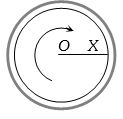
The diagram shows a cup of tea seen from above. The tea has been stirred and is now rotating without turbulence. A graph showing the speed $ v$ with which the liquid is crossing points at a distance $ X$ from $O $ along a radius $XO$ would look like
Medium
Download our app for free and get started
(d)When we move from centre to circumference, the velocity of liquid goes on decreasing and finally becomes zero.

Download our appand get started for free
Experience the future of education. Simply download our apps or reach out to us for more information. Let's shape the future of learning together!No signup needed.*
Similar Questions
- 1A machine is blowing spherical soap bubbles of different radii filled with helium gas.It is found that, if the bubbles have a radius smaller than $1\,cm$, then they sink to the floor in still air. Larger bubbles float in the air. Assume that the thickness of the soap film in all bubbles is uniform and equal. Assume that the density of soap solution is same as that of water $\left(=1000 \,kg m ^{-3}\right)$. The density of helium inside the bubbles and air are $0.18 \,kg m ^{-3}$ and $1.23 \,kg m ^{-3}$, respectively. Then, the thickness of the soap film of the bubbles is .......... $\mu m$ (Note $1 \,\mu m =10^{-6} \,m$ )View Solution
- 2A spherical solid ball of volume $V$ is made of a material of density $\rho_1$ . It is falling through a liquid of density $\rho_2 (\rho_2 < \rho_1 )$. Assume that the liquid applies a viscous force on the ball that is proportional to the square of its speed $v$, i.e., $F_{viscous}= -kv^2 (k >0 )$,The terminal speed of the ball isView Solution
- 3View SolutionSelect wrong statement about pressure ..........
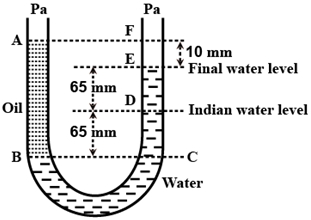
- 4A $U$ tube with both ends open to the atmosphere, is partially filled with water. Oil, which is immiscible with water, is poured into one side until it stands at a distance of $10\,\, mm$ above the water level on the other side. Meanwhile the water rises by $65\,\, mm$ from its original level (see diagram). The density of the oil is ......... $kg/m^3$View Solution
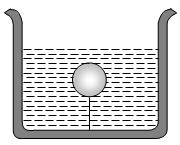
- 5A solid sphere of density $\eta$ $( > 1)$ times lighter than water is suspended in a water tank by a string tied to its base as shown in fig. If the mass of the sphere is m then the tension in the string is given byView Solution
- 6The weight of an empty balloon on a spring balance is $w_1$. The weight becomes $w_2$ when the balloon is filled with air. Let the weight of the air itself be $w$ .Neglect the thickness of the balloon when it is filled with air. Also neglect the difference in the densities of air inside $\&$ outside the balloon. Then :View Solution
- 7Fountains usually seen in gardens are generated by a wide pipe with an enclosure at one end having many small holes. Consider one such fountain which is produced by a pipe of internal diameter $2$ $cm$ in which water flows at a rate $3$ $ms^{^{-1}}$. The enclosure has $100$ holes each of diameter $0.05$ $cm$. The velocity of water coming out of the holes ids ( in $ms^{^{-1}}$)View Solution
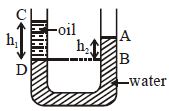
- 8In a $U-$ tube experiment, a column $AB$ of water is balanced by a column $‘CD’$ of oil, as shown in the figure. Then the relative density of oil isView Solution
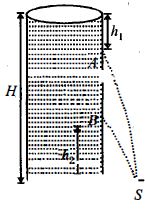
- 9In a cylindrical water tank, there are two small holes $A$ and $B$ on the wall at a depth of $h_1$ , from the surface of water and at a height of $h_2$ from the bottom of water tank. Surface of water is at height of $h_2$ from the bottom of water tank. Surface of water is at heigh $H$ from the bottom of water tank. Water coming out from both holes strikes the ground at the same point $S$. Find the ratio of $h_1$ and $h_2$View Solution
- 10Water is moving with a speed of $5.18 ms^{-1}$ through a pipe with a cross-sectional area of $4.20 cm^2$. The water gradually descends $ 9.66 m $ as the pipe increase in area to $7.60 cm^2$. The speed of flow at the lower level is ....... $ms^{-1}$View Solution