Question
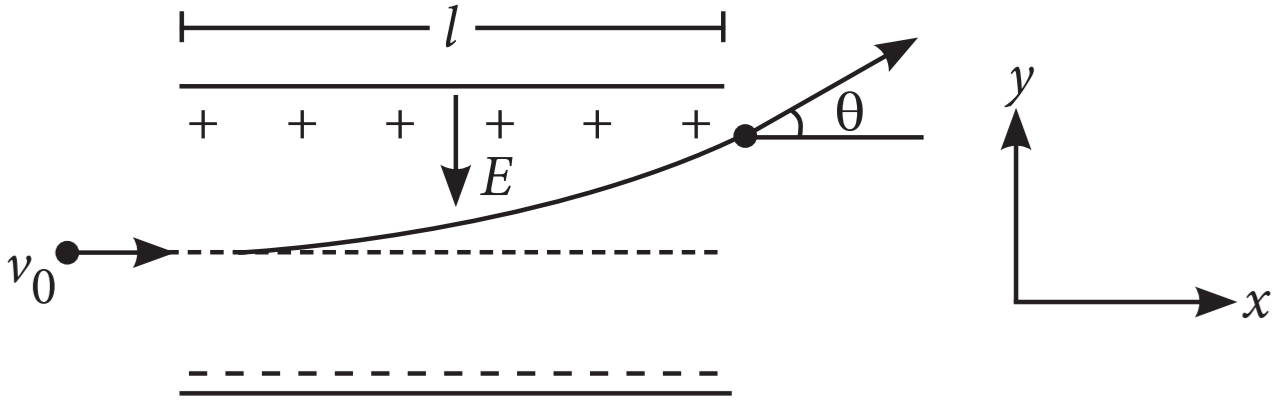
When a charged particle is placed in an electric field, it experiences an electrical force. If this is the only force on the particle, it must be the net force. The net force will cause the particle to accelerate according to Newton's second law. So $\vec{\text{F}}_\text{e}=\text{q}\vec{\text{E}}=\text{m}\vec{\text{a}}$
- An electron of mass m, charge e falls through a distance h metre in a uniform electric field E. Then time of fall,
- $\text{t}=\sqrt{\frac{\text{2hm}}{\text{eE}}}$
- $\text{t}=\frac{\text{2hm}}{\text{eE}}$
- $\text{t}=\sqrt{\frac{\text{2eE}}{\text{hm}}}$
- $\text{t}=\frac{\text{2eE}}{\text{hm}}$
- An electron moving with a constant velocity v along X-axis enters a uniform electric field applied along Y-axis. Then the electron moves:
- With uniform acceleration along Y-axis
- Without any acceleration along Y-axis
- In a trajectory represented as y = ax2
- In a trajectory represented as y = ax
- Two equal and opposite charges of masses m1 and m2 are accelerated in an uniform electric field through the same distance. What is the ratio of their accelerations if their ratio of masses is $\frac{\text{m}_1}{\text{m}_2}=0.5?$
- $\frac{\text{a}_1}{\text{a}_2}=2$
- $\frac{\text{a}_1}{\text{a}_2}=0.5$
- $\frac{\text{a}_1}{\text{a}_2}=3$
- $\frac{\text{a}_1}{\text{a}_2}=1$
- A particle of mass m carrying charge q is kept at rest in a uniform electric field E and then released. The kinetic energy gained by the particle, when it moves through a distance y is:
- $\frac{1}{2}\text{qEy}^2$
- qEy
- qEy2
- qE2y
- A charged particle is free to move in an electric field. It will travel:
- Always along a line of force.
- Along a line of force, if its initial velocity is zero.
- Along a line of force, if it has some initial velocity in the direction of an acute angle with the line of force.
- None of these.