Alternate Answer

12 questions · self-marked practice — reveal the answer and mark yourself.

Alternate Answer


Explanation:
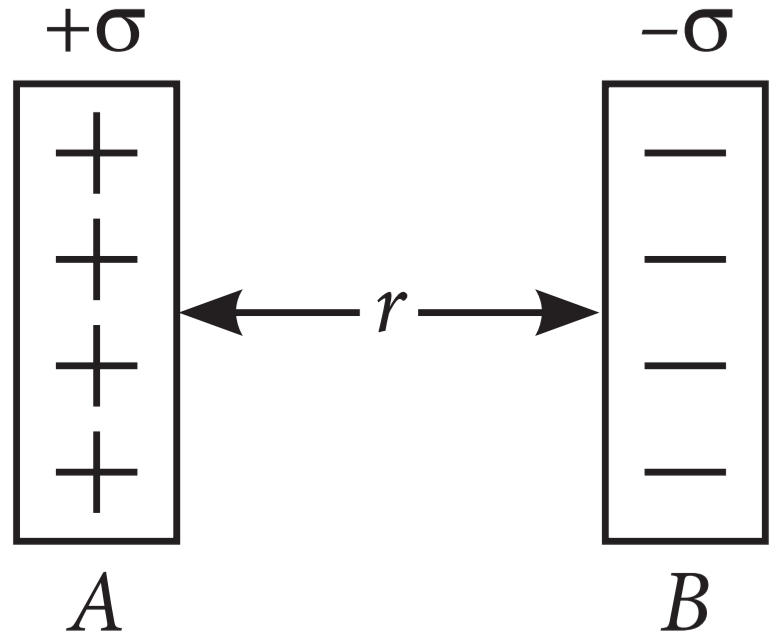
There are two plates A and B having surface charge densities,

$\sigma_\text{A}=17.0\times10^{-22}\text{C/m}^2$
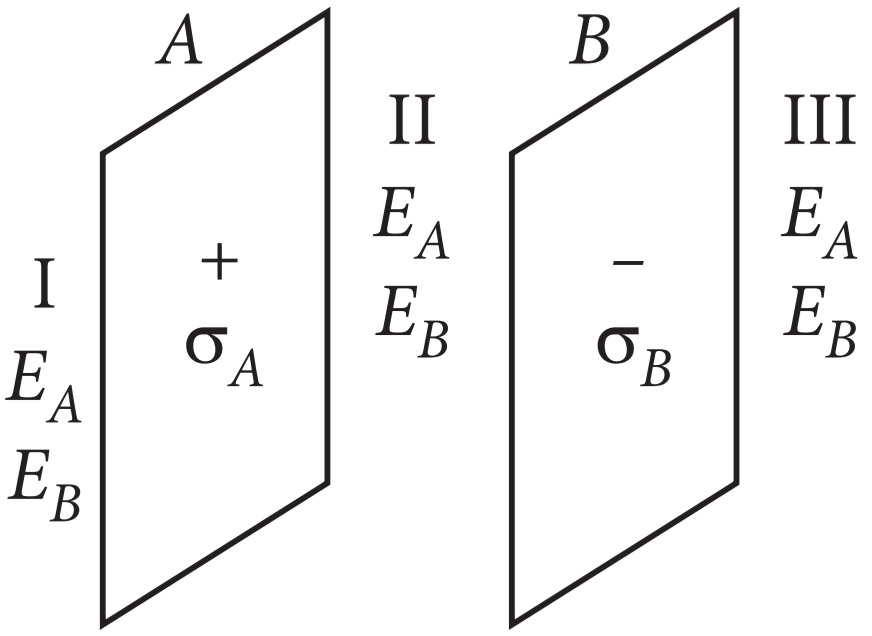
on A and $\sigma_\text{B}=-17.0\times10^{-22}\text{C/m}^2$on B, respectively. According to Gauss' theorem, if the plates have same surface charge density but having opposite signs, then the electric field in region I is zero.
$\text{E}_\text{I}=\text{E}_\text{A}+\text{E}_\text{B}$
$=\frac{\sigma}{2\in_0}+\Big(-\frac{\sigma}{2\in_0}\Big)=0$
Explanation:
The electric field in region III is also zero.
$\text{E}_\text{III}=\text{E}_\text{A}+\text{E}_\text{B}$
$=\frac{\sigma}{2\in_0}+\Big(-\frac{\sigma}{2\in_0}\Big)=0$
Explanation:
In region II or between the plates, the electric field.
$\text{E}_\text{II}=\text{E}_\text{A}-\text{E}_\text{B}$
$=\frac{\sigma}{2\in_0}+=\frac{\sigma}{2\in_0}$
$=\frac{\sigma(\sigma_\text{A}\text{ or }\sigma_\text{B})}{\in_0}=\frac{17.0\times10^{-22}}{8.85\times10^{-12}}$
E = 1.9 × 10⁻¹⁰ N/C
Explanation:
Since electric field due to an infinite-plane sheet of charge does not depend on the distance of observation point from the plane sheet of charge. So, for the given distances, the ratio of E will be 1 : 1.
Explanation:
ln order to estimate the electric field due to a thin finite plane metal plate, we take a cylindrical cross-sectional area A and length 2r as the gaussian surface.

Explanation:
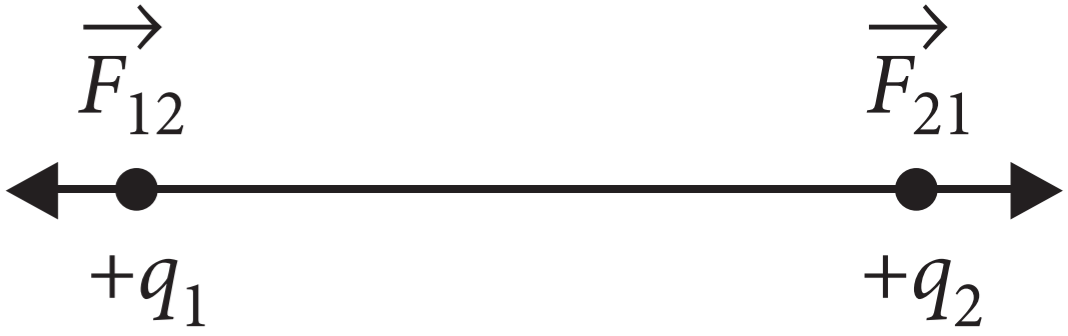
The proportionality constant k depends on the nature of the medium between the two charges.
Explanation:
As, $[\in_0]=\frac{1}{4\pi\text{F}}.\frac{\text{q}_1\text{q}_2}{\text{r}^2}$
$=\frac{[\text{AT]}^2}{[\text{M L T}^{-2}][\text{L}^2]}$
$\text{[M}^{-1} \text{ L}^{-3} \text{ T}^4 \text{A}^2]$
$2\mu\text{C}$
Explanation:
$\text{F}=\frac{1}{4\pi\in_0}\frac{\text{q}_1\text{q}_2}{\text{d}^2}$
$\therefore(10\times10^{-3})\times10=\frac{(9\times10^9)\times\text{q}^2}{(0.6)^2}$
Or $\text{q}^2=\frac{10^{-1}\times0.36}{9\times10^9}=4\times10^{-12}$
Or $\text{q}=2\times10^{-6}\text{ C}=2\mu\text{C}$

Explanation:
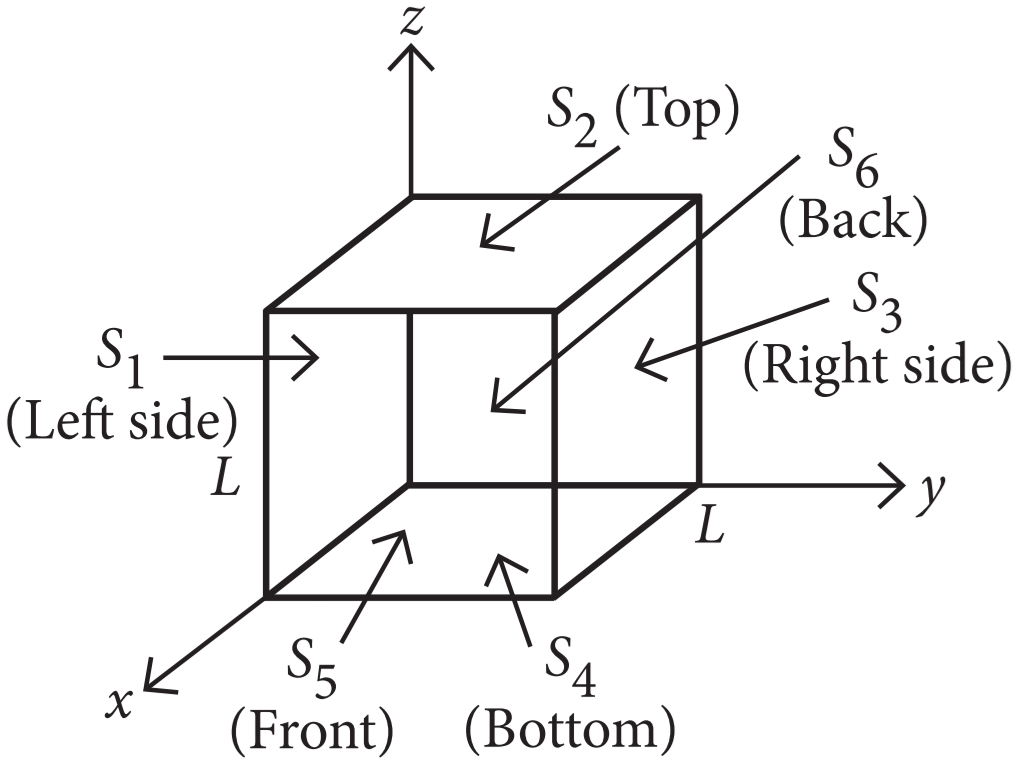
Electric flux, $\phi=\vec{\text{E}}\cdot\vec{\text{A}}=\text{EA} \cos\theta.$
Where $\vec{\text{A}}=\widehat{\text{An}}$
For electric flux passing through $\text{S}_6,\widehat{\text{n}}_{\text{s}_6}=-\widehat{\text{i}}\text{ (Back})$
$\therefore \phi_{\text{s}{_6}}=-(4\times10^3\text{ N}\text{ C}^{-1})(0.1\text{m})^2 \cos37^\circ$
-32N m2 C-1
Explanation:
For electric flux passing through $\text{S}_1,\widehat{\text{n}}_{\text{s}_1}=-\widehat{\text{j}}\text{ (Left})$
$\therefore \phi_{\text{s}_{1}}=-(4\times10^3\text{ N}\text{ C}^{-1})(0.1\text{m})^2 \cos(90^\circ-37^\circ)$
-24 N m2 C-1
Explanation:
Here, $\widehat{\text{n}}_{\text{s}_{2}} = + \widehat{\text{k}} \text{ (Top)}$
$\therefore \phi_{\text{s}_{2}}=-(4\times10^3\text{ N}\text{ C}^{-1})(0.1\text{m})^2 \cos90^\circ=0$
$\widehat{\text{n}}_{\text{s}_{3}} = + \widehat{\text{j}} \text{ (Right)}$
$\widehat{\text{n}}_{\text{s}_{4}} = - \widehat{\text{k}} \text{ (Bottom)}$
$\therefore \phi_{\text{s}_{4}}=-(4\times10^3\text{ N}\text{ C}^{-1})(0.1\text{m})^2 \cos90^\circ=0$
And, $\widehat{\text{n}}_{\text{s}_{5}} = - \widehat{\text{i}} \text{ (Fornt)}$
$\therefore \phi_{\text{s}_{5}}=-(4\times10^3\text{ N}\text{ C}^{-1})(0.1\text{m})^2 \cos37^\circ$
= 32N m2 C-1
S2 and S4 surface have zero flux.
Explanation:
As the field is uniform, the total flux through the cube must be zero, i.e., any flux entering the cube must leave it.
Explanation:
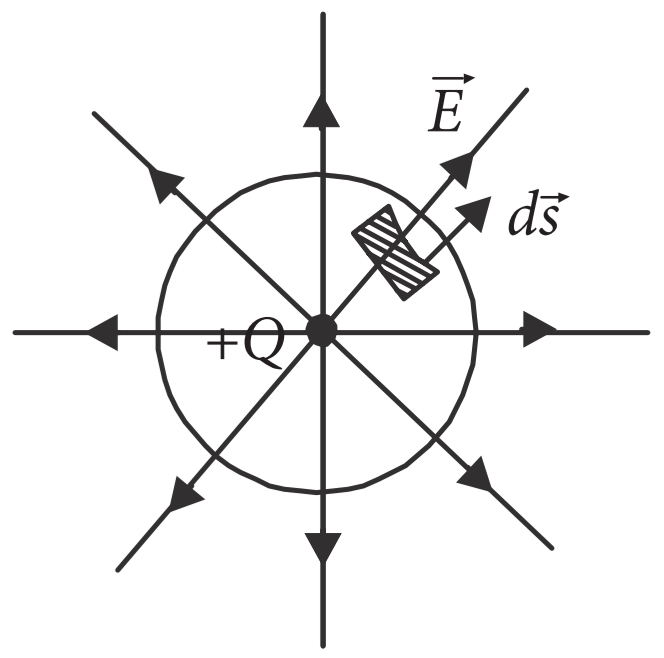
Surface integral $\oint\vec{\text{E}}\cdot\text{d}\vec{\text{S}}$ is the net electric flux over a closed surface S.
$\therefore[\phi_\text{E}]=[\text{M}\text{ L}^3\text{ T}^{-3}\text{ A}^{-1}]$
Explanation:
As, qE = mg
$\Rightarrow\text{q}=\frac{1.08\times10^{-14}\times9.8}{1.68\times10^5}$
= 6.40 × 10⁻¹⁹C
Explanation:
q = ne or
$\Rightarrow\text{n}=\frac{6.4\times10^{-19}}{1.6\times10^{-19}}=4$
Explanation:
For the drop to be stationary,
Force on the drop due to electric field = Weight of the drop qE = mg.
$\text{q}=\frac{\text{mg}}{\text{E}}=\frac{1.6\times10^{-6}\times10}{100}=1.6\times10^{-7}\text{C}$
Number of electrons carried by the drop is
$\text{n}=\frac{\text{q}}{\text{e}}=\frac{1.6\times10^{-7}\text{C}}{1.6\times10^{-19}\text{C}}=10^{12}$
Explanation:
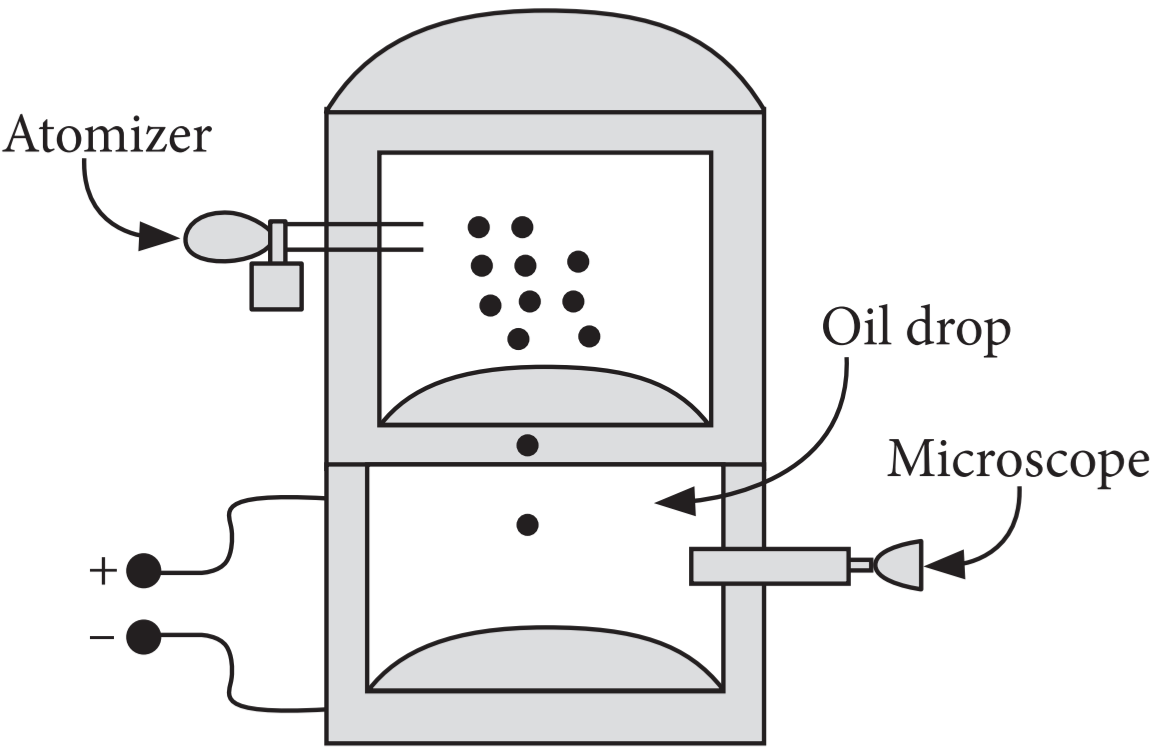
Millikan's experiment confirmed that the charges are quantized, i.e., charges are small integer multiples of the base value which is charge on electron. The charges on the drops are found to be multiple of 4. Hence, the quanta of charge is $4\mu\text{C}.$


Explanation:
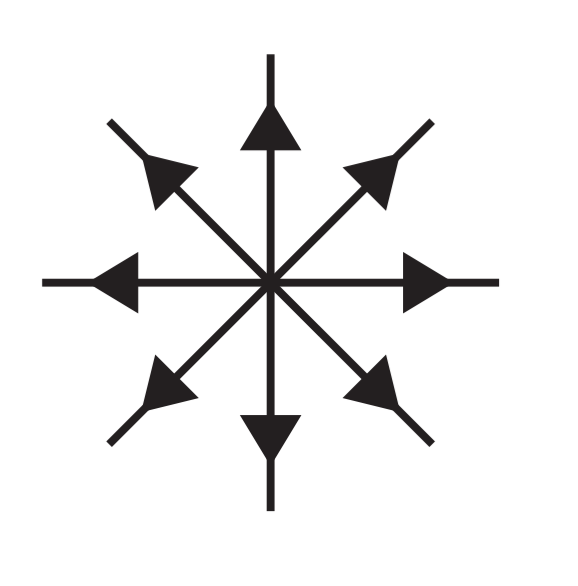
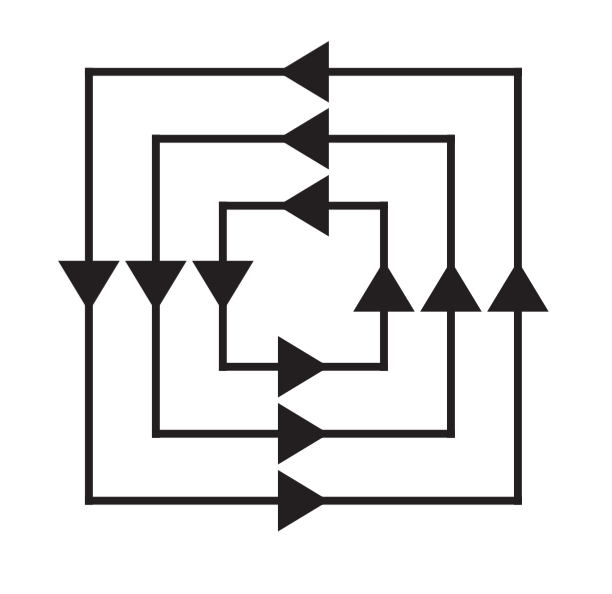
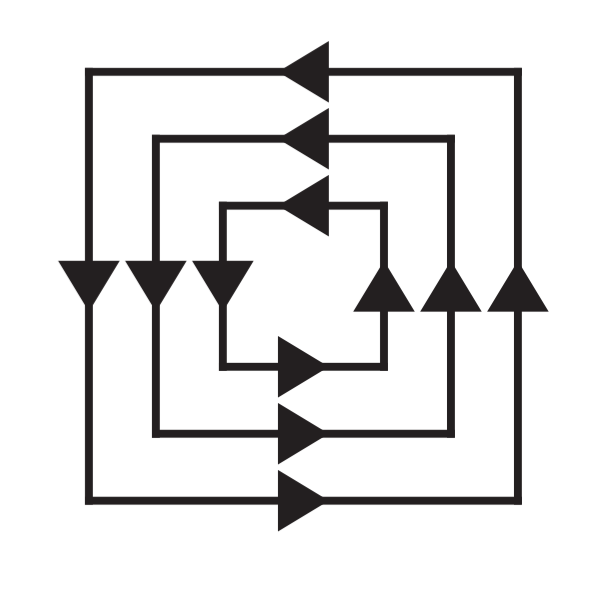
Electric lines of force do not form any closed loops.
Explanation:
Electric field tines can't be closed.

Statement 2: Electric dipole don't have symmetrical charge distribution.

Explanation:
Gauss's law is applicable for any closed surface. Gauss's law is most useful in situation where the charge distribution has spherical or cylindrical symmetry or is distributed uniformly over the plane. Whereas electric dipole is a system of two equal and opposite point charges separated by a very small and finite distance.
Explanation:
According to Gauss's law, the electric flux through the sphere is
$\phi=\frac{\text{q}_{in}}{\in_0}=\frac{8.85\times10^{-13}\text{C}}{8.85\times10^{-12}\text{C}^2\text{N}^{-1}\text{m}^{-2}}$
= 0.1NC-1 m2
Explanation:
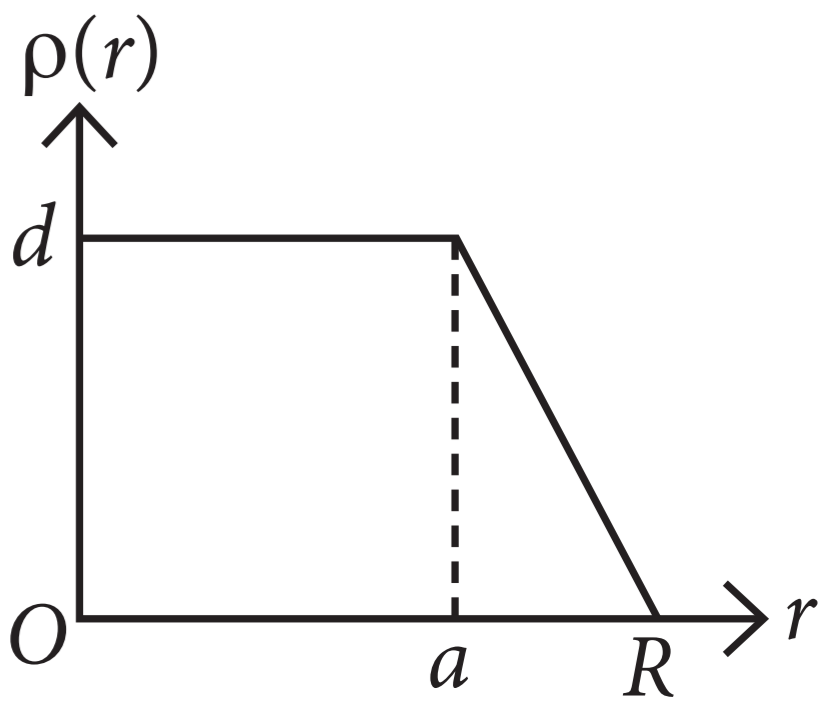
For uniformly volume charge density,
$\text{E}=\frac{\text{Pr}}{3\in_0}$
$\text{E}\propto\text{r}$
Explanation:
r = 25cm = 0.25m,
$\sigma=\frac{3}{\pi}\text{C/m}^2$
As, $\sigma=\frac{\text{q}}{4\pi\text{r}^2}$
$\Rightarrow\text{q}=4\pi\times(0.25)^2\times\frac{3}{\pi}=0.75\text{C.}$
Explanation:
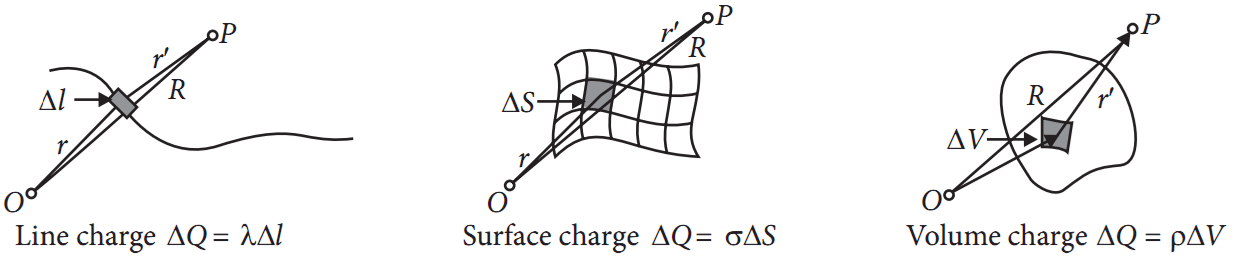
The line charge density at a point on a tine is the charge per unit length of the line at that point
$\lambda=\frac{\text{bq}}{\text{bL}}$
Thus, the SI unit for $\lambda$ is Cm-1.


Explanation:
If there is only one type of charge in the universe, then it will produce electric field somehow. Hence, Gauss's law is valid.
Explanation:
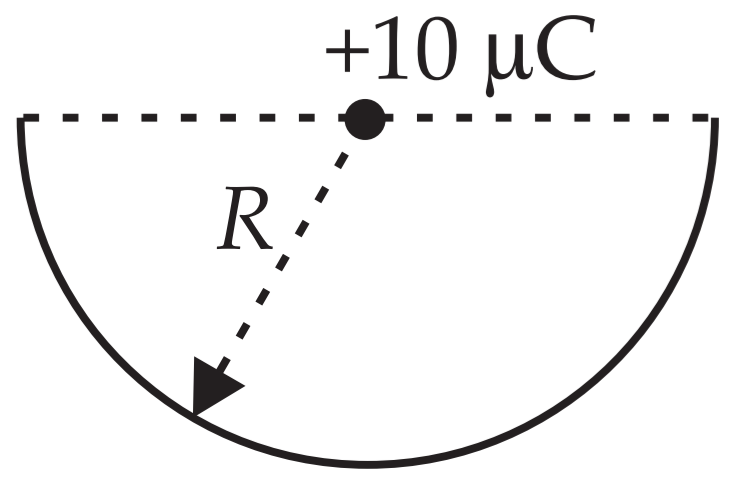
According to Gauss's theorem,
Electric flux through the sphere $=\frac{\text{q}}{\in_0}$
$\therefore$ Electric flux through the hemisphere $=\frac{1}{2}\frac{\text{q}}{\in_0}$
$=\frac{10\times10^{-6}}{2\times8.854\times10^{-12}}=0.56\times10^6\text{ Nm}^2\text{ C}^{-1}$
= 0.6 × 10⁶ Nm2 C-1 = 6 × 10⁵ Nm2 C-1
Explanation:
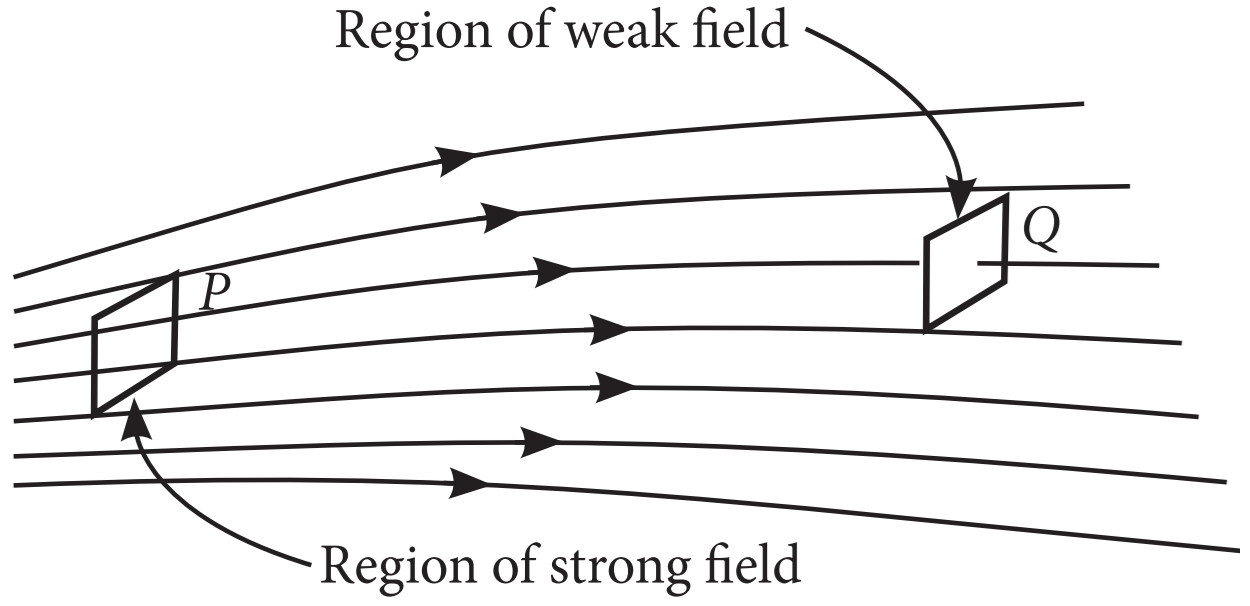
As flux is the total number of tines passing through the surface, for a given charge, it is always the charge enclosed $\frac{\text{Q}}{\in_0}.$ If area is doubled, the flux remains the same.
Explanation:
As net charge on a dipole is (- q + q) = 0
Thus, when agaussian surface encloses a dipole, as per Gauss's theorem, electric flux through the surface,
$\oint\vec{\text{E}}\cdot\text{d}\vec{\text{S}}=\frac{\text{q}}{\in_0}=0$

Explanation:
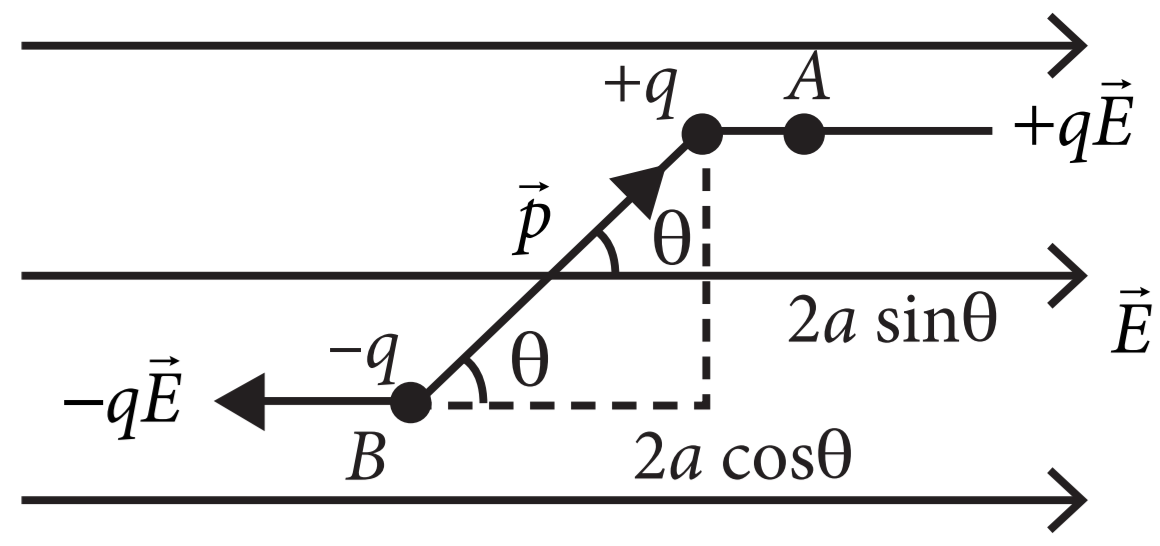
As $\tau=$ either force × perpendicular distance between the two forces.
$=\text{qaE}\sin\theta\text{ or }\tau=\text{PE}\sin\theta$
$(\because\text{qa}=\text{P})$
Or $\vec{\tau}=\vec{\text{P}}\times\vec{\text{E}}$
Explanation:
The maximum torque on the dipole in an external electric field is given by
$\tau=\text{pE}=\text{q}(\text{2a})\times\text{E}$
Here, $\text{q}=1\mu\text{C}=10^{-6}\text{C,}$
2a = 2cm = 2 × 10⁻²m,
E = 105N C-1,
$\tau=?$
$\therefore\tau=10^{-6}\times2\times10^{-2}\times10^5$
$=2\times10^{-3}\text{Nm}$
Explanation:
When $\theta$ is 0 or 180º, the $\tau$ minimum, which means the dipole moment should be parallel to the direction of the uniform electric field.
Explanation:
Net force is zero and torque acts on the dipole, trying to align p with E.
Explanation:
Torque, $\tau=\text{pE}\sin\theta$ and potential energy, $\text{U}=-\text{pE}\cos\theta.$

Explanation:
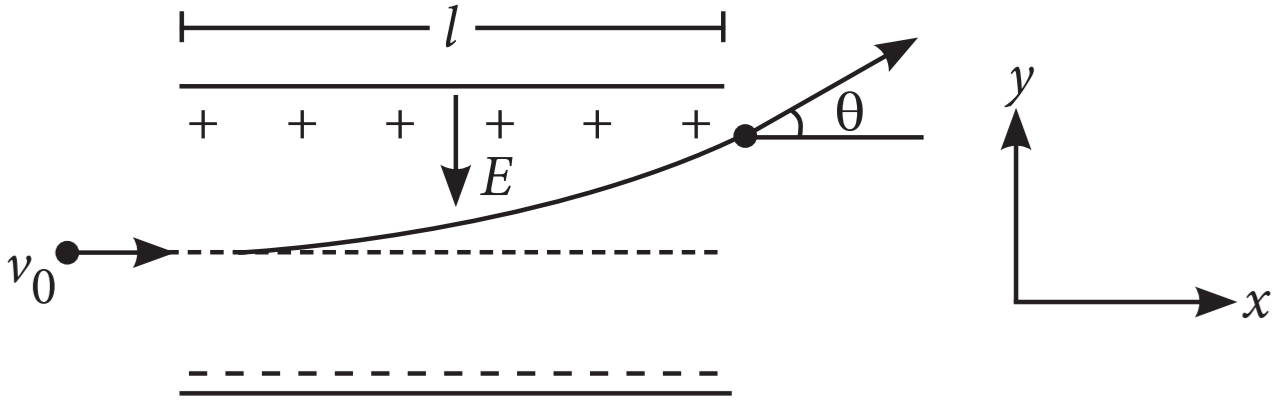
From Newton's law,
$\text{F}=\text{m}\vec{\text{a}}$
Or $\text{qE}=\text{m}\vec{\text{a}}$
$\Rightarrow\text{a}=\frac{\text{qE}}{\text{m}}=\frac{\text{eE}}{\text{m}}$
Using, $\text{s}=\text{ut}+\frac{1}{2}\text{at}^2$
$\therefore\text{ h}=0+\frac{1}{2}\times\frac{\text{eE}}{\text{m}}\text{t}^2$
$\Rightarrow\text{t}=\sqrt{\frac{\text{2hm}}{\text{eE}}}$
Explanation:
Force is same in magnitude for both.
$\therefore$ m1a1 = m2a2;
$\frac{\text{a}_1}{\text{a}_2}=\frac{\text{m}_2}{\text{m}_1}=\frac{1}{0.5}=2$
Explanation:
Here, u = 0;
$\text{a}=\frac{\text{qE}}{\text{m}};\text{ s}=\text{y}$
Using, v2 - u2 = 2as
$\Rightarrow\text{v}^2=2\frac{\text{qE}}{\text{m}}\text{y}$
$\therefore\text{ K.E.}=\frac{\text{1}}{\text{2}}\text{my}^2=\text{qEy}$
Explanation:
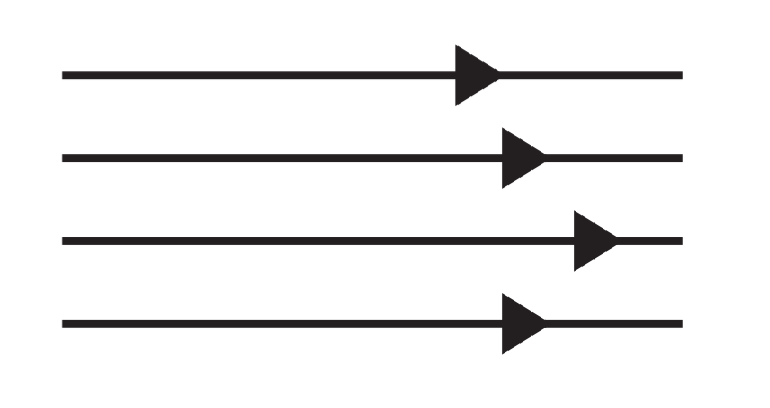
If charge particle is put at rest in electric field, then it will move along line of force.

Explanation:
From, $\text{q}=\text{ne,}\text{ n}=\frac{\text{q}}{\text{e}}$
$=\frac{3.2\times10^{-18}}{1.6\times10^{-19}}=20$
As n is an integer, hence this value of charge is possible.
Explanation:
Charge on the body is q = ne
$\therefore$ No. of electrons present on the body is
$\text{n}=\frac{\text{q}}{\text{e}}=\frac{1\times10^{-9}\text{C}}{1.6\times10^{-19}\text{C}}=6.25\times10^9$
Explanation:
Here, n = 109 electrons per second Charge given per second,
q = ne = 109 × 1.6 × 10-19C
q = 1.6 × 10⁻¹⁰C
Total charge, Q = 1 C (given)
$\therefore$ Time required $=\frac{\text{Q}}{\text{q}}=\frac{1}{1.6\times10^{-10}}\text{s}=6.25\times10^9\text{s}$
$\therefore\frac{6.25\times10^9}{3600\times24\times365}\text{year}=198.19\text{year.}$
Explanation:
As $\text{q}=\text{ne,}\text{ n}=\frac{3.2\times10^{-7}}{1.6\times10^{-19}}$
$\Rightarrow\text{n}=2\times10^{12}\text{ electrons.}$