Question
When a charged particle is placed in an electric field, it experiences an electrical force. If this is the only force on the particle, it must be the net force. The net force will cause the particle to accelerate according to Newton's second law. So $\vec{\text{F}}_\text{e}=\text{q}\vec{\text{E}}=\text{m}\vec{\text{a}}$
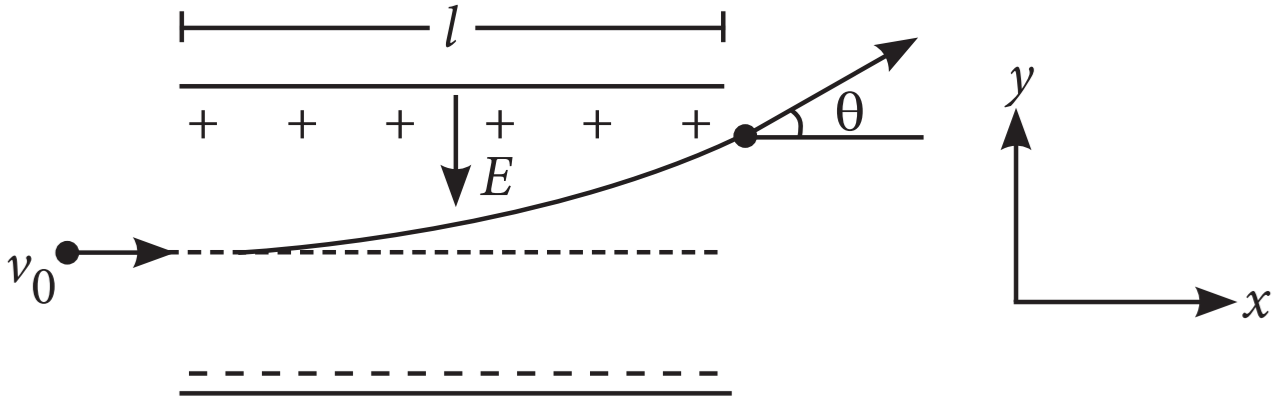
If $\vec{\text{E}}$ is uniform, then $\vec{\text{a}}$ is constant and $\vec{\text{a}}=\text{q}\vec{\text{E}}\text{/ m.}$ If the particle has a positive charge, its acceleration is in the direction of the field. If the particle has a negative charge, its acceleration is in the direction opposite to the electric field. Since the acceleration is constant, the kinematic equations can be used.

  1. An electron of mass m, charge e falls through a distance h metre in a uniform electric field E. Then time of fall,
  1. $\text{t}=\sqrt{\frac{\text{2hm}}{\text{eE}}}$

  2. $\text{t}=\frac{\text{2hm}}{\text{eE}}$

  3. $\text{t}=\sqrt{\frac{\text{2eE}}{\text{hm}}}$

  4. $\text{t}=\frac{\text{2eE}}{\text{hm}}$

  1. An electron moving with a constant velocity v along X-axis enters a uniform electric field applied along Y-axis. Then the electron moves:
  1. With uniform acceleration along Y-axis
  2. Without any acceleration along Y-axis
  3. In a trajectory represented as y = ax2
  4. In a trajectory represented as y = ax
  1. Two equal and opposite charges of masses m1 and m2 are accelerated in an uniform electric field through the same distance. What is the ratio of their accelerations if their ratio of masses is $\frac{\text{m}_1}{\text{m}_2}=0.5?$
  1. $\frac{\text{a}_1}{\text{a}_2}=2$

  2. $\frac{\text{a}_1}{\text{a}_2}=0.5$

  3. $\frac{\text{a}_1}{\text{a}_2}=3$

  4. $\frac{\text{a}_1}{\text{a}_2}=1$

  1. A particle of mass m carrying charge q is kept at rest in a uniform electric field E and then released. The kinetic energy gained by the particle, when it moves through a distance y is:
  1. $\frac{1}{2}\text{qEy}^2$
  2. qEy
  3. qEy2
  4. qE2y
  1. A charged particle is free to move in an electric field. It will travel:
  1. Always along a line of force.
  2. Along a line of force, if its initial velocity is zero.
  3. Along a line of force, if it has some initial velocity in the direction of an acute angle with the line of force.
  4. None of these.

Answer

  1. (a) $\text{t}=\sqrt{\frac{\text{2hm}}{\text{eE}}}$

Explanation:

From Newton's law,

$\text{F}=\text{m}\vec{\text{a}}$

Or $\text{qE}=\text{m}\vec{\text{a}}$

$\Rightarrow\text{a}=\frac{\text{qE}}{\text{m}}=\frac{\text{eE}}{\text{m}}$

Using, $\text{s}=\text{ut}+\frac{1}{2}\text{at}^2$

$\therefore\text{ h}=0+\frac{1}{2}\times\frac{\text{eE}}{\text{m}}\text{t}^2$

$\Rightarrow\text{t}=\sqrt{\frac{\text{2hm}}{\text{eE}}}$

  1. (c) In a trajectory represented as y = ax2
  2. (b) $\frac{\text{a}_1}{\text{a}_2}=0.5$

Explanation:

Force is same in magnitude for both.

$\therefore$ m1a1 = m2a2;

$\frac{\text{a}_1}{\text{a}_2}=\frac{\text{m}_2}{\text{m}_1}=\frac{1}{0.5}=2$

  1. (b) qEy

Explanation:

Here, u = 0;

$\text{a}=\frac{\text{qE}}{\text{m}};\text{ s}=\text{y}$

Using, v2 - u= 2as

$\Rightarrow\text{v}^2=2\frac{\text{qE}}{\text{m}}\text{y}$

$\therefore\text{ K.E.}=\frac{\text{1}}{\text{2}}\text{my}^2=\text{qEy}$

  1. (b) Along a line of force, if its initial velocity is zero.

Explanation:

If charge particle is put at rest in electric field, then it will move along line of force.

Need a full question paper?

Generate a complete, print-ready paper with questions like this in minutes — across 16+ boards, with answer keys.

Start Generating Free

Similar questions

Draw a labelled diagram of an a.c. generator. Obtain the expression for the emf induced in the rotating coil of N turns each of cross-sectional area A in the presence of a magnetic field $\overrightarrow{ B }$.
A thick wire of $15 \Omega$ is stretched to three times its original length. Assuming that the density of the wire remains unchanged, calculate the resistance of the new wire.
A tangent galvanometer shows a deflection of 45° when 10mA of current is passed through it. If the horizontal component of the earth's magnetic field is BH = 3.6×10⁻⁵ T and radius of the coil is 10cm, find the number of turns in the coil.
Two long bar magnets are placed with their axes coinciding in such a way that the north pole of the first magnet is 2·0cm from the south pole of the second. If both the magnets have a pole strength of 10A-m, find the force exerted by one magnet on the other.
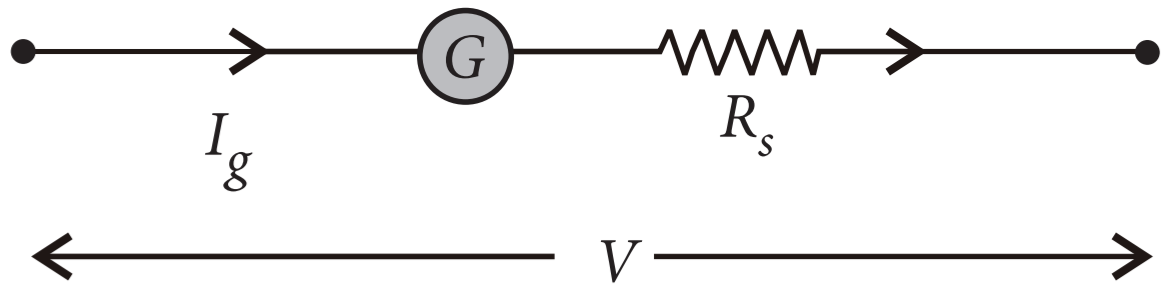
A galvanometer can be converted into voltmeter of given range by connecting a suitable resistance R, in series with the galvanometer, whose value is given by,
$\text{R}_\text{s}=\frac{\text{V}}{\text{I}_\text{g}}-\text{G}$
where Vis the voltage to be measured, lg is the current for full scale deflection of galvanometer and G is the resistance of galvanometer.

Series resistor(R,) increases range of voltmeter and the effective resistance of galvanometer. It also protects the galvanometer from damage due to large current. Voltmeter is a high resistance instrument and it is always connected in parallel with the circuit element across which potential difference is to be measured. An ideal voltmeter has infinite resistance. In order to increase the range of voltmeter n times the value of resistance to be connected in series with galvanometer is Rs = (n - 1)G.
  1. 10mA current can pass through a galvanometer of resistance $25\Omega$ What resistance in series should be connected through it, so that it is converted into a voltmeter of 100V?
  1. $0.975\Omega$
  2. $99.75\Omega$
  3. $975\Omega$
  4. $9975\Omega$
  1. There are 3 voltmeter A, B, C having the same range but their resistance are $15000\Omega,10000\Omega$, and $5000\Omega$ respectively. 'Tile best voltmeter amongst them is the one whose resistance is
  1. $5000\Omega$
  2. $10000\Omega$
  3. $15000\Omega$
  4. all are equally good.
  1. A milliammeter of range 0 to 25mA and resistance of $10\Omega$ is to be converted into a voltmeter with a range of 0 to 25V. 'Tile resistance that should be connected in series will be:
  1. $930\Omega$
  2. $960\Omega$
  3. $990\Omega$
  4. $1010\Omega$
  1. To convert a moving coil galvanometer (MCG) into a voltmeter:
  1. A high resistance R is connected in parallel with MCG.
  2. A low resistance R is connected in parallel with MCG.
  3. A low resistance R is connected in series with MCG.
  4. A high resistance R is connected in series with MCG.
  1. To increase the current sensitivity of a moving coil galvanometer, we should decrease:
  1. Zero.
  2. Low.
  3. High.
  4. Infinity.
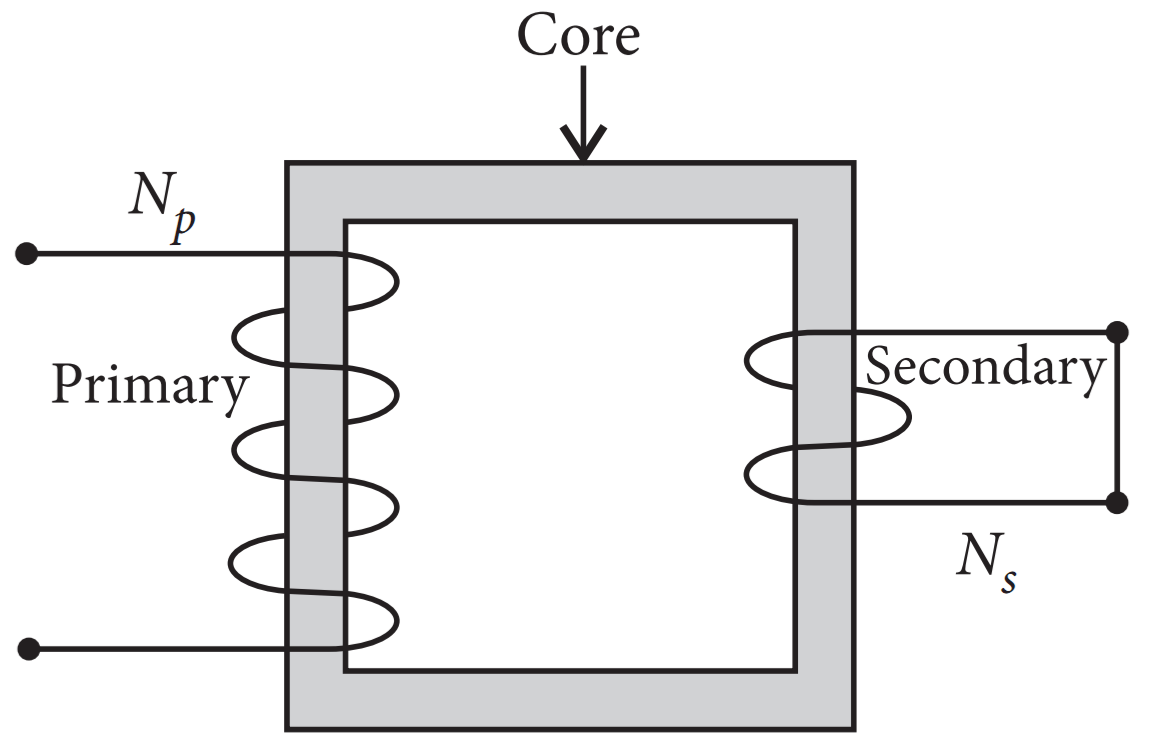
Step-down transformers are used to decrease or step-down voltages. These are used when voltages need to be lowered for use in homes and factories. A small town with a demand of 800kW of electric power at 220V is situated 15km away from an electric plant generating power at 440V. The resistance of the two wire line carrying power is 0.5Q per km. The town gets power from the line through a 4000 - 220V step-down transformer at a sub-station in the town.

  1. The value of total resistance of the wires is:
  1. $25\Omega$
  2. $30\Omega$
  3. $35\Omega$
  4. $15\Omega$
  1. The line power loss in the form of heat is:
  1. 550kW
  2. 650kW
  3. 600kW
  4. 700kW
  1. How much power must the plant supply, assuming there is negligible power loss due to leakage?
  1. 600kW
  2. 1600kW
  3. 500W
  4. 1400kW
  1. The voltage drop in the power line is:
  1. 1700V
  2. 3000V
  3. 2000V
  4. 2800V
  1. The total value of voltage transmitted from the plant is:
  1. 500V
  2. 4000V
  3. 3000V
  4. 7000V
Sunita and her friends visited an exhibition. The policeman asked them to pass through a metal detector. Sunita’s friends were initially scared of it. Sunita, however, explained to them the purpose and working of the metal detector.
Answer the following questions:
  1. On what principle does a metal detector work?
  2. Why does the detector emit sound when a person carrying any metallic object walks through it?
  3. State any two qualities which Sunita displayed while explaining the purpose of walking through the detector.
If an automobile engine is overheated, it is cooled by putting water on it. It is advised that the water should be put slowly with engine running. Explain the reason.
If the radius of a circular current carrying coil is doubled and the current flowing through it is reduced to half, then what will be effect on magnetic moment?
Electrons oscillating in a circuit give rise to radiowaves. A transmitting antenna radiates most effectively the radiowaves of wavelength equal to the size of the antenna. The infrared waves incident on a substance set into oscillation all its electrons, atoms and molecules. This increases the internal energy and hence the temperature of the substance.
  1. If vg, vx and vm are the speeds of gamma rays, X-rays and microwaves respectively in vacuum, the
  1. vg > vx > vm
  2. vg < vx < vm
  3. vg > vx > vm
  4. vg = vx = vm
  1. Which of the following wi II deflect in electric field?
  1. X-rays.
  2. $\gamma-\text{rays}.$
  3. Cathode rays.
  4. Ultraviolet rays.
  1. $\gamma-\text{rays}$ are detected by:
  1. Point contact diodes.
  2. Thennopiles.
  3. Ionization chamber.
  4. Photocells.
  1. The frequency of electromagnetic wave, which best suited to observe a particle ofradius 3 × 10⁻⁴cm is the order of,
  1. 1015Hz
  2. 1014 Hz
  3. 1013Hz
  4. 1012Hz
  1. We consider the radiation emitted by the human body. Which one of the following statements is true?
  1. The radiation emitted is in the infrared region.
  2. The radiation is emitted only during the day.
  3. The radiation is emitted during the summers and absorbed during the winters.
  4. The radiation emitted lies in the ultraviolet region and hence it is not visible.