Question
When a charged particle moves at right angle to a magnetic field quantity that changes is:

Answer

  1. Momentum
Explanation:
When a charged particle moves perpendicular to the field, its speed remains the same whereas its velocity keeps on changing.
Momentum is the product of the mass of the particle and the velocity if the particle, hence since velocity varies, momentum also varies.
When a charged particle moves at right angle to a magnetic field quantity that changes is momentum.

Need a full question paper?

Generate a complete, print-ready paper with questions like this in minutes — across 16+ boards, with answer keys.
Start Generating Free

Similar questions

A 20F capacitor is charged to 5V and isolated. It is then connected in parallel with an uncharged 30F capacitor. The decrease in the energy of the system will be(a) 25 J(b) 200 J(c) 125 J  (d) 150 J
       
Which particles will have minimum frequency of revolution when projected with the same velocity perpendicular to a magnetic field
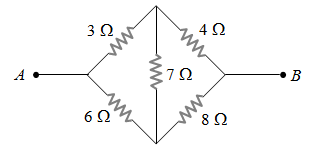
In the given figure, equivalent resistance between $A$ and $B$ will be
Two bulbs, one of 50 watt and another of 25 watt are connected in series to the mains. The ratio of the currents through them is(a) 2 : 1(b) 1 : 2(c) 1 : 1(d) Without voltage, cannot be calculated
   
   
Zener diode acts as a/an:
A semiconductor is cooled from $ T_{1} K $ to $ T_{2} K $, then its resistance will :
Assertion :   The capacity of a given conductor remains same even if charge is varied on it.
Reason      : Capacitance depends upon nearly medium as well as size and shape of conductor.(a) If both assertion and reason are true and the reason is the correct explanation of the assertion.(b) If both assertion and reason are true but reason is not the correct explanation of the assertion.(c) If assertion is true but reason is false.(d) If the assertion and reason both are false.


The phenomenon of light passing through the object is called:
Full wave rectifier uses:
Consider the motion of the tip of the minute hand of a clock. In one hour:
  1. The displacement is zero.
  2. The distance covered is zero.
  3. The average speed is zero.
  4. The average velocity is zero.