MCQ
When a copper ball is heated, the largest percentage increase will occur in its
  • A
    Diameter
  • B
    Area
  • Volume
  • D
    Density

Answer

Correct option: C.
Volume
c
(c) When a copper ball is heated, it’s size increases.

As Volume $\propto(radius)^3$ and Area $\propto ((radius)^2$, so percentage increase will be largest in it’s volume.

Density will decrease with rise in temperature.

Need a full question paper?

Generate a complete, print-ready paper with questions like this in minutes — across 16+ boards, with answer keys.
Start Generating Free

Similar questions

The average translational energy and the $r.m.s.$ speed of molecules in a sample of oxygen gas at $300 K$ are $6.21 \times {10^{ - 21}}\,J$ and $484\, m/s$ respectively. The corresponding values at $600 K$ are nearly (assuming ideal gas behaviour)
When a gas filled in a closed vessel is heated by raising the temperature by $1^{\circ} C$, its pressure increase by $0.4 \%$. The initial temperature of the gas is ..........$K$
A body cools in $7$ minutes from ${60^o}C$ to ${40^o}C$ What time (in minutes) does it take to cool from ${40^o}C$ to ${28^o}C$ if the surrounding temperature is ${10^o}C$? Assume Newton’s Law of cooling holds
A string is stretched between fixed points separated by $75.0\,\, cm.$ It is observed to have resonant frequencies of $420\,\, Hz$ and $315\,\, Hz$. There are no other resonant frequencies between these two. The lowest resonant frequency for this string is .... $Hz$
A wheel of mass $10\, kg$ has a moment of inertia of $160\, kg-m^2$ about its own axis, the radius of gyration will be ....... $m$
A bus is moving with a velocity of $5 m/s$ towards a huge wall. the driver sounds a horn of frequency $165 Hz.$ If the speed of sound in air is $355 m/s,$ the number of beats heard per second by a passenger on the bus will be
Sound waves travel at $350\,\, m/s$ through a warm air and at $3500\,\, m/s$ through brass. The wavelength of a $700\,\, Hz$ acoustic wave as it enters brass from warm air 
Gravitational potential difference between surface of a planet and a point situated at a height of $20\,m$ above its surface is $2\,joule/kg$. If gravitational field is uniform, then the work done in taking a $5\,kg$ body of height $4\,meter$ above surface will be ........ $J$
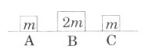
Three objects $A$, $B$ and $C$ are kept in a straight line on a frictionless horizontal surface. These have masses $m, 2 m$ and $m$, respectively. The object $A$ moves towards $B$ with a speed $9 \mathrm{~m} / \mathrm{s}$ and makes an elastic collision with it. Thereafter, $B$ makes completely inelastic collision with $C$. All motions occur on the same straight line. Find the final speed (in $\mathrm{m} / \mathrm{s}$ ) of the object $\mathrm{C}$.
$Assertion$ : A rocket moves forward by pushing the surrounding air backwards.

$Reason$ : It derives the necessary thrust to move forward according to Newton’s third law of motion