Question
When a copper object is exposed to moist air for a long time, then a green coating is formed on its surface.
$a.$ What is the material of the green coating?
$b.$ State whether the green coating is acidic or basic.
Answer

$a.$ When copper vessel is exposed to moist air for a long time it develops a green layer on its surface. Copper corrodes by oxidation in which it reacts with oxygen in the air to form copper oxide. Copper oxide then combines with carbon dioxide to make copper carbonate, which gives it a green colour. This process is called corrosion of copper. The green material is a mixture of copper hydroxide $(\ce{Cu(OH)_2})$ and copper carbonate $(\ce{CuCO_3}).$
The following is the reaction $\ce{2 \mathrm{Cu} + \mathrm{H}_2 \mathrm{O} + \mathrm{CO}_2 + \mathrm{O}_2 \rightarrow \mathrm{Cu}(\mathrm{OH})_2 + \mathrm{CuCO}_3}$ moist air.
$b.$ The green coating will be basic in nature. Green coating is made of copper oxide which is an oxide of metal. Metals react with oxygen to form metallic oxides. These metallic oxides are basic because they react with water to form bases.

Need a full question paper?

Generate a complete, print-ready paper with questions like this in minutes — across 16+ boards, with answer keys.

Start Generating Free

Similar questions

What are the conditions necessary for combustion to take place?
Draw a labeled diagram of the human male reproductive system.
What necessary precautions should we take to protect ourselves from lightning?
State the various uses of a periscope.
Draw a neat labelled diagram of human ear and explain its working.
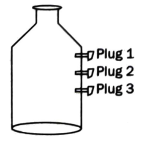
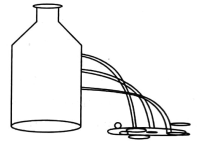
Watson fills a bottle completely with water. The bottle has three same sized plugged holes on Its wall. Watson pulls out the plugs and checks the position of the stream of water coming out.
Image
Image
(i) What does Watson's activity show ?
$\quad$(a) Liquids exert pressure.
$\quad$(b) Liquids contract on cooling.
$\quad$(c) Liquids cannot be compressed.
$\quad$(d) Liquids have no definite shape.
(ii) Liquids exert pressure on the walls of container
$\quad$1. at same depth
$\quad$2. at different depth
$\quad$3. with same strength
$\quad$Which of the following is correct ?
$\quad$(a) Only 1$\quad$(b) Only 3$\quad$(c) Only 2$\quad$(d) Only 1 and 3
(iii) Pressure exerted by liquids at the bottom depends on
$\quad$(a) width of the liquid column
$\quad$(b) shape of the column
$\quad$(c) shape of the container
$\quad$(d) height of the liquid column
(iv) Which of the following does not affect the pressure beneath the surface of a liquid ?
$\quad$(a) Strength of the gravitational field
$\quad$(b) Area of the liquid
$\quad$(c) Density of the liquid
$\quad$(d) Depth of the liquid
Cell make up $A; A$ makeup $B; B$ make up $C$, and finally $C$ make up an organism. What is $A, B$, and $C?$
Describe an activity to show that a liquid exerts equal pressure in all the direction at a given depth.
Explain in brief, what happens when two force act in opposite direction on an object.
A group of students is experimenting. They have two beakers, A and B, each containing 100 mL of water. In beaker A, they add 5 grams of salt and stir. In beaker B, they add 20 grams of salt and stir. They observe that all the salt in beaker A dissolves, but in beaker B, some salt remains at the bottom, even after stirring vigorously.
Q.1. Why did all the salt dissolve in beaker A, but not in beaker B?
Q.2. What kind of solution is formed in beaker A?
Q.3. What about beaker B (considering the undissolved salt)?