MCQ
When a current flows through a conductor its temperature
  • A
    May increase or decrease
  • B
    Remains same
  • C
    Decreases
  • Increases

Answer

Correct option: D.
Increases
d
(d)Heating effect of current.

Need a full question paper?

Generate a complete, print-ready paper with questions like this in minutes — across 16+ boards, with answer keys.

Start Generating Free

Similar questions

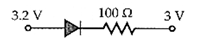
The current in the circuit shown in the figure considering ideal diode is
Image
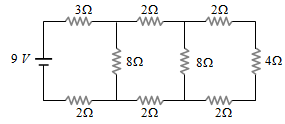
In the circuit shown in the figure, the current through

For a parallel beam of monochromatic light of wavelength $'\lambda'$ diffraction is produced by a single slit whose width $'a'$ is of the order of the wavelength of the light . If $'D'$ is the distance of the screen from the slit, the width of the central maxima will be
It two parallel wires carry current in opposite directions:
The forbidden energy gap for germanium crystal at $0 K$ is:
A circular coil is in $y-z$ plane with centre at the origin. The coil is carrying a constant current. Assuming direction of magnetic field at $x = -25\, cm$ to be positive direction of magnetic field, which of the following graphs shows variation of magnetic field along $x-$ axis
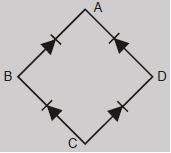
For the given circuit shown in fig, to act as full wave rectifier :-  $a.c.$ input should be  connected across .............. and ................. the $d.c.$ output would appear across  ............. and ..................
Material $A$ has critical angle $i_A$, and material $B$ has critical angle $i_B\left(i_B>i_A\right)$. Then which of the following is true
(i) Light can be totally internally reflected when it passes from $B$ to $A$
(ii) Light can be totally internally reflected when it passes from $A$ to $B$
(iii) Critical angle for total internal reflection is $i _{ B }- i _{ A }$
(iv) Critical angle between $A$ and $B$ is $\sin ^{-1}\left(\frac{\sin ^A A}{\sin _{ A }}\right)$
The maximum kinetic energy of photoelectrons emitted from a surface when photons of energy $6 eV$ fall on it is $4 eV$. The stopping potential in volts is
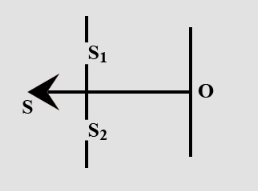
In the set up shown, the two slits $S_1$​ and $S_2$ are not equidistant from the slit $S$. The central fringe at $O$ is then: