Question

When a current of 1 ampere is passed through a conductor whose ends are maintained at temperature difference of 1 , the amount of heat evolved or absorbed is called

(a) Peltier coefficient

(b) Thomson coefficient

(c) Thermoelectic power

(d) Thermo e.m.f.

Answer

(b) Thomson coefficient

Need a full question paper?

Generate a complete, print-ready paper with questions like this in minutes — across 16+ boards, with answer keys.

Start Generating Free

Similar questions

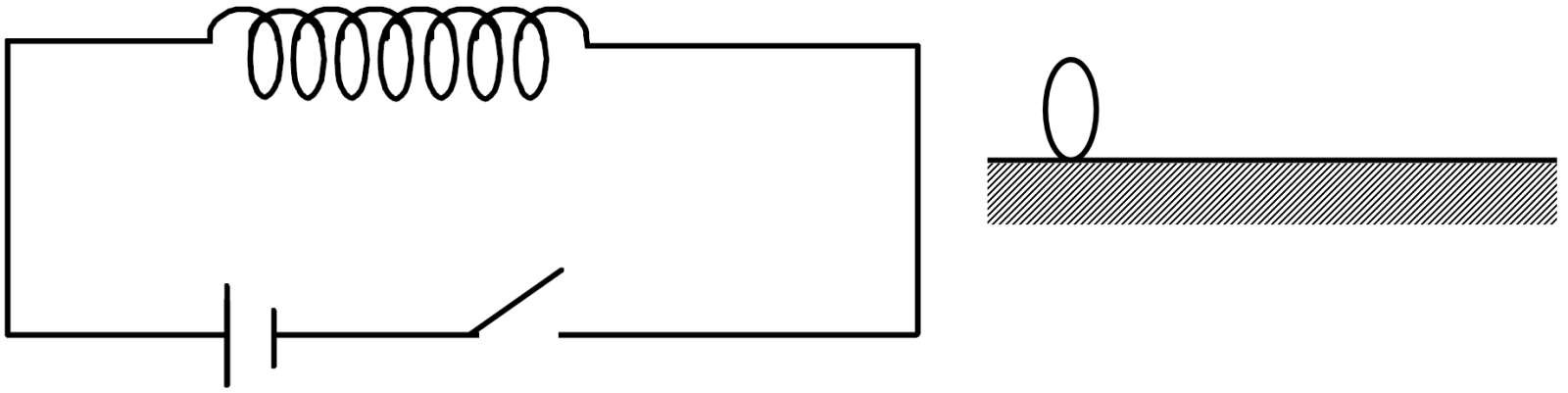
Figure shows a horizontal solenoid connected to a battery and a switch. A copper ring is placed on a frictionless track, the axis of the ring being along the axis of the solenoid. As the switch is closed, the ring will:
  1. Remain stationary.
  2. Move towards the solenoid.
  3. Move away from the solenoid.
  4. Move towards the solenoid or away from it depending on which terminal (positive or negative) of the battery is connected to the left end of the solenoid.

Electromagnetic waves travel in a medium which has relative permeability 1.3 and relative permittivity 2.14. Then the speed of the electromagnetic wave in the medium will be

(a) 13.6  

(b) 1.8  

(c) 3.6  

(d) 1.8  

The wavelength Ka X-rays produced by an X-ray tube is 0.76 Å. The atomic number of anticathode material is

(a) 82       

(b) 41

(c) 20    

(d) 10

Refractive index of glass is   and refractive index of water is . If the speed of light in glass is 2.00  m/s, the speed in water will be

(a) 2.67 m/s

(b) 2.25  m/s

(c) 1.78  m/s

(d) 1.50   m/s

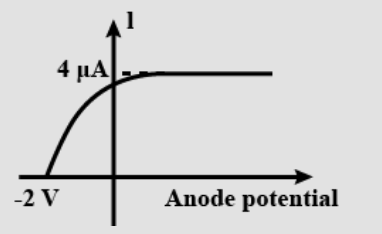
The graph shown below depicts plot of photocurrent versus anode potential for a cathode with 4 eV work function. The energy of the incident photon is:

If the two ends of a p-n junction are joined by a wire:

An electron is travelling along the x-direction. It encounters a magnetic field in the y-direction. Its subsequent motion will be

(a) Straight line along the x-direction

(b) A circle in the xz-plane

(c) A circle in the yz-plane

(d) A circle in the xy-plane

Which of the following quantities are always zero in a simple harmonic motion?

  1. $\overrightarrow{\text{F}}\times\overrightarrow{\text{a}}$

  2. $\overrightarrow{\text{v}}\times\overrightarrow{\text{r}}$

  3. $\overrightarrow{\text{a}}\times\overrightarrow{\text{r}}$

  4. $\overrightarrow{\text{F}}\times\overrightarrow{\text{r}}$

The stopping potential ( 

(a) Depends upon the angle of incident light

(b) Depends upon the intensity of incident light

(c) Depends upon the surface nature of the substance

(d) Is independent of the intensity of the incident light

An A.C. circuit containing only capacitance, the current: