Question
When a circuit element ‘X’ is connected across an a.c. source, a current of $\sqrt{2}\text{A}$ flows through it and this current is in phase with the applied voltage. When another element ‘Y’ is connected across the same a.c. source, the same current flows in the circuit but it leads the voltage by $\frac{\pi}{2}$ radians.
  1. Name the circuit element X and Y.
  2. Find the current that flows in the circuit when the series combination of X and Y is connected across the same a.c. voltage.
  3. Net impedance.

Answer

  1. When circuit element is X, the current is in phase with the applied emf, this implies that X is pure resistance.

When circuit element Y is connected, the current leads the voltage by $\frac{\pi}{2}$ so Y is pure capacitance.

  1.  

Resistance of X = R; $\text{I}=\frac{\text{V}}{\text{R}}$

$\sqrt{2}=\frac{\text{V}}{\text{R}} \ ...(\text{i})$

Reactance of $\text{Y, X}_{\text{C}}=\frac{1}{\omega\text{C}},\text{I}=\frac{\text{V}}{\text{X}_{\text{C}}}\Rightarrow\sqrt{2\text{C}}=\frac{\text{V}}{\text{X}_{\text{C}}} \ ...(\text{ii})$

This implies $\text{X}_{\text{C}}=\text{R}$

When R and C are connected in series across same voltage source, then

Impedance $\text{Z}=\sqrt{\text{R}^2+\text{X}^2_{\text{C}}}=\sqrt{\text{R}^2+\text{R}^2}=\sqrt{2}\text{R} \ ...(\text{iii})$

$\therefore$ Current in circuit $\text{I}=\frac{\text{V}}{\text{Z}}=\frac{\text{V}}{\sqrt{2}\text{R}}$

From (1), $\frac{\text{V}}{\text{R}}=\sqrt{2},\therefore\text{I}=\frac{1}{\sqrt{2}}\times\sqrt{2}=1\text{A}$

  1.  

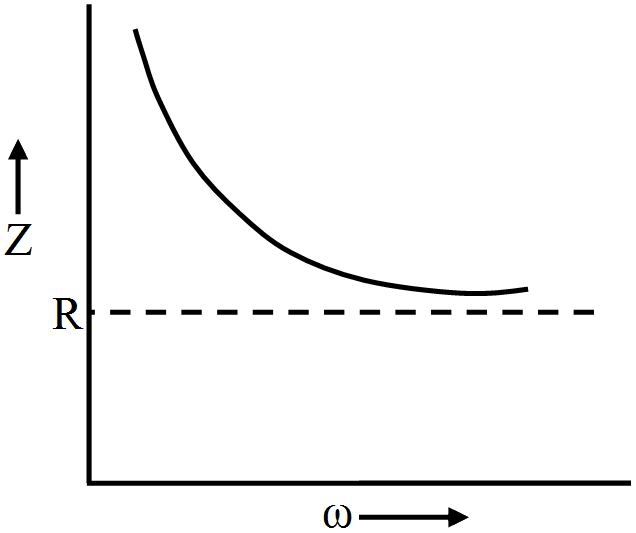
$\text{Z}=\sqrt{\text{R}^2+\Big(\frac{1}{\omega\text{C}}\Big)^2}$

i.e., impedance decreases with increase of angular frequency $\omega$

When $\omega=0,\text{Z}=\infty$

When $\omega=0,\text{Z = R}$

The graph of impedance Z versus $\omega$ is shows in fig.

Need a full question paper?

Generate a complete, print-ready paper with questions like this in minutes — across 16+ boards, with answer keys.

Start Generating Free

Similar questions

A circular coil of 200 turns has a radius of 10cm and carries a current of 2.0A.
  1. Find the magnitude of the magnetic field. B at the centre of the coil.
  2. At what distance from the centre along the axis of the coil will the field B drop to half its value at the centre? $\big(\sqrt[3]{4}=1.5874\ ...\big)$
  1. Derive an expression for drift velocity of electrons in a conductor. Hence, deduce Ohm's law.
  2. A wire whose cross-sectional area is increasing linearly from its one end to the other, is connected across a battery of V volts.

Which of the following quantities remain constant in the wire?

  1. Drift speed.
  2. Current density.
  3. Electric current.
  4. Electric field.
Derive an expression for magnetic field intensity due to a magnetic dipole at a point lies on its equatorial line.
A convex lens of focal length 20cm and a concave lens of focal length 10cm are placed 10cm apart with their principal axes coinciding. A beam of light travelling parallel to the principal axis and having a beam diameter 5.0mm, is incident on the combination. Show that the emergent beam is parallel to the incident one. Find the beam diameter of the emergent beam.
A cubical metal block of edge 12cm floats in mercury with one fifth of the height inside the mercury. Water is poured till the surface of the block is just immersed in it. Find the height of the water column to be poured. Specific gravity of mercury = 13.6.
Consider circuit in Fig. How much energy is absorbed by electrons from the initial state of no current (ignore thermal motion) to the state of drift velocity?

Two parallel wires seprated by a distance of 10cm carry currents of 10A and 40A along-the same direction. Where should a third current be placed so that it experiences no magnetic force?
An electron is projected horizontally with a kinetic energy of 10keV. A magnetic field of strength 1.0 × 10⁻⁷T exists in the vertically upward direction.
  1. Will the electron deflect towards the right or left of its motion?
  2. Calculate the sideways deflection of the electron while travelling through 1m. Make appropriate approximations.
What is Gauss theorem? With its help, obtain an expression for the electric field intensity at any point near a uniformly charged linear conductor of infinite length.###Make the necessary diagram and with the help of Gauss law, calculate the electric field intensity at any point due to a charged wire of infinite length. Plot the change in intensity with distance.###Define Gauss' law. With its help, find the value of electric field intensity at a distance from a uniformly charged linear conductor of infinite extension. Make the necessary diagram and also make a graph of the change of electric field with distance.
A bulb with rating 250V, 100W is connected to a power supply of 220V situated 10m away using a copper wire of area of cross-section 5mm2. How much power will be consumed by the connecting wires? Resistivity of copper $1.7\times10^{-8}\Omega-\text{m}$.