Question
When a circuit element ‘X’ is connected across an a.c. source, a current of $\sqrt{2}\text{A}$ flows through it and this current is in phase with the applied voltage. When another element ‘Y’ is connected across the same a.c. source, the same current flows in the circuit but it leads the voltage by $\frac{\pi}{2}$ radians.
  1. Name the circuit element X and Y.
  2. Find the current that flows in the circuit when the series combination of X and Y is connected across the same a.c. voltage.
  3. Net impedance.

Answer

  1. When circuit element is X, the current is in phase with the applied emf, this implies that X is pure resistance.
When circuit element Y is connected, the current leads the voltage by $\frac{\pi}{2}$ so Y is pure capacitance.
  1.  
Resistance of X = R; $\text{I}=\frac{\text{V}}{\text{R}}$

$\sqrt{2}=\frac{\text{V}}{\text{R}} \ ...(\text{i})$

Reactance of $\text{Y, X}_{\text{C}}=\frac{1}{\omega\text{C}},\text{I}=\frac{\text{V}}{\text{X}_{\text{C}}}\Rightarrow\sqrt{2\text{C}}=\frac{\text{V}}{\text{X}_{\text{C}}} \ ...(\text{ii})$

This implies $\text{X}_{\text{C}}=\text{R}$

When R and C are connected in series across same voltage source, then

Impedance $\text{Z}=\sqrt{\text{R}^2+\text{X}^2_{\text{C}}}=\sqrt{\text{R}^2+\text{R}^2}=\sqrt{2}\text{R} \ ...(\text{iii})$

$\therefore$ Current in circuit $\text{I}=\frac{\text{V}}{\text{Z}}=\frac{\text{V}}{\sqrt{2}\text{R}}$

From (1), $\frac{\text{V}}{\text{R}}=\sqrt{2},\therefore\text{I}=\frac{1}{\sqrt{2}}\times\sqrt{2}=1\text{A}$
  1.  
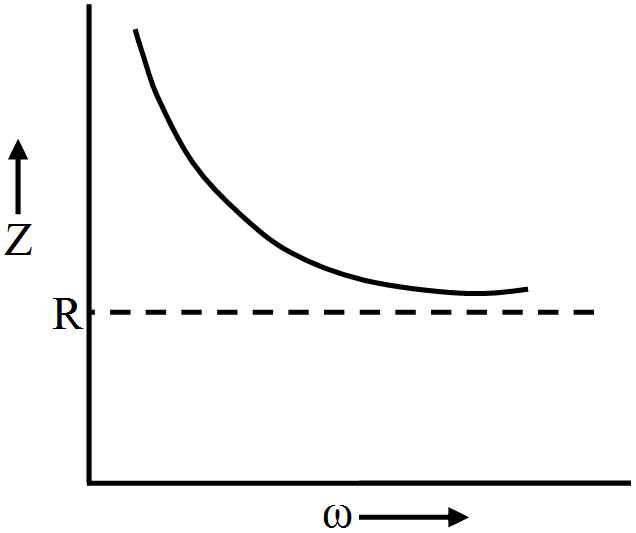
$\text{Z}=\sqrt{\text{R}^2+\Big(\frac{1}{\omega\text{C}}\Big)^2}$

i.e., impedance decreases with increase of angular frequency $\omega$

When $\omega=0,\text{Z}=\infty$

When $\omega=0,\text{Z = R}$

The graph of impedance Z versus $\omega$ is shows in fig.

Need a full question paper?

Generate a complete, print-ready paper with questions like this in minutes — across 16+ boards, with answer keys.

Start Generating Free

Similar questions

Consider a p-n junction diode having the characteristic $\text{i}-\text{i}_0\Big(\text{e}^{\frac{\text{eV}}{\text{kT}}}-1\Big)$ where $\text{i}_0=20\mu\text{A}.$ The diode is operated at T = 300K.
  1. Find the current through the diode when a voltage of 300mV is applied across it in forward bias.
  2. At what voltage does the current double?
With the help of a circuit, show how a moving coil galvanometer can be converted into an ammeter of a given range. Write the necessary mathematical formula.
A composite slab is prepared by pasting two plates of thicknesses $L_1$ and $L_2$ and thermal conductivities $K_1$ and $K_2$. The slabs have equal cross-sectional area. Find the equivalent conductivity of the composite slab.
Verify the Ampere's law for magnetic field of a point dipole of dipole moment $\text{m}=\text{m}\hat{\text{k}}$. Take C as the closed curve running clockwise along:
  1. The z-axis from z = a > 0 to z = R.
  2. Along the quarter circle of radius R and centre at the origin, in the first quadrant of x-z plane.
  3. Along the x-axis from x = R to x = a.
  4. Along the quarter circle of radius a and centre at the origin in the first quadrant of x-z plane.
The radius of a gold nucleus (Z = 79) is about $7.0 \times 10^{-15}m$. Assume that the positive charge is distributed uniformly throughout the nuclear volume. Find the strength of the electric field at:
  1. The surface of the nucleus.
  2. At the middle point of a radius. Remembering that gold is a conductor, is it justified to assume that the positive charge is uniformly distributed over the entire volume of the nucleus and does not come to the outer surface?
When an electron goes from the valence band to the conduction band in silicon, its energy is increased by 1.1eV. The average energy exchanged in a thermal collision is of the order of kT which is only 0.026eV at room temperature. How is a thermal collision able to take some of the electrons from the valence band to the conduction band?
A bullet of mass 20g moving horizontally at a speed of 300m/s is fired into a wooden block of mass 500g suspended by a long string. The bullet crosses the block and emerges on the other side. If the centre of mass of the block rises through a height of 20.0cm, find the speed of the bullet as it emerges from the block.
A hemispherical bowl of radius R is rotated about its axis of symmetry which is kept vertical. A small block is kept in the bowl at a position where the radius makes an angle $\theta$ with the vertical. The block rotates with the bowl without any slipping. The friction coefficient between the block and the bowl surface is $\mu.$ Find the range of the angular speed for which the block will not slip.
The ratio of the molar heat capacities of an ideal gas is $\frac{\text{C}_\text{p}}{\text{C}_\text{V}}=\frac{7}{6}.$ Calculate the change in internal energy of 1.0 mole of the gas when its temperature is raised by 50K.
  1. Keeping the pressure constant.
  2. Keeping the volume constant.
  3. Adiabatically.
A rectangular conducting loop consists of two wires on two opposite sides of length l joined together by rods of length d. The wires are each of the same material but with cross-sections differing by a factor of 2. The thicker wire has a resistance R and the rods are of low resistance, which in turn are connected to a constant voltage source $V_0.$ The loop is placed in uniform a magnetic field B at 45° to its plane. Find $\tau$, the torque exerted by the magnetic field on the loop about an axis through the centres of rods.