MCQ
When a disc rotates with uniform angular velocity, which of the following is not true?
  • A
    The sense of rotation remains same.
  • B
    The orientation of the axis of rotation remains same.
  • C
    The speed of rotation is non-zero and remains same.
  • D
    The angular acceleration is non-zero and remains same.
Answer

  1. The angular acceleration is non-zero and remains same.
Explanation:

$\because\ \omega$ is uniform or constant

$\therefore\ \alpha=\frac{\text{d}\omega}{\text{dt}}$

$\Rightarrow\alpha=0$

Hence, angular acceleration is zero, not non zero.

Need a full question paper?

Generate a complete, print-ready paper with questions like this in minutes — across 16+ boards, with answer keys.

Start Generating Free

Similar questions

A mass of $5\, kg$ is suspended by a rope of length $2\,m$ from a ceiling. A force of $50\,N$ in the horizontal direction is applied at the mid-point of the rope. The angle made by the rope with the vertical, in equilibrium is ........ $^o$
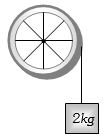
A block of mass $2\,kg$ hangs from the rim of a wheel of radius $0.5\,m$. On releasing from rest the block falls through $5\,m$ height in $2\,s$. The moment of inertia of the wheel will be ...... $kg - {m^2}$
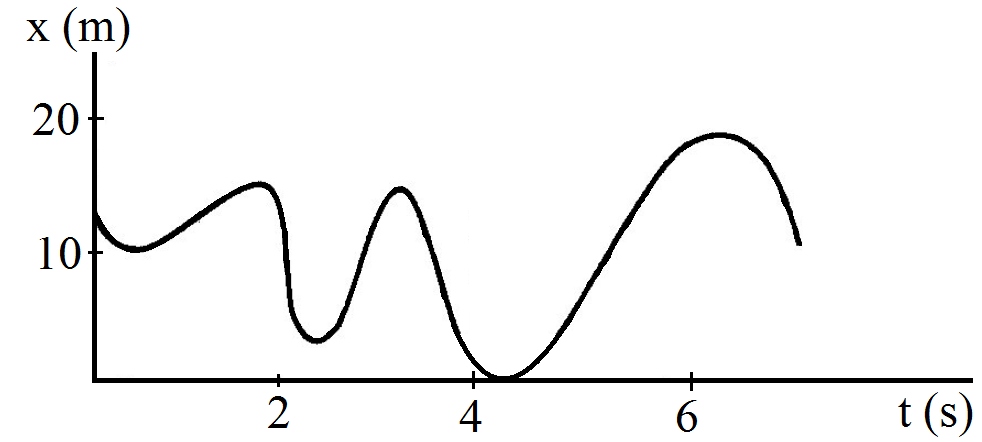
Figure shows the position of a particle moving on the X-axis as a function of time.

​​​​50% of the X-rays coming from a Coolidge tube are able to pass through a 0.1mm thick aluminium foil. If the potential difference between the target and the filament is increased, the fraction of the X-rays passing through the same foil will be:
  1. 0%
  2. < 50%
  3. 50%
  4. > 50%
A force $F$ is given by $F = at + b{t^2}$, where $t$ is time. What are the dimensions of $a$ and $b$
The coefficient of apparent expansion of mercury in a glass vessel is $153 \times 10^{-6} /{ }^{\circ} C$ and in steel vessel is $144 \times 10^{-6} /{ }^{\circ} C$. If $\alpha$ for steel is $12 \times 10^{-6} /{ }^{\circ} C ,$ then that of glass is
During an isothermal expansion, a confined ideal gas does $-150 \,J$ of work against its surroundings. This implies that
A pendulum bob has a speed of $3\, m/s$ at its lowest position. The pendulum is $0.5\, m$ long. The speed of the bob, when the length makes an angle of ${60^o}$ to the vertical, will be ..... $m/s$ (If $g = 10\,m/{s^2}$)
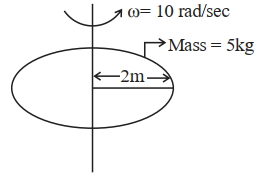
Consider a Disc of mass $5 \mathrm{~kg}$, radius $2 \mathrm{~m}$, rotating with angular velocity of $10 \mathrm{rad} / \mathrm{s}$ about an axis perpendicular to the plane of rotation. An identical disc is kept gently over the rotating disc along the same axis. The energy dissipated so that both the discs continue to rotate together without slipping is ___________$J$.
A copper wire is held at the two ends by rigid supports. At $50^{\circ} C$ the wire is just taut, with negligible tension. If $Y=1.2 \times 10^{11} \,N / m ^2, \alpha=1.6 \times 10^{-5} /{ }^{\circ} C$ and $\rho=9.2 \times 10^3 \,kg / m ^3$, then the speed of transverse waves in this wire at $30^{\circ} C$ is .......... $m / s$