Question
When a ferromagnetic material goes through a hysteresis loop, its thermal energy is increased. Where does this energy come from?

Answer

When a ferromagnetic material is taken through the cycle of magnetisation, magnet dipoles of the material orient and reorient with time. This molecular motion within the material results in the production of heat, which increses thermal energy of material.

Need a full question paper?

Generate a complete, print-ready paper with questions like this in minutes — across 16+ boards, with answer keys.
Start Generating Free

Similar questions

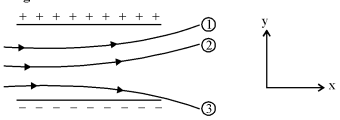
Figure shows track of three charged particles in a uniform elecrostatic field. Give the signs of the three charges. Which particle has the highest charge to mass ratio?
Image
Draw a block diagram of a generalized communication system. Write the functions of each of the following:
(a) Transmitter, (b) Channel, (c) Receiver.
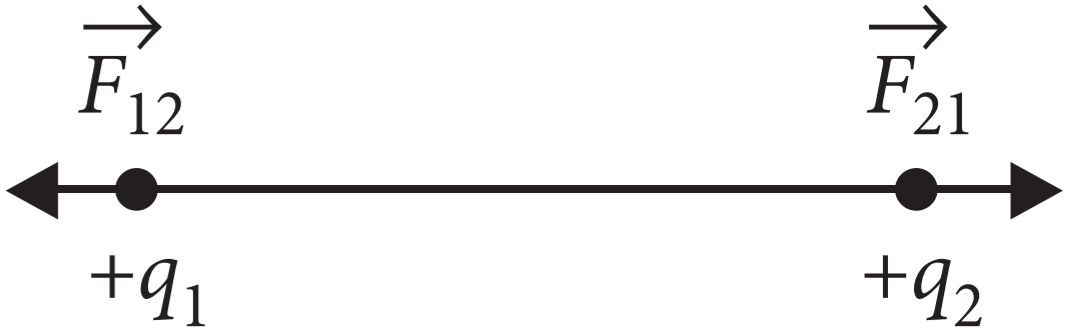
Coulomb's law states that the electrostatic force of attraction or repulsion acting between two stationary point charges is given by : $\text{F}=\frac{1}{4\pi\epsilon_0}\frac{\text{q}_1\text{q}_2}{\text{r}^2}$

Where $F$ denotes the force between two charges $q_1$ and $q_2$ separated by a distance $r$ in free space, $\epsilon_0$ is a constant known as permittivity of free space. Free space is vacuum and may be taken to be air practically. If free space is replaced by a medium, then $\epsilon_0$ is replaced by $(\epsilon_0\text{k})$ or $(\epsilon_0\epsilon_\text{r})$ where $k$ is known as dielectric constant or relative permittivity.
  1. In coulomb's law, $\text{F}=\text{k}\frac{\text{q}_1\text{q}_2}{\text{r}^2}$ then on which of the following factors does the proportionality constant $k$ depends?
  1. Electrostatic force acting between the two charges.
  2. Nature of the medium between the two charges.
  3. Magnitude of the two charges.
  4. Distance between the two charges.
  1. Dimensional formula for the permittivity constant $\epsilon_0$ of free space is:
  1. $[ML^{-3 }T^4 A^2]$
  2. $[M^{-1} L^3 T^2 A^2]$
  3. $[M^{-1} L^{-3} T^4 A^2]$
  4. $ML^{-3} T^4 A^{-2}]$
  1. The force of repulsion between two charges of $1C$ each, kept $1m$ apart in vaccum is:
  1. $\frac{1}{9\times10^9}\text{N}$
  2. $9 \times 10^9N$
  3. $9 \times 10^7N$
  4. $\frac{1}{9\times10^{12}}\text{N}$
  1. Two identical charges repel each other with a force equal to $10$ mgwt when they are $0.6m$ apart in air.$(g = 10m s^{-2})$. The value of each charge is:
  1. $2mC$
  2. $2 \times 10^{-7}mC$
  3. $2 nC$
  4. $2\mu\text{C}$
  1. Coulomb's law for the force between electric charges most closely resembles with:
  1. Law of conservation of energy.
  2. Newton's law of gravitation.
  3. Newton's $2^{nd}$ law of motion.
  4. Law of conservation of charge.
The magnetic field at a point, $10\ cm$ away from a magnetic dipole, is found to be $2.0 \times 10^{-4 }T.$ find the magnetic moment of the dipole if the point is.
  1. In end$-$on position of the dipole.
  2. In broadside$-$onposition of the dipole.
The needle of a dip circle shows an apparent dip of 45° in a particular position and 53° when the circle is rotated through 90°. Find the true dip.
An electromagnetic wave transports linear momentum as it travels through space. If an electromagnetic wave transfers a total energy $U$ to a surface in time $t,$ then total linear momentum delivered to the surface is $\text{p}=\frac{\text{U}}{\text{c}}.$ When an electromagnetic wave falls on a surface, it exerts pressure on the surface. ln $1903,$ the American scientists Nichols and Hull succeeded in measuring radiation pressures of visible light where other had failed, by making a detailed empirical analysis of the ubiquitous gas heating and ballistic effects.
  1. The pressure exerted by an electromagnetic wave of intensity $I (Wm^{-2})$ on a non$-$reflecting surface is $(c$ is the velocity of light$).$ 
  1. $\text{Ic}$
  2. $\text{Ic}^2$
  3. $\frac{\text{I}}{\text{c}}$
  4. $\frac{\text{I}}{\text{c}^2}$
  1. Light with an energy flux of $18\frac{\text{W}}{\text{cm}^2}$ falls on a non$-$reflecting surface at normal incidence. The pressure exerted on the surface is:
  1. $3\frac{\text{N}}{\text{m}^2}$
  2. $2\times10^{-4}\frac{\text{N}}{\text{m}^2}$
  3. $6\frac{\text{N}}{\text{m}^2}$
  4. $6\times10^{-4}\frac{\text{N}}{\text{m}^2}$
  1. Radiation of intensity $0.5Wm^{-2}$ are striking a metal plate. The pressure on the plate is:
  1. $0.166 \times 10^{-8}Nm^{-2}$
  2. $0.212 \times 10^{-8}Nm^{-2}​​​​​​​$
  3. $0.132 \times 10^{-8}Nm^{-2}​​​​​​​$
  4. $0.083 \times 10^{-8}Nm^{-2}​​​​​​​$
  1. A point source of electromagnetic radiation has an average power out$-$put of $1500W.$ The maximum value of electric field at a distance of 3m from this source $($in $Vm^{-1})$ is:
  1. $500$
  2. $100$
  3. $\frac{500}{3}$
  4. $\frac{250}{3}$
  1. The radiation pressure of the visible light is of the order of,
  1. $10^{-2}\frac{\text{N}}{\text{m}^2}$
  2. $10^{-4}\frac{\text{N}}{\text{m}}$
  3. $10^{-6}\frac{\text{N}}{\text{m}^2}$
  4. $10^{-8}\text{N}$
A person goes to bed at sharp 10:00 pm every day. Is it an example of periodic motion? If yes, what is the time period? If no, why?
A bar magnet makes 40 oscillations per minute in an oscillation magnetometer. An identical magnet is demagnetized completely and is placed over the magnet in the magnetometer. Find the time taken for 40 oscillations by this combination. Neglect any induced magnetism.
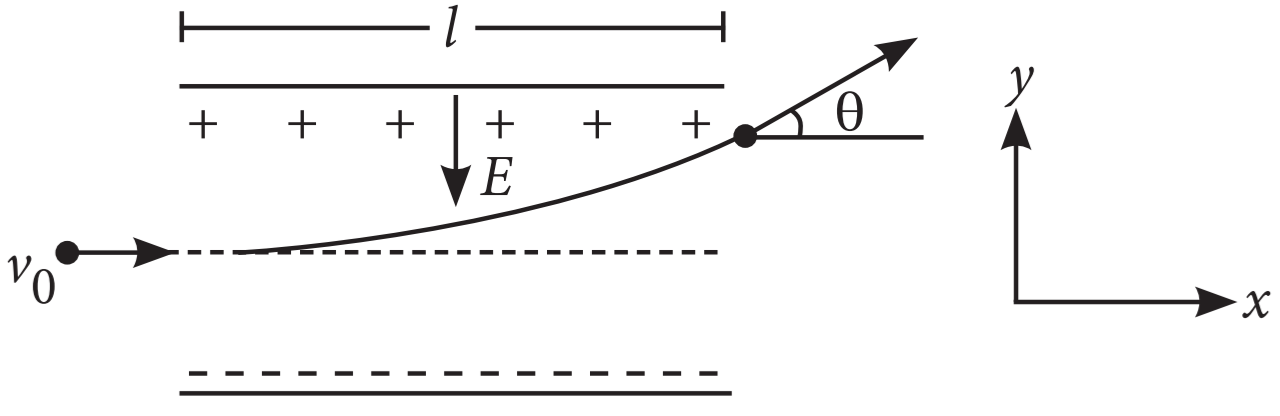
When a charged particle is placed in an electric field, it experiences an electrical force. If this is the only force on the particle, it must be the net force. The net force will cause the particle to accelerate according to Newton's second law. So $\vec{\text{F}}_\text{e}=\text{q}\vec{\text{E}}=\text{m}\vec{\text{a}}$
If $\vec{\text{E}}$ is uniform, then $\vec{\text{a}}$ is constant and $\vec{\text{a}}=\text{q}\vec{\text{E}}\text{/ m.}$ If the particle has a positive charge, its acceleration is in the direction of the field. If the particle has a negative charge, its acceleration is in the direction opposite to the electric field. Since the acceleration is constant, the kinematic equations can be used.
  1. An electron of mass $m,$ charge e falls through a distance h metre in a uniform electric field $E$. Then time of fall,
  1. $\text{t}=\sqrt{\frac{\text{2hm}}{\text{eE}}}$
  2. $\text{t}=\frac{\text{2hm}}{\text{eE}}$
  3. $\text{t}=\sqrt{\frac{\text{2eE}}{\text{hm}}}$
  4. $\text{t}=\frac{\text{2eE}}{\text{hm}}$
  1. An electron moving with a constant velocity $v$ along $X-$ axis enters a uniform electric field applied along $Y-$ axis. Then the electron moves:
  1. With uniform acceleration along $Y-$ axis
  2. Without any acceleration along $Y-$ axis
  3. In a trajectory represented as $y = ax^2$
  4. In a trajectory represented as $y = ax$
  1. Two equal and opposite charges of masses $m_1$ and $m_2$ are accelerated in an uniform electric field through the same distance. What is the ratio of their accelerations if their ratio of masses is $\frac{\text{m}_1}{\text{m}_2}=0.5?$
  1. $\frac{\text{a}_1}{\text{a}_2}=2$
  2. $\frac{\text{a}_1}{\text{a}_2}=0.5$
  3. $\frac{\text{a}_1}{\text{a}_2}=3$
  4. $\frac{\text{a}_1}{\text{a}_2}=1$
  1. A particle of mass $m$ carrying charge $q$ is kept at rest in a uniform electric field $E$ and then released. The kinetic energy gained by the particle, when it moves through a distance $y$ is:
  1. $\frac{1}{2}\text{qEy}^2$
  2. $qEy$
  3. $qEy^2$
  4. $qE^2y$
  1. $A$ charged particle is free to move in an electric field. It will travel:
  1. Always along a line of force.
  2. Along a line of force, if its initial velocity is zero.
  3. Along a line of force, if it has some initial velocity in the direction of an acute angle with the line of force.
  4. None of these.
The weight Mg of an extended body is generally shown in a diagram to act through the centre of mass. Does it mean that the earth does not attract other particles?