Question
When a ferromagnetic material goes through a hysteresis loop, its thermal energy is increased. Where does this energy come from?

Answer

When a ferromagnetic material is taken through the cycle of magnetisation, magnet dipoles of the material orient and reorient with time. This molecular motion within the material results in the production of heat, which increses thermal energy of material.

Need a full question paper?

Generate a complete, print-ready paper with questions like this in minutes — across 16+ boards, with answer keys.
Start Generating Free

Similar questions

In the year 1939, German scientist Otto Hahn and Strassmann discovered that when an uranium isotope was bombarded with a neutron, it breaks into two intermediate mass fragments. It was observed that, the sum of the masses of new fragments formed were less than the mass of the original nuclei. This difference in the mass appeared as the energy released in the process. Thus, the phenomenon of splitting of a heavy nucleus (usually A > 230) into two or more lighter nuclei by the bombardment of proton, neutron $\alpha$-particle, etc. with liberation of energy is called nuclear fission.
$\ _{92}\text{U}^{235}+\ _0\text{n}^{1}\rightarrow_{92}\text{U}^{236} \rightarrow\ _{56}\text{B}^{114}+\ _{36}\text{Kr}^{89}\ +3\ _{0}\text{n}^{1} + \text{Q}$
$\big[\because \ _{92}\text{U}^{236}= \text{Unstable nucleus}\big]$
  1. Nuclear fission can be explained on the basis of.
  1. Millikan's oil drop method
  2. Liquid drop model
  3. Shell model
  4. Bohr's model.
  1. For sustaining the nuclear fission chain reaction in a sample (of small size) of $_{92}^{235}\text{U}$ it is desirable to slow down fast neutrons by.
  1. Friction
  2. Elastic damping/ scattering
  3. Absorption
  4. None of these.
  1. Which of the following is/ are fission reaction(s)?
  1. $_0^1\text{n}\ +\ _{92}^{235}\text{U}\rightarrow\ _{92}^{235}\text{U}\rightarrow\ _{51}^{133}\text{Sb}+\ _{41}^{99}\text{nb}+\ 4_1^0\text{n}$
  2. $_0^1\text{n}\ +\ _{92}^{235}\text{U}\rightarrow\ _{54}^{1.40}\text{Xe}+\ _{38}^{94}\text{Sr}\ +2_0^1\text{n}$
  3. $_1^2\text{H}\ +\ _1^2\text{H}\rightarrow\ _2^3\text{He}+\ _0^1\text{n}$
  1. Both II and III
  2. Both I and III
  3. Only II
  4. Both I and II
  1. On an average, the number of neutrons and the energy of a neutron released per fission of a uranium atom are respectively.
  1. 2.5 and 2 keV
  2. 3 and 1 keV
  3. 2.5 and 2 MeV
  4. 2 and 2 keV
  1. In any fission process, ratio of mass of daughter nucleus to mass of parent nucleus is.
  1. Less than I
  2. Greater than I
  3. Equal to I
  4. Depends o the mass of parent nucleus.
Draw the ray diagram for the formation of image by a compound microscope and obtain the formula for magnification.
At a prayer meeting, the disciples sing JAI-RAM JAI-RAM. The sound amplified by a loudspeaker comes back after reflection from a building at a distance of 80m from the meeting. What maximum time interval can be kept between one JAI-RAM and the next JAI-RAM so that the echo does not disturb a listener sitting in the meeting. Speed of sound in air is 320m/s.
According to wave theory, the tight of any frequency can emit electrons from metallic surface provided the intensity of light be sufficient to provided necessary energy for emission of electrons, but according to experimental observations, the light of frequency less than threshold frequency can not emit electrons; whatever be the intensity of incident light. Einstein also proposed that electromagnetic radiation is quantised. If photoelectrons are ejected from a surface when light of wavelength $\lambda_1=550\text{nm}$ is incident on it. The stopping potential for such electrons is Vs = 0.19V. Suppose the radiation of wavelength $\lambda_2=190\text{nm}$ is incident on the surface.
  1. Photoelectric effect supports quantum nature oflight because.
  1. There is a minimum frequency of light below which no photoelectrons are emitted.
  2. The maximum K.E. of photoelectric depends only on the frequency oflight and not on its intensity.
  3. Even when the metal surface is faintly illuminated, the photo electrons leave the surface immediately.
  4. Electric charge of the photoelectrons is quantized.
  1. A, B, C
  2. B, C
  3. C, D
  4. A, D, C
  1. ln photoelectric effect, electrons are ejected from metals, if the incident light has a certain minimum.
  1. Wavelength.
  2. Frequency.
  3. Amplitude.
  4. Angle of incidence.
  1. Calculate the stopping potential $\text{V}_{\text{s}_2}$ of surface.
  1. 4.47
  2. 3.16
  3. 2.76
  4. 5.28
  1. Calculate the work function of the surface.
  1. 3.75
  2. 2.07
  3. 4.20
  4. 3.60
  1. Calculate the threshold frequency for the surface.
  1. 500 × 1012Hz
  2. 480 × 1013Hz
  3. 520 × 1011Hz
  4. 460 × 1013Hz
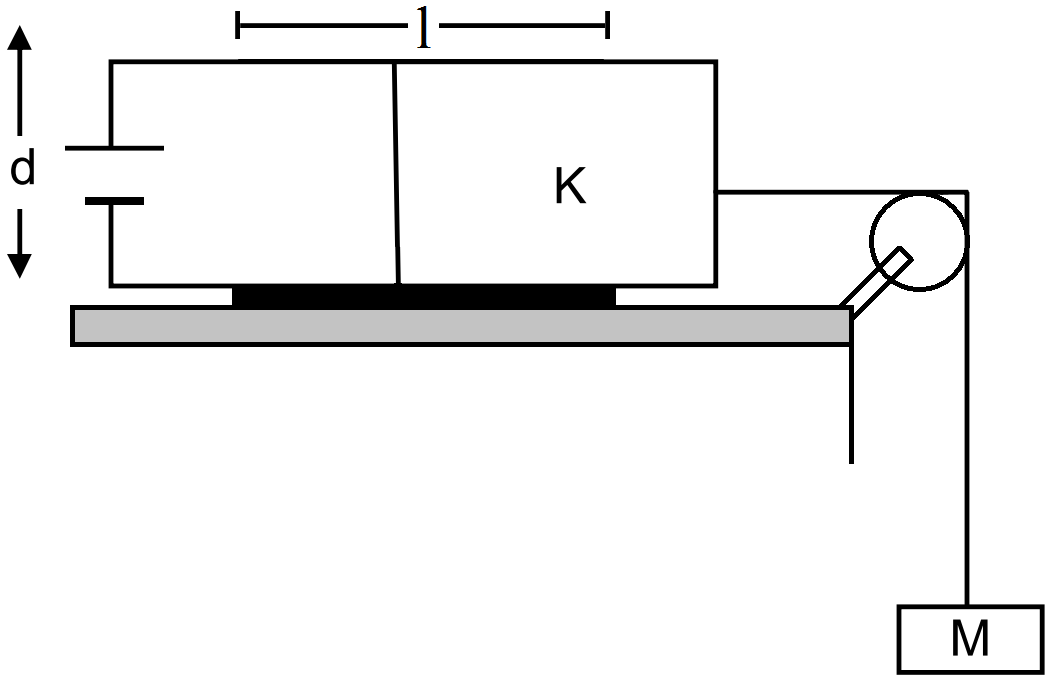
Consider the situation shown in figure. The width of each plate is b. The capacitor plates are rigidly clamped in the laboratory and connected to a battery of emf $\in.$ All surfaces are frictionless. Calculate the value of M for which the dielectric slab will stay in equilibrium.

A narrow pencil of parallel light is incident normally on a solid transparent sphere of radius r. What should be the refractive index if the pencil is to he focused.
  1. At the surface of the sphere.
  2. At the centre of the sphere.
A uniform magnetic field of 0.20 × 10-3 T exists in the space. Find the change in the magnetic scalar potential as one moves through 50cm along the field.
  1. A point-object is placed on the principal axis of a convex spherical surface of radius of curvature R, which separates the two media of refractive indices n 1 and n 2 (n 2 > n 1). Draw the ray diagram and deduce the relation between the distance of the object (u),distance of the image (v) and the radius of curvature (R) for refraction to take place at the convex spherical surface from rarer to denser medium.
  2. Use the above relation to obtain the condition on the position of the object and the radius of curvature in terms of n1 and n2 when the real image is formed.
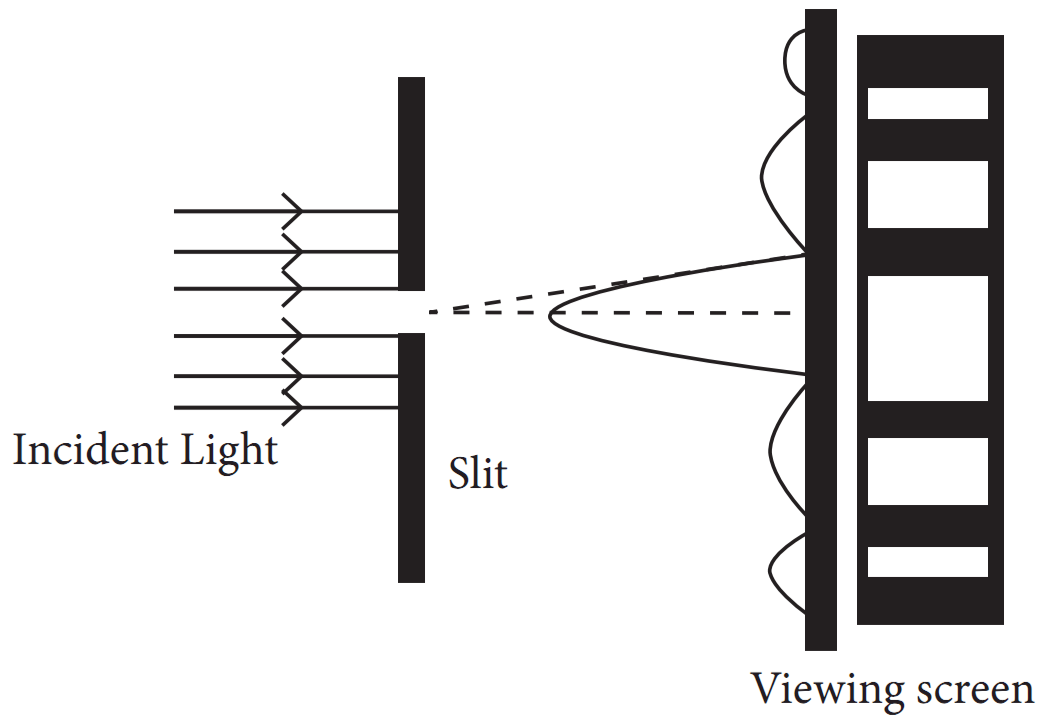
When light from a monochromatic source is incident on a single narrow slit, it gets diffracted and a pattern of ahem ate bright and dark fringes is obtained on screen, called "Diffraction Pattern" of single slit. ln diffraction pattern of single slit, it is found that.

  1. Central bright fringe is of maximum intensity and the intensity of any secondary bright fringe decreases with increase in its order.
  2. Central bright fringe is twice as wide as any other secondary bright or dark fringe.

  1. A single slit of width 0.1mm is illuminated by a parallel beam oftight of wavelength $6000\mathring{\text{A}}$ and diffraction bands are observed on a screen 0.5m from the slit. The distance of the third dark band from the central bright band is:

  1. 3mm
  2. 1.5mm
  3. 9mm
  4. 4.5mm
  1. ln Fraunhofer diffraction pattern, slit width is 0.2mm and screen is at 2m away from the lens. If wavelength of tight used is $5000\mathring{\text{A}}$ then the distance between the first minimum on either side the central maximum is:
  1. 10-1m
  2. 10-2m
  3. 2 × 10⁻²m
  4. 2 × 10⁻¹m
  1. Light of wavelength 600nm is incident normally on a slit of width 0.2mm. The angular width of central maxima in the diffraction pattern is (measured from minimum to minimum).
  1. 6 × 10⁻³rad
  2. 4 × 10⁻³rad
  3. 2.4 × 10⁻³rad
  4. 4.5 × 10⁻³rad
  1. A diffraction pattem is obtained by using a beam of red light. What will happen, if the red light is replaced by the blue light?
  1. Bands disappear
  2. Bands become broader and farther apart
  3. No change will take place
  4. Diffraction bands become narrower and crowded together.
  1. To observe diffraction, the size of the obstacle.
  1. Should be $\frac{\lambda}{2}$, where $\lambda$, is the wavelength.

  2. Should be of the order of wavelength.
  3. Has no relation to wavelength.
  4. Should be much larger than the wavelength.
Show that the magnetic field at a point due to a magnetic dipole is perpendicular to the magnetic axis if the line joining the point with the centre of the dipole makes an angle of $\tan^{-1}(\sqrt{2})$ with the magnetic axis.