Question
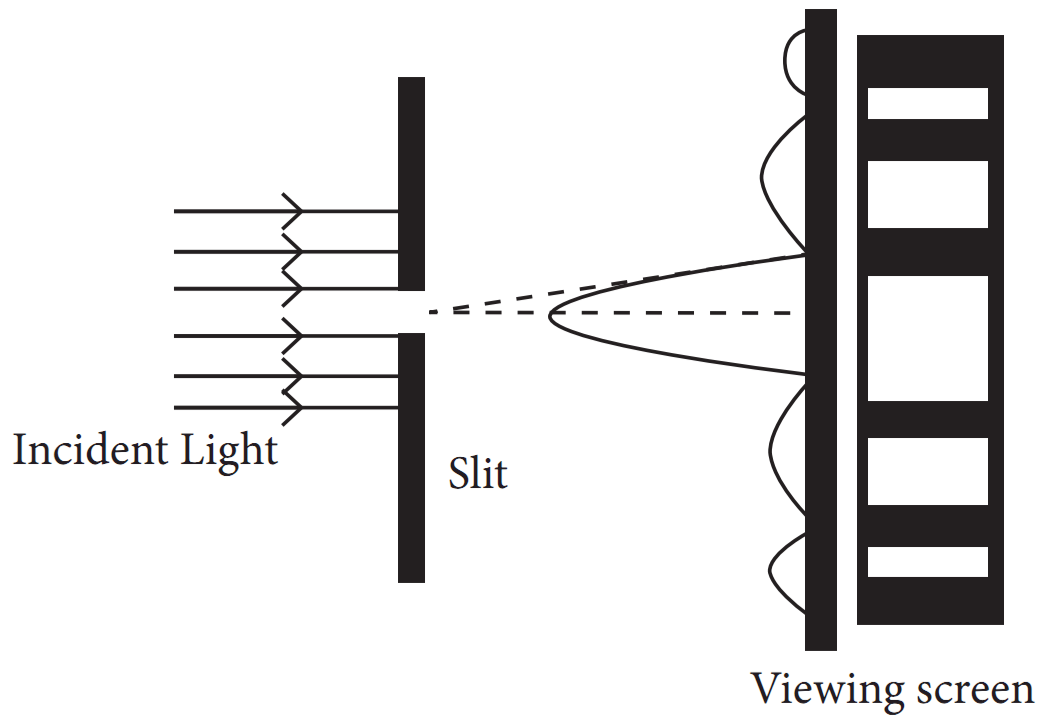
When light from a monochromatic source is incident on a single narrow slit, it gets diffracted and a pattern of ahem ate bright and dark fringes is obtained on screen, called "Diffraction Pattern" of single slit. ln diffraction pattern of single slit, it is found that.

  1. Central bright fringe is of maximum intensity and the intensity of any secondary bright fringe decreases with increase in its order.
  2. Central bright fringe is twice as wide as any other secondary bright or dark fringe.
  1. A single slit of width 0.1mm is illuminated by a parallel beam oftight of wavelength $6000\mathring{\text{A}}$ and diffraction bands are observed on a screen 0.5m from the slit. The distance of the third dark band from the central bright band is:

  1. 3mm
  2. 1.5mm
  3. 9mm
  4. 4.5mm
  1. ln Fraunhofer diffraction pattern, slit width is 0.2mm and screen is at 2m away from the lens. If wavelength of tight used is $5000\mathring{\text{A}}$ then the distance between the first minimum on either side the central maximum is:
  1. 10-1m
  2. 10-2m
  3. 2 × 10⁻²m
  4. 2 × 10⁻¹m
  1. Light of wavelength 600nm is incident normally on a slit of width 0.2mm. The angular width of central maxima in the diffraction pattern is (measured from minimum to minimum).
  1. 6 × 10⁻³rad
  2. 4 × 10⁻³rad
  3. 2.4 × 10⁻³rad
  4. 4.5 × 10⁻³rad
  1. A diffraction pattem is obtained by using a beam of red light. What will happen, if the red light is replaced by the blue light?
  1. Bands disappear
  2. Bands become broader and farther apart
  3. No change will take place
  4. Diffraction bands become narrower and crowded together.
  1. To observe diffraction, the size of the obstacle.
  1. Should be $\frac{\lambda}{2}$, where $\lambda$, is the wavelength.

  2. Should be of the order of wavelength.
  3. Has no relation to wavelength.
  4. Should be much larger than the wavelength.
Answer

  1. (c) 9mm

Explanation:

Here, $\text{d} = 0.1 \text{mm},\lambda= 6000 \mathring{\text{A}}, \text{D}=0.5\text{m}$

For third dark band, $\text{d}\sin\theta=3\lambda\ ;\ \sin\theta=\frac{3\lambda}{\text{d}}=\frac{\text{y}}{\text{D}}$

$\text{y}=\frac{3\text{D}\lambda}{\text{d}}=\frac{3\times0.5\times6\times10^{-7}}{0.1\times10^{-3}}$

$=9\times10^{-3}\text{m}=9\text{mm}$

  1. (b) 10-2m

Explanation:

Given d = 0.2mm = 0.2 × 10⁻³m, D = 2m

$\lambda=5000\mathring{\text{A}}=5\times10^{-7}\text{m}$

The distance between the first minimum on other side of the central maximum

$\text{x}=\frac{2\lambda\text{D}}{\text{d}}=\frac{2\times5\times10^{-7}\times2}{0.2\times10^{-3}}$

$\Rightarrow\text{x}=10^{-2}\text{m}$

  1. (a) 6 × 10⁻³rad

Explanation:

Here, $\lambda=600\text{nm}=6\times10^{-7}\text{m}$

$\text{a}=0.2\text{mm}=2\times10^{-4}\text{m},\theta=?$

Angular width of central maxima,

$\theta=\frac{2\lambda}{\text{a}}=\frac{2\times6\times10^{-7}}{2\times10^{-4}}=6\times10^{-3}\text{rad}$

  1. (d) Diffraction bands become narrower and crowded together.

Explanation:

When red light is replaced by blue light $(\lambda_\text{B}<\lambda_\text{R})$ the diffraction pattern bands becomes narrow and crowded together.

  1. (b) Should be of the order of wavelength.

Explanation:

To observe diffraction, the size of the obstacle should be of the order of wavelength.

Need a full question paper?

Generate a complete, print-ready paper with questions like this in minutes — across 16+ boards, with answer keys.

Start Generating Free

Similar questions

(a) An electron is revolving with a speed of 2 $\times 10^5 m / s$ in the orbit of radius $0.51 A$ in a hydrogen atom. Calculate the magnetic moment of the electron.
(b) Equivalent electric current due to orbital speed of electron.
(c) Magnetic field generated at the centre of the nucleus.
What is power factor? Explain.
To keep valuable instruments away from the earth's magnetic field, they are enclosed in iron boxes. Explain.
The mean free path of electrons in a gas in a discharge tube is inversely proportional to the pressure inside it. The Crookes dark space occupies half the length of the discharge tube when the pressure is 0.02mm of mercury. Estimate the pressure at which the dark space will fill the whole tube.
The human body has an average temperature of 98°F. Assume that the vapour pressure of the blood in the veins behaves like that of pure water. Find the minimum atmospheric pressure which is necessary to prevent the blood from boiling. Use figure. of the text for the vapour pressures.


Calculate the intensity of the electric field due to the helium nucleus at a distance of $1Å$ from it.
The weight Mg of an extended body is generally shown in a diagram to act through the centre of mass. Does it mean that the earth does not attract other particles?
Determine the current in each branch of the network shown in figure.
Image
A metal rod is placed along the axis of a solenoid carrying a high-freqμency alternating current. It is found that the rod gets heated. Explain why the rod gets heated.