MCQ
When a ferromagnetic material goes through a hysteresis loop, the magnetic susceptibility:
  1. Has a fixed value.
  2. May be zero.
  3. May be infinity.
  4. May be negative.
  • A
    $A$ and $B$
  • B
    $B$ and $D$
  • C
    $A$ and $D$
  • $B,C$ and $D$

Answer

Correct option: D.
$B,C$ and $D$
When a ferromagnetic material goes through a Hysteresis loop, the Magnetic susceptibility may be zero, may be infinity or may be negative.

Need a full question paper?

Generate a complete, print-ready paper with questions like this in minutes — across 16+ boards, with answer keys.

Start Generating Free

Similar questions

If $R$ is the radius of the earth and the acceleration due to gravity on the surface of earth is $g=\pi^2 \mathrm{~m} / \mathrm{s}^2$, then the length of the second's pendulum at a height $h=2 R$ from the surface of earth will be,:
The excess pressure inside a soap bubble is twice the excess pressure inside a second soap bubble. The volume of the first bubble is n times the volume of the second where n is:
A mass of $50\,g$ of water in a closed vessel, with surroundings at a constant temperature takes $2\, minutes$ to cool from $30\,^oC$ to $25\,^oC$. A mass of $100\,g$ of another liquid in an identical vessel with identical surroundings takes the same time to cool from $30\,^oC$ to $25\,^o C$. The specific heat of the liquid is .......... $kcal/kg$ (The water equivalent of the vessel is $30\,g$.)
A cyclist riding the bicycle at a speed of $14 \sqrt{3} \,m / s$ takes a turn around a circular road of radius $20 \sqrt{3} \,m$ without skidding. What is his inclination to the vertical?
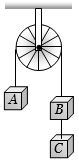
Three equal weights $A, B$ and $C$ of mass $2\, kg$ each are hanging on a string passing over a fixed frictionless pulley as shown in the figure The tension in the string connecting weights $B$ and $C$ is ........... $N$
Which of the following shows the correct relationship between the pressure $'P'$ and density $\rho $ of an ideal gas at constant temperature ?
The efficiency of a frictionless engine can be 100% only when the heat sink is:
If the period of oscillation of mass $m$ suspended from a spring is $2\, sec$, then the period of mass $4m$ will be  .... $\sec$
From a tower of height $H$, a particle is thrown vertically upwards with a speed $ u$. The time taken by the particle, to hit the ground, is $n$ times that taken by it to reach the highest point of its path. The relation between $H, u$ and $n$ is:
A train starts from rest from a station with acceleration $0.2 \,m / s ^2$ on a straight track and then comes to rest after attaining maximum speed on another station due to retardation $0.4 \,m / s ^2$. If total time spent is half an hour, then distance between two stations is [Neglect length of train]