MCQ
When a ferromagnetic material goes through a hysteresis loop, the magnetic susceptibility:
- AHas a fixed value.
- BMay be zero.
- CMay be infinity.
- DMay be negative.
Explanation:
When a ferromagnetic material goes through a Hysteresis loop, the Magnetic susceptibility may be zero, may be infinity or may be negative.
Generate a complete, print-ready paper with questions like this in minutes — across 16+ boards, with answer keys.
In N-type semiconductors, majority charge carriers are
|
(a) Holes |
(b) Protons |
(c) Neutrons |
(d) Electrons |
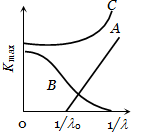
The correct graph between the maximum energy of a photoelectron and the inverse of wavelength of the incident radiation is given by the curve
|
(a) A |
(b) B |
(c) C |
(d) None of the above |
In the network of resistors shown in the adjoining figure, the equivalent resistance between A and B is

|
(a) 54 ohm |
(b) 18 ohm |
(c) 36 ohm |
(d) 9 ohm |
A small coil of N turns has area A and a current I flows through it. The magnetic dipole moment of this coil will be
|
(a) NI/A |
(b) |
(c) |
(d) NIA |
The time taken by sunlight to cross a 5 mm thick glass plate (μ = 3/2) is
|
(a) 0.25 |
(b) 0.167 |
(c) 2.5 |
(d) 1.0 |
X-rays region lies between
| (a) Short radiowave and visible region | (b) Visible and ultraviolet region |
| (c) Gamma rays and ultraviolet region | (d) Short radiowave and long radiowave |