MCQ
When a force of constant magnitude and a fixed direction acts on a moving object, then its path is
- ACircular
- BParabolic
- CStraight line
- ✓Either $(b)$ or $(c)$
$1$. To move a particle in circular motion centripetal force is required which has variable direction.
$2$. Parabolic is possible (example projectile motion)
$3$. If force is in the direction of motion or just opposite to it, path will be straight line
Generate a complete, print-ready paper with questions like this in minutes — across 16+ boards, with answer keys.
($A$) Straight bright and dark bands parallel to the $x$-axis
($B$) The region very close to the point $O$ will be dark
($C$) Hyperbolic bright and dark bands with foci symmetrically placed about $\mathrm{O}$ in the $x$-direction
($D$) Semi circular bright and dark bands centered at point $\mathrm{O}$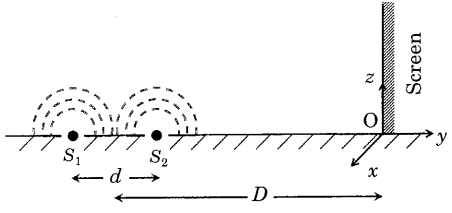
(if $\mu_{0}$ : permeability of free space and $B$ : magnetic field)