MCQ
When a hole is produced in $P-$type semiconductor, there is:
  • A
    Extra electron in valence band
  • B
    Extra electron in conduction band
  • Missing electron in valence band
  • D
    Missing electron in conduction band

Answer

Correct option: C.
Missing electron in valence band
A hole is not itself a physical quantity but a missing electron in valence band. An electron from adjacent site jumps to fill this hole and thus creates a hole at its former site. So it seems as if the hole itself has moved.

Need a full question paper?

Generate a complete, print-ready paper with questions like this in minutes — across 16+ boards, with answer keys.
Start Generating Free

Similar questions

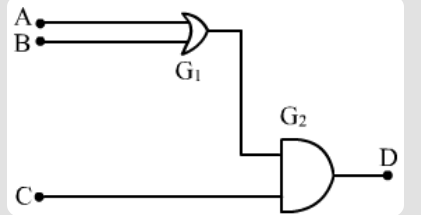
For the given combination of gates, if the logic states of inputs $\text{A, B, C}$ are as follows $A = B = C = 0$ and $A = B = 1,C = 0$ then the logic states of output $D$ are:
A capacitor of capacitance $9 n F$ having dielectric slab of $\varepsilon_{ r }=2.4$ dielectric strength $20\, MV / m$ and $P.D. =20 \,V$ then area of plates is ....... $\times 10^{-4}\, m ^{2}$
Assertion : Free electron always keep on moving in a conductor even then no magnetic force act on them in magnetic field unless a current is passed through it.
Reason : The average velocity of free electron is zero.
Consider a mixture of oxygen and hydrogen kept at room temperature. AB compared to a hydrogen molecule an oxygen molecule hits the wall:
The product of angular speed and tangential speed of electron in $n^{\text {th }}$ orbit of hydrogen atom is
A man suffering from myopia can read a book placed at 10 cm distance. For reading the book at a distance of 60 cm with relaxed vision, focal length of the lens required will be
A parallel plate air capacitor is charged to a potential difference of $V$ volts. After disconnecting the charging battery the distance between the plates of the capacitor is increased using an insulating handle. As a result the potential difference between the plates
Two resistors $A$ and $B$ have resistances $R_A$ and $R_B$, respectively, and $R_A<R_B$. The resistivities of their materials are $\rho_A$ and $\rho_{ B }$.
A negative charge is located in the uniform electric field between two plates $($not shown$).$
Where in the diagram will the electron have the greatest change in potential energy before hitting the one of the plates?
The work which is required to be done to make an arrangement of four particles each having a charge $+q$ such that the particles lie at the four corners of a square of side $a$ is .......