MCQ
When a light source of power $P$ emitting monochromatic light of wavelength $\lambda$ is kept at a distance $r$ from a photosensitive surface of work function $\phi$ and surface  area $A$, we will have wrong option :-
  • A
    the maximum energy of emitted photoelectrons as $\frac{hc}{\lambda} - \phi$
  • the stopping potential needed to stop the fastest photoelectron as $e\left[ {\frac{{hc}}{\lambda } - \phi } \right]$
  • C
    the number of photons striking the surface per unit times as $\frac{{P\lambda A}}{{4\pi hc{r^2}}}$
  • D
    All the above

Answer

Correct option: B.
the stopping potential needed to stop the fastest photoelectron as $e\left[ {\frac{{hc}}{\lambda } - \phi } \right]$
b
$\mathrm{K.E}_{.}=\mathrm{eV}_{0}=\frac{\mathrm{hc}}{\lambda}-\phi$

$\mathrm{V}_{0}=\frac{1}{\mathrm{e}}\left[\frac{\mathrm{hc}}{\lambda}-\phi\right]$

Need a full question paper?

Generate a complete, print-ready paper with questions like this in minutes — across 16+ boards, with answer keys.

Start Generating Free

Similar questions

A spider and a fly are on opposite side of surface of glass sphere. What must be the maximum range of solid angle, where the  fly can be seen by the spider. 

Given : dimension of spider and fly is very small $w.r .t.$ to sphere $RI$ of glass $μ_g = \sqrt 2$

A long wire A carries a current of 10 amp. Another long wire B, Which is parallel to A and separated by 0.1m from A, carries a current of 5 amp, in the opposite direction to that in A. what is the magnitude and nature of the force experienced per unit length of B $\left(\mu_0=4 \pi \times 10^{-7}\right.$ weber/amp -m$)$
An induction coil stores $32$ joules of magnetic energy and dissipates energy as heat at the rate of $320$ watts. When $a$ current of $4$ amperes is passed through it. Find the time constant of the circuit when the coil is joined across a battery......$s$
$A$ small source of light is $4m$ below the surface of a liquid of refractive index $5/3$. In order to cut off all the light coming out of liquid surface, minimum diameter of the disc placed on the surface of liquid is ..........$m$
Two equally charged, identical metal spheres $A$ and $B$ repel each other with a force '$F$'. The spheres are kept fixed with a distance '$r$' between them. A third identical, but uncharged sphere $C$ is brought in contact with $A$ and then placed at the mid-point of the line joining $A$ and $B$. The magnitude of the net electric force on $C$ is
Energy released in the fission of a single $_{92}{U^{235}}$ nucleus is $200\, MeV$. The fission rate of a $_{92}{U^{235}}$ fuelled reactor operating at a power level of $5\,W$ is
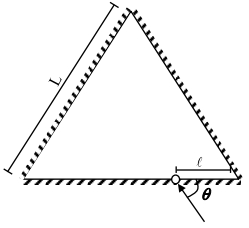
Three plane mirrors form an equilateral triangle with each side of length $L$. There is a small hole at a distance $l > 0$ from one of the comers as shown in the figure. A ray of light is passed through the hole at an angle $\theta$ and can only come out through the same hole. The cross section of the mirror configuration and the ray of light lie on the same plane.

Which of the following statement($s$) is(are) correct?

$(A)$ The ray of light will come out for $\theta=30^{\circ}$, for $0 < l < L$.

$(B)$ There is an angle for $l=\frac{L}{2}$ at which the ray of light will come out after two reflections.

$(C)$ The ray of light will $NEVER$ come out for $\theta=60^{\circ}$, and $l=\frac{L}{3}$.

$(D)$ The ray of light will come out for $\theta=60^{\circ}$, and $0 < l < \frac{L}{2}$ after six reflections.

A potentiometer has uniform potential gradient across it. Two cells connected in series
(i) to support each other and
(ii) to oppose each other are balanced over 6m and 2m respectively on the potentiometer wire.
The e.m.f.’s of the cells are in the ratio of
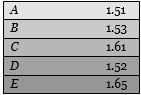
Immiscible transparent liquids $A, B, C, D$ and $E$ are placed in a rectangular container of glass with the liquids making layers according to their densities. The refractive index of the liquids are shown in the adjoining diagram. The container is illuminated from the side and a small piece of glass having refractive index $1.61$ is gently dropped into the liquid layer. The glass piece as it descends downwards will not be visible in
Identify the conclusion of the photoelectric experiment from the following.