When a load of $10 \,kg$ is suspended on a metallic wire, its length increase by $2 \,mm$. The force constant of the wire is $....... N / m$
Easy
Download our app for free and get started
Force constant $(K)=\frac{\text { Force }}{\text { Elongation }}=\frac{F}{\Delta x}$ $\left\{\begin{array}{l}F=10 \,kg =100 \,N \\ \Delta x=2 \,mm =0.002 \,m \end{array}\right.$
Substituting values
$K=\frac{100}{0.002}=5 \times 10^4 \,N / m$
Substituting values
$K=\frac{100}{0.002}=5 \times 10^4 \,N / m$

Download our appand get started for free
Experience the future of education. Simply download our apps or reach out to us for more information. Let's shape the future of learning together!No signup needed.*
Similar Questions
- 1If the force constant of a wire is $K,$ the work done in increasing the length of the wire by $l$ isView Solution
- 2A wire of length $L,$ area of cross section $A$ is hanging from a fixed support. The length of the wire changes to $L_{1}$ when mass $M$ is suspended from its free end. The expression for Young's modulus isView Solution
- 3View SolutionFour uniform wires of the same material are stretched by the same force. The dimensions of wire are as given below. The one which has the minimum elongation has
- 4View SolutionThe longitudinal strain is only possible in
- 5$Assertion :$ Stress is the internal force per unitarea of a body.View Solution
$Reason :$ Rubber is more elastic than steel. - 6A $2 \,m$ long rod of radius $1 \,cm$ which is fixed from one end is given a twist of $0.8$ radians. The shear strain developed will beView Solution
- 7In plotting stress versus strain curves for two materials $P$ and $Q$, a student by mistake puts strain on the $y$-axis and stress on the $x$-axis as shown in the figure. Then the correct statement$(s)$ is(are)View Solution
$(A)$ $P$ has more tensile strength than $Q$
$(B)$ $P$ is more ductile than $Q$
$(C)$ $P$ is more brittle than $Q$
$(D)$ The Young's modulus of $P$ is more than that of $Q$
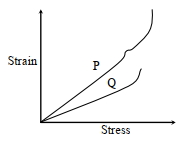
- 8The ratio of the lengths of two wires $A$ and $B$ of same material is $1 : 2$ and the ratio of their diameter is $2 : 1.$ They are stretched by the same force, then the ratio of increase in length will beView Solution
- 9A wire of length $L$ and cross-sectional area $A$ is made of a material of Young's modulus $Y.$ It is stretched by an amount $x$. The work done isView Solution
- 10The stress-strain curves are drawn for two different materials $X$ and $Y$. It is observed that the ultimate strength point and the fracture point are close to each other for material $X$ but are far apart for material $Y$. We can say that materials $X$ and $Y$ are likely to be (respectively)View Solution