MCQ
When a magnetic substance is heated, then it
  • A
    Becomes a strong magnet
  • Losses its magnetism
  • C
    Does not effect the magnetism
  • D
    Either $(a)$ or $ (c)$

Answer

Correct option: B.
Losses its magnetism
b
(b) When a magnetic substance is heated it loses its magnetic property. It is because all the atomic magnet becomes randomly oriented due to heat.

Need a full question paper?

Generate a complete, print-ready paper with questions like this in minutes — across 16+ boards, with answer keys.
Start Generating Free

Similar questions

A $12.5\,eV$ electron beam is used to bombard gaseous hydrogen at room temperature. The number of spectral lines emitted will be:
The charges on two sphere are +7mC and – 5mC respectively. They experience a force F. If each of them is given and additional charge of – 2mC, the new force of attraction will be
The modulation frequency of an $AM$ radio station is $250\, kHz$, which is $10\%$ of the carrier wave. If another $AM$ station approaches you for license what broadcast frequency will you allot?........$kHz$
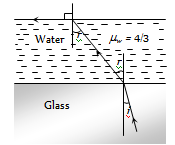
A ray of light is incident at the glass–water interface at an angle i, it emerges finally parallel to the surface of water, then the value of $\mu_{ g }$ would be
On connecting a battery to the two corners of a diagonal of a square conductor frame of side a the magnitude of the magnetic field at the centre will be 
Lenz's law is a consequence of the law of conservation of:
The wrong statement about electric lines of force is
Two ions having masses in the ratio 1 : 1 and charges 1 : 2 are projected into uniform magnetic field perpendicular to the field with speeds in the ratio 2 : 3. The ratio of the radii of circular paths along which the two particles move is
The extreme wavelengths of Paschen series are
An electric iron draws $5\, amp$, a $TV$ set draws $3\, amp$ and refrigerator draws $2\, amp$ from a $220\, volt$ main line. The three appliances are connected in parallel. If all the three are operating at the same time, the fuse used may be of ............. $amp$