MCQ
When a metal surface is illuminated by light of wavelength $5 \lambda$, the stopping potential is $8V.$ When the same surface is illuminated by light of wavelength $3 \lambda$, stopping potential is $2V.$ The threshold wavelength for this surface is $:$
  • A
    $5 \lambda$
  • B
    $3 \lambda$
  • C
    $9 \lambda$
  • D
    $4.5 \lambda$

Answer

$E=\phi+K_{\max }$
$\phi=\frac{hc}{\lambda_0}$
$K_{\max }=eV_0$
$8 e=\frac{hc}{\lambda}-\frac{hc}{\lambda_0} \ldots \ldots .(i)$
$2 e=\frac{hc}{3 \lambda}-\frac{hc}{\lambda_0} \ldots \ldots . \text { (ii) }$
on solving $(i)\ \& \ (ii) $
$\lambda_0=9 \lambda$

Need a full question paper?

Generate a complete, print-ready paper with questions like this in minutes — across 16+ boards, with answer keys.

Start Generating Free

Similar questions

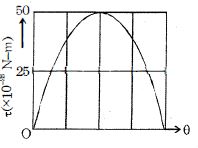
An electric dipole is placed in a uniform electric field $\vec E$ of magnitude $40\ N/C$. Graph shows the magnitude of the torque on the dipole versus the angle $\theta $ between the field  $\vec E$  and the dipole moment $\vec P$. The magnitude of dipole moment $\vec P$ is equal to 
The displacement of a particle from a point having position vector $2 \hat{i}+4 \hat{j}$ to another point having position vector $5 \hat{i}+1 \hat{j}$ is ........ units
The average $e.m.f$ induced in a coil in which the current changes from $2$ $ampere$ to $4$ $ampere$ in $0.05$ $second$ is $8$ $volt.$ What is the self inductance of the coil ?......$H$
When the amount of work done is $333\, cal$ and change in internal energy is $167\, cal$, then the heat supplied is ....... $cal$
Which of the following electromagnetic radiations have the smaller wavelength ?

X-rays b. y-rays c. UV waves d. Microwaves.

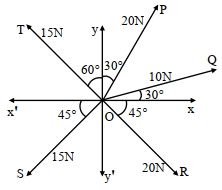
The resultant of these forces $\overrightarrow{O P}, \overrightarrow{O Q}, \overrightarrow{O R}, \overrightarrow{O S}$ and $\overrightarrow{{OT}}$ is approximately $\ldots \ldots {N}$.

[Take $\sqrt{3}=1.7, \sqrt{2}=1.4$ Given $\hat{{i}}$ and $\hat{{j}}$ unit vectors along ${x}, {y}$ axis $]$

Match the columns

  Column $-I$
    $R/H_{max}$
  Column $-II$
  Angle of projection $\theta $
   $A.$ $1$    $1.$ ${60^o}$
   $B.$ $4$    $2.$ ${30^o}$
   $C.$ $4\sqrt 3$    $3.$ ${45^o}$
   $D.$ $\frac {4}{\sqrt 3}$    $4.$ $tan^{-1}\,4\,=\,{76^o}$


Two bodies $M$ and $N $ of equal masses are suspended from two separate massless springs of force constants $k_1$ and $k_2$ respectively. If the two bodies oscillate vertically such that their maximum velocities are equal, the ratio of the amplitude $M$ to that of $N$ is
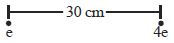
In given diagram. Find distance of neutral point from particle of charge $e$ is......$cm$
Consider the magnetic field produced by a finitely long current carrying wire.