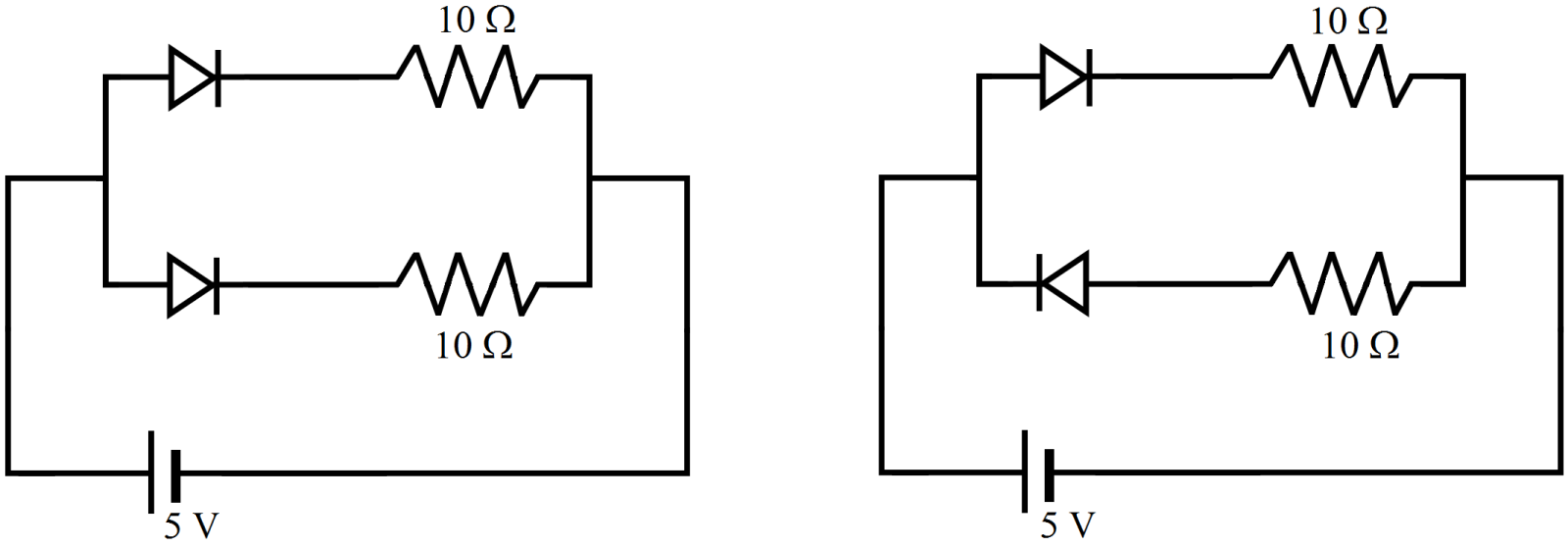
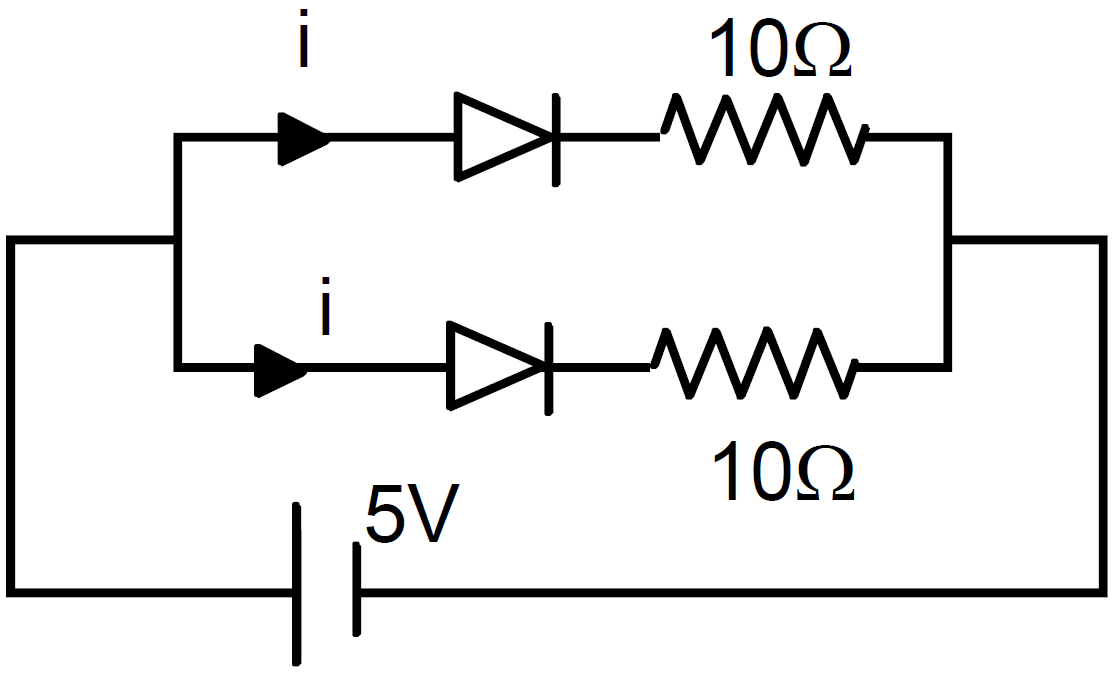
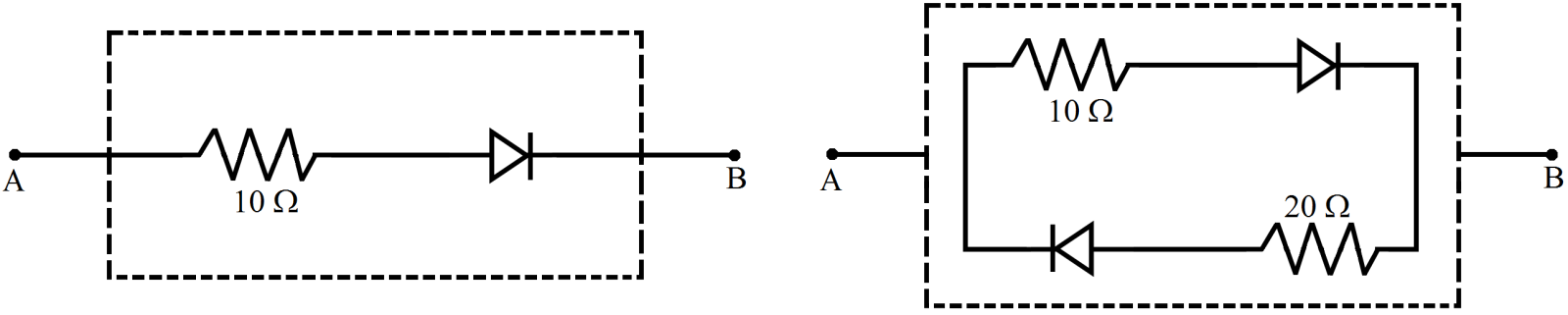
$\text{i}=\frac{5}{\frac{10\times10}{10+10}}=\frac{5}{5}=1\text{A}$
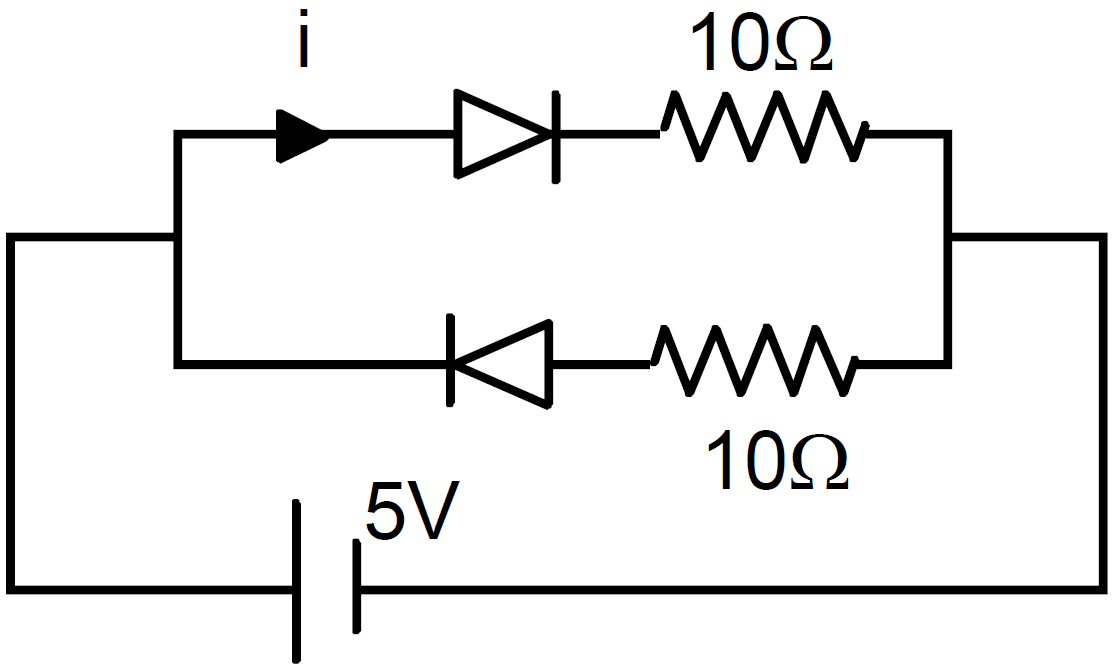
One diode is forward biased and other is reverse biased.

$\text{i}=\frac{\text{V}}{\text{R}_\text{net}}=\frac{5}{10+0}=\frac{1}{2}=0.5\text{A}$
14 questions · self-marked practice — reveal the answer and mark yourself.


$\text{V}_0=\text{I}_\text{c}\times\text{R}_\text{L}$
$\because\text{I}_\text{c}=\beta\times\text{I}_\text{b}$
$\therefore\text{V}_0=\beta\times\text{I}_\text{b}\times\text{R}_\text{L}$
$\Rightarrow\text{V}_0=50\times50\mu\text{A}\times2\text{k}\Omega$
$\Rightarrow\text{V}_0=5\text{V}$
$\delta\text{V}_\text{i}=\delta\text{l}_\text{b}\times\text{R}_\text{i}$
$\Rightarrow\delta\text{V}_\text{i}=50\times10^{-6}\times5\times10^2$
$\Rightarrow\delta\text{V}_\text{i}=25\times10^{-3}$
$\Rightarrow\delta\text{V}_\text{i}=25\text{mV}$
$\beta^2\times\frac{\text{R}_\text{L}}{\text{R}_\text{i}}$
$\Rightarrow2500\times\frac{2}{0.5}$
$\Rightarrow2500\times\frac{20}{5}=10^4.$
$\text{X}=1.\Big(\overline{0.1}\Big)+0\Big(\overline{1.1}\Big)+1\Big(\overline1.0\Big)$
$=1.\bar{0}+0.\bar{1}+1.\bar{0}$
$=1.1+0.0+1.1$
$=1+0+1$
$=1+1$
$=1$
$\text{X}=1\Big(\overline{1.1}\Big)+1\Big(\overline{1.1}\Big)+1\Big(\overline{1.1}\Big)$
$=1.\bar{1}+1.\bar{1}+1.\bar{1}$
$=1.0+1.0+1.0$
$=0+0+0$
$=0$
$\text{X}=0\Big(\overline{0.0}\Big)+0\Big(\overline{0.0}\Big)+0\Big(\overline{1.1}\Big)$
$=0.\bar{0}+0.\bar{0}+0.\bar{0}$
$=0.1+0.1+0.1$
$=0+0+0$
$=0.$
$\text{i}=\text{i}_0\text{e}^{\frac{\text{eV}}{\text{KT}}-1}$ $=20\times10^{-6}\Big(\text{e}^{\frac{100}{8.62}}-1\Big)=2.18\text{A}=2\text{A}.$
$\Rightarrow\text{e}^{\frac{\text{V}\times10^3}{8.62\times3}}-1=\frac{4\times10^6}{20}$
$\Rightarrow\text{e}^{\frac{\text{V}\times10^3}{8.62\times3}}=200001\Rightarrow\frac{\text{V}\times10^{3}}{8.62\times3}=12.2060$
$\Rightarrow\text{V}=315\text{mV}=318\text{mV}.$
When in unbiased condition drift current = diffusion current
$\therefore$ Diffusion current $=25\mu\text{A}.$
x - Drift current = Forward biasing current
$\Rightarrow\text{x}-25\mu\text{A}=75\mu\text{A}$
$\Rightarrow\text{x}=(75+25)\mu\text{A}=100\mu\text{A}.$

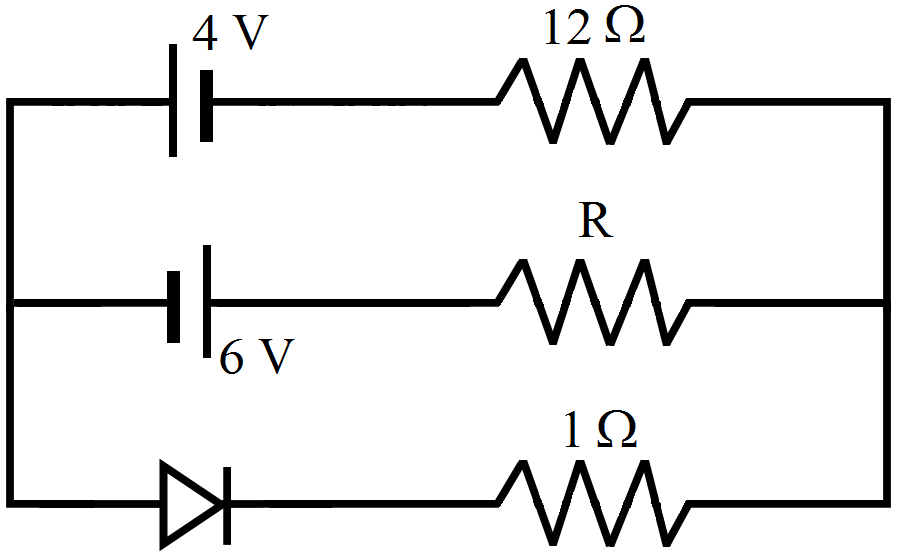
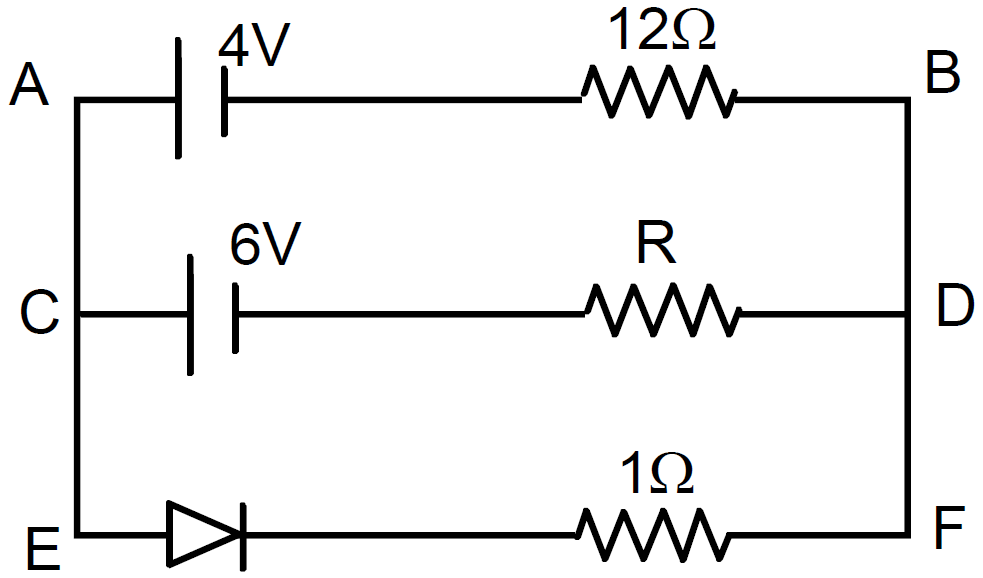
The wire EF becomes ineffective due to the net (-)ve voltage.
Hence, current through $\text{R}=\frac{10}{24}=0.4166=042\text{A}.$
$\text{i}=\frac{10}{(48+12)}=\frac{10}{60}=0.16\text{A}.$
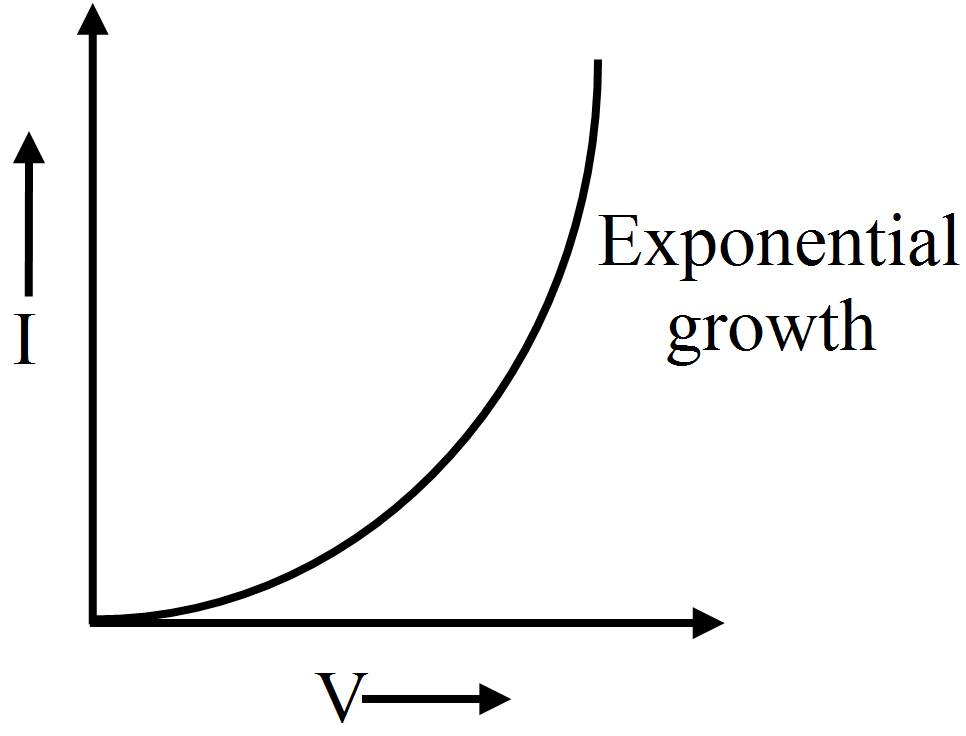
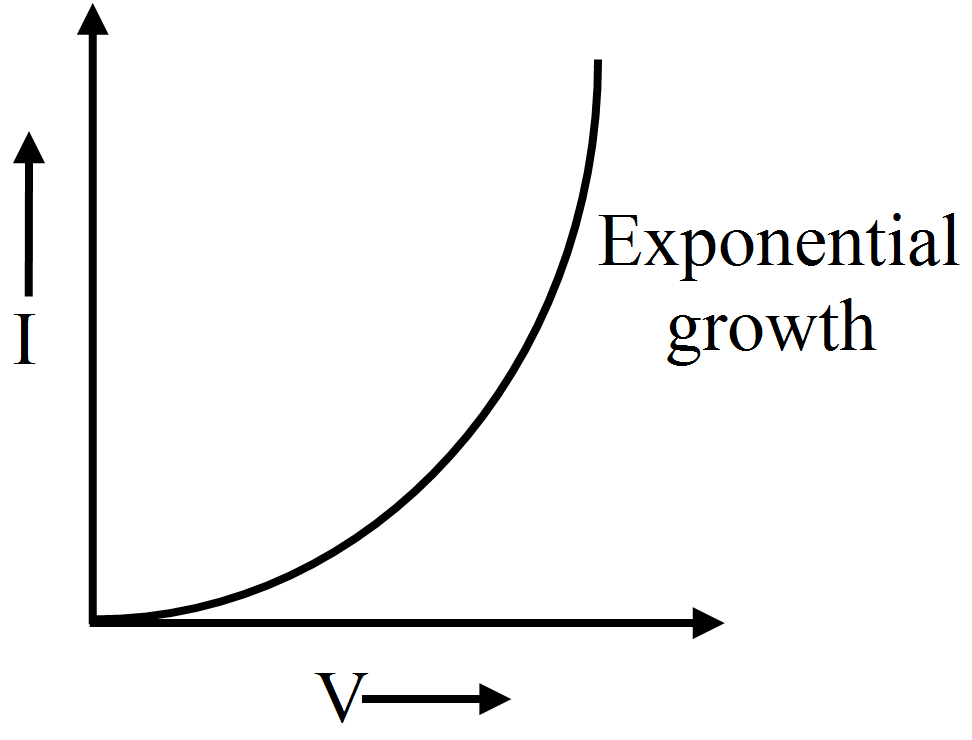
For a large value of voltage, 1 can be neglected.
$\text{i}\approx\text{i}_0\text{e}^{\frac{\text{eV}}{\text{KT}}}$
Again, we need to find the voltage at which
$\text{e}^{\frac{\text{eV}}{\text{KT}}}=100$
$\Rightarrow\frac{\text{eV}}{\text{kT}}=\text{In }100$
$\Rightarrow\text{V}=\frac{\text{In }100\times\text{kT}}{\text{e}}$
$\Rightarrow\text{V}=\frac{2.303\times\log\ 100\times8.62\times10^{-5}\times300}{\text{e}}$
$\Rightarrow\text{V}=0.12\text{V}$
$\text{i}=\text{i}_0\Big(\text{e}^{\frac{\text{eV}}{\text{kT}-1}}\Big)\ ...(1)$
We know that the dynamic resistance of a diode is the rate of change of voltage w.r.t. current.
i.e. $\text{R}=\frac{\text{dV}}{\text{di}}$
As the exponential factor dominates the factor of 1, we can neglect this factor.
Now, on differentiating eq. (1) w.r.t. V, we get,
$\frac{\text{di}}{\text{dV}}=\text{i}_0\frac{\text{e}}{\text{kT}}\text{e}^{\frac{\text{eV}}{\text{kT}}}$
$\Rightarrow\frac{1}{\text{R}}=\frac{\text{ei}_0}{\text{kT}}\text{e}^{\frac{\text{eV}}{\text{kT}}}$
$\Rightarrow\text{R}=\frac{\text{kT}}{\text{ei}_0}\text{e}^{\frac{-\text{eV}}{\text{kT}}}\ ...(2)$
$\text{R}=2\Omega$
On substituting this value in eq. (2), we get
$2=\frac{8.62\times10^{-5}\times300}{\text{e}\times10\times10^{-6}}\text{e}^{\frac{\text{-eV}}{8.62\times10^{-5}\times300}}$
$\Rightarrow\text{V}=0.25\text{V}.$
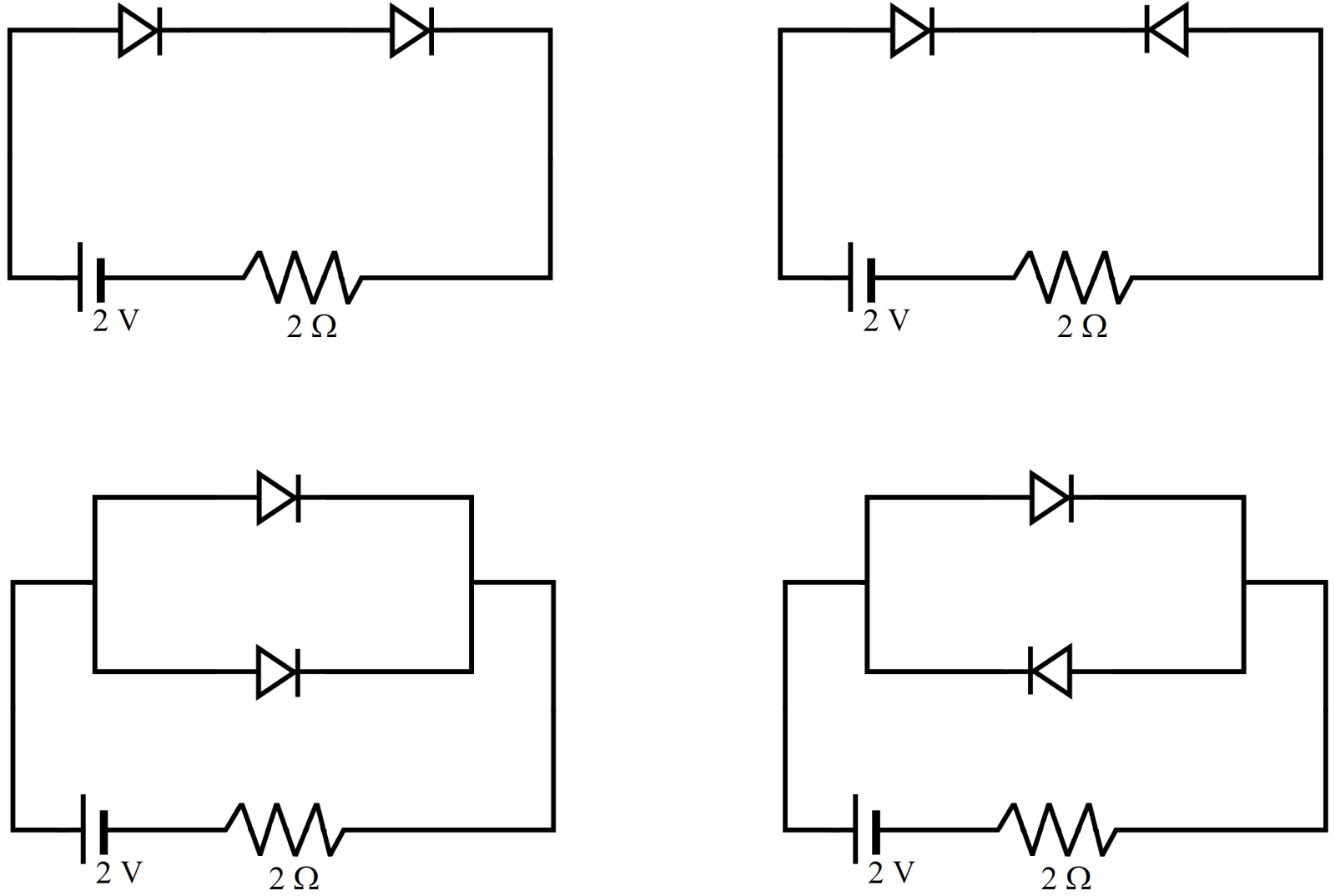
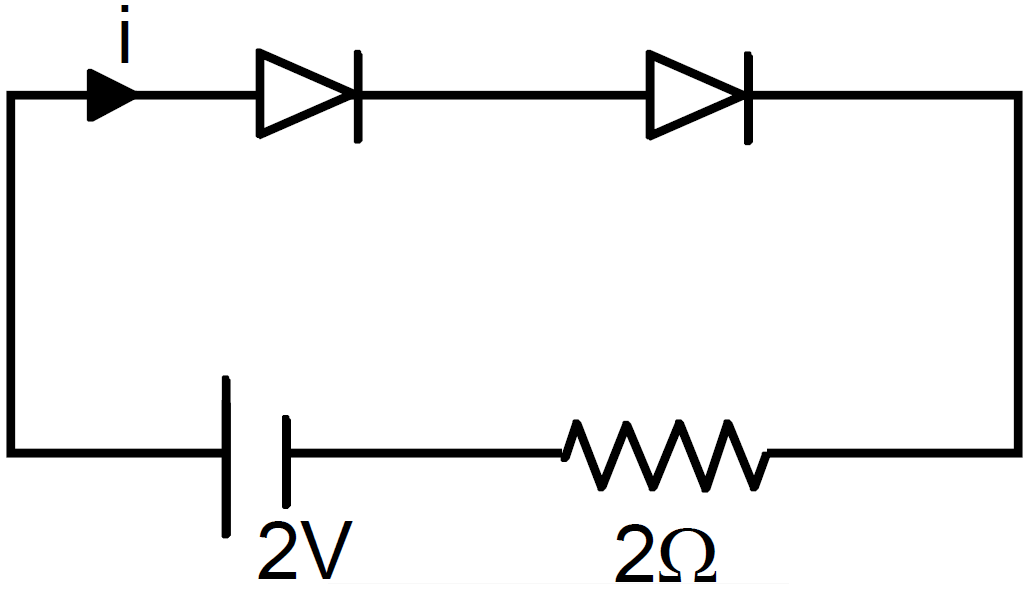
$\text{i}=\frac{2\text{V}}{2\Omega}=1\text{A}$
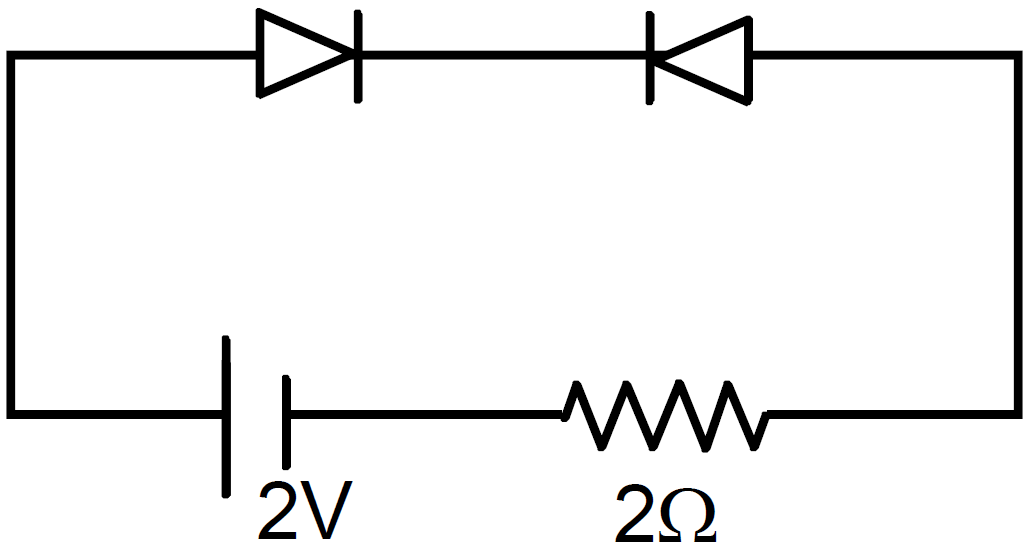
Thus the resistance of one becomes $\infty.$

$\text{i}=\frac{2}{2+\infty}=0\text{A}$
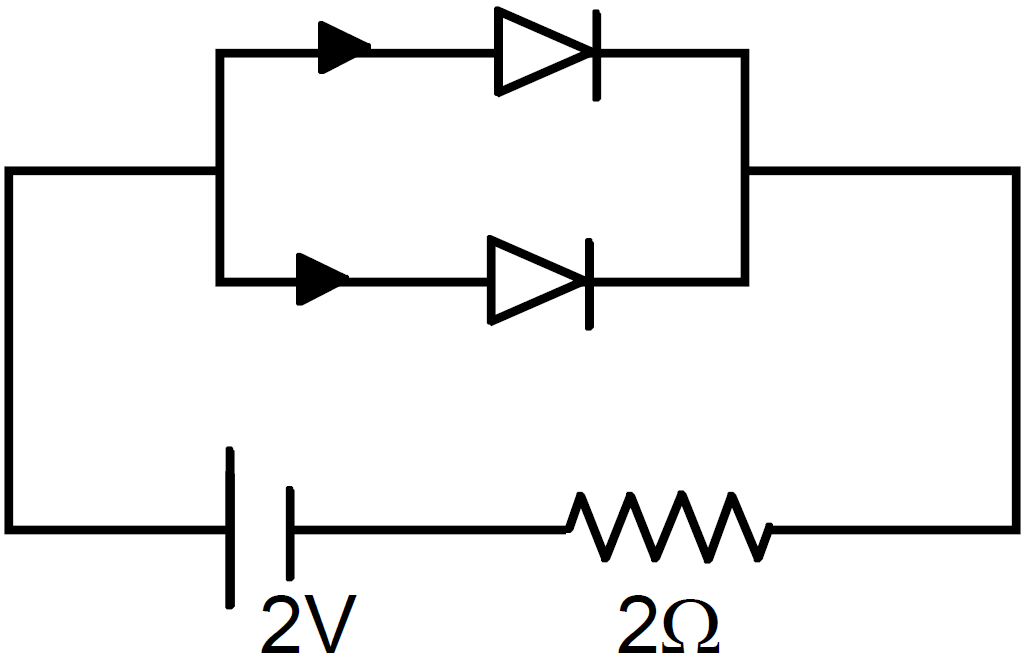
Both are forward biased.
Thus the resistance is 0.

$\text{i}=\frac{2}{2}=1\text{A}.$
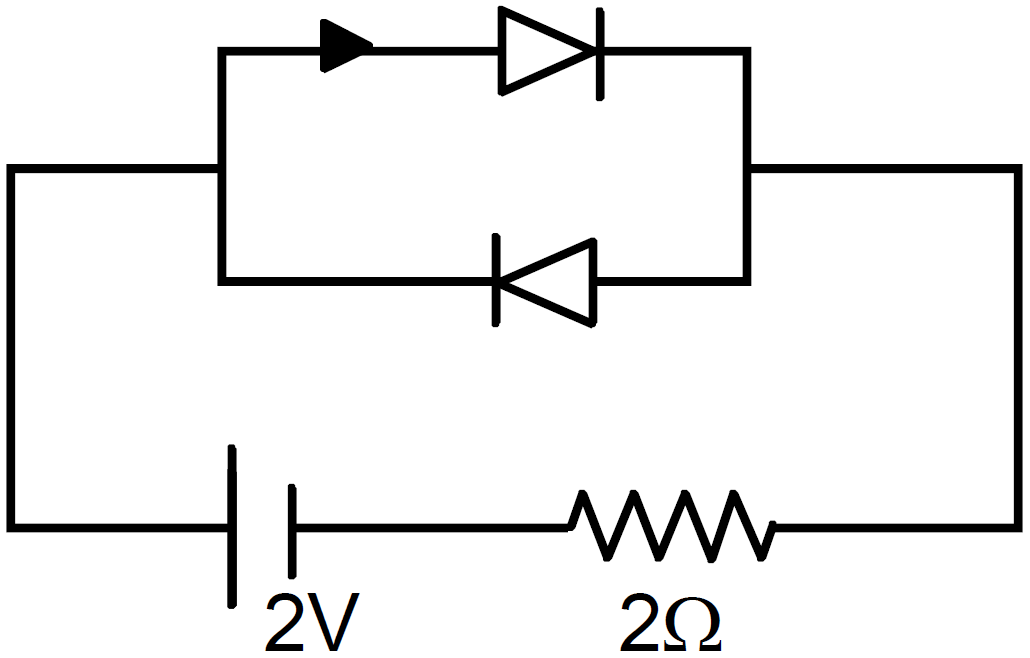
One is forward biased and other is reverse biased.
Thus the current passes through the forward biased diode.

$\therefore\text{i}=\frac{2}{2}=1\text{A}.$