Question
When a p-n junction is reverse-biased, the current becomes almost constant at $25\mu\text{A}.$ When it is forwardbiased at 200mV, a current of $75\mu\text{A}$ is obtained. Find the magnitude of diffusion current when the diode is,
  1. Unbiased.
  2. Reverse-biased at 200mV.
  3. Forward-biased at 200mV.

Answer

  1. $\text{i}_1=25\mu\text{A},\text{V}=200\text{mV},\text{i}_2=75\mu\text{A}$
When in unbiased condition drift current = diffusion current

$\therefore$ Diffusion current $=25\mu\text{A}.$
  1. On reverse biasing the diffusion current becomes ‘O’.
  2. On forward biasing the actual current be x.
x - Drift current = Forward biasing current

$\Rightarrow\text{x}-25\mu\text{A}=75\mu\text{A}$

$\Rightarrow\text{x}=(75+25)\mu\text{A}=100\mu\text{A}.$

Need a full question paper?

Generate a complete, print-ready paper with questions like this in minutes — across 16+ boards, with answer keys.

Start Generating Free

Similar questions

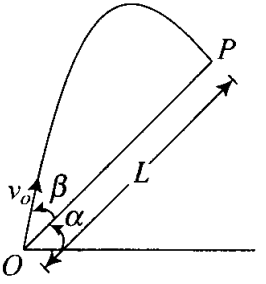
A particle is projected in air at an angle $\beta$ to a surface which itself is inclined at an angle $\alpha$ to the horizontal (Fig.).
  1. β at which range will be maximum.
(Hint: This problem can be solved in two different ways:
  1. Point P at which particle hits the plane can be seen as intersection of its trajectory (parobola) and straight line. Remember particle is projected at an angle $(\alpha+\beta)$ w.r.t. horizontal.
  2. We can take x-direction along the plane and y-direction perpendicular to the plane. In that case resolve g (acceleration due to gravity) in two differrent components, $g_x$ along the plane and $g_y$ perpendicular to the plane. Now the problem can be solved as two independent motions in x and y directions respectively with time as a common parameter.)
It is a well known fact that during a total solar eclipse the disk of the moon almost completely covers the disk of the Sun. From this fact and from the information you can gather from examples $2.3$ and $2.4$, determine the approximate diameter of the moon.
A ballon has $5.0g$ mole of helium at $7^\circ C$. Calculate.
  1. The number of atoms of helium in the balloon,
  2. The total internal energy of the system.
Use the formula $\text{v}=\sqrt{\frac{\gamma\text{P}}{\rho}}$ to explain why the speed of sound in air:
Increases with humidity.
When an electron goes from the valence band to the conduction band in silicon, its energy is increased by 1.1eV. The average energy exchanged in a thermal collision is of the order of kT which is only 0.026eV at room temperature. How is a thermal collision able to take some of the electrons from the valence band to the conduction band?
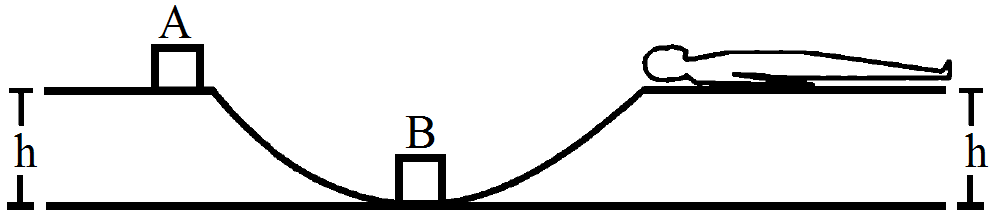
The track shown in figure is frictionless. The block B of mass $2m$ is lying at rest and the block A of mass m is pushed along the track with some speed. The collision between A and B is perfectly elastic. With what velocity should the block A be started to get the sleeping man awakened?
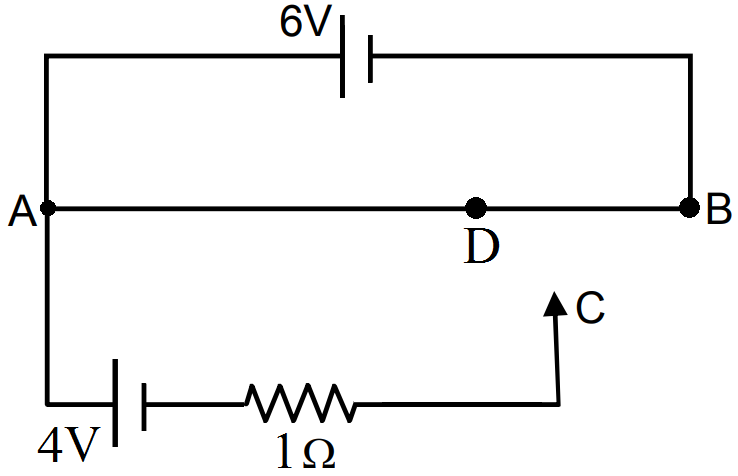
A 6 volt battery of negligible internal resistance is connected across a uniform wire AB of length $100cm$. The positive terminal of another battery of emf $4V$ and internal resistance $1\Omega$ is joined to the point A, as shown in the figure. Take the potential at B to be zero. (a) What are the potentials at the points A and C? (b) At which point D of the wire AB, the potential is equal to the potential at C? (c) If the points C and D are connected by a wire, what will be the current through it? (d) If the $4V$ battery is replaced by a $7.5V$ battery, what would be the answers of parts (a) and (b)?
One end of a $10cm$ long silk thread is fixed to a large vertical surface of a charged nonconducting plate and the other end is fastened to a small ball having a mass of $10g$ and a charge of $4.0 \times 10^{-5}C$. In equilibrium, the thread makes an angle of $60°$ with the vertical. Find the surface charge density on the plate.
The initial pressure and volume of a given mass of a gas $\Big(\frac{\text{C}_\text{P}}{\text{C}_\text{V}}=\gamma\Big)$ are $P_0$ and $V_0$. The gas can exchange heat with the surrounding.
  1. It is slowly compressed to a volume $\frac{\text{V}_0}{2}$ and then suddenly compressed to $\frac{\text{V}_0}{4}.$ Find the final pressure.
  2. If the gas is suddenly compressed from the volume $V_0$ to $\frac{\text{V}_0}{2}$ and then slowly compressed to $\frac{\text{V}_0}{4},$ what will be the final pressure?
The driver of a three-wheeler moving with a speed of 36km/h sees a child standing in the middle of the road and brings his vehicle to rest in 4.0s just in time to save the child. What is the average retarding force on the vehicle ? The mass of the three-wheeler is 400kg and the mass of the driver is 65kg.