Question
It is a well known fact that during a total solar eclipse the disk of the moon almost completely covers the disk of the Sun. From this fact and from the information you can gather from examples $2.3$ and $2.4$, determine the approximate diameter of the moon.
Answer

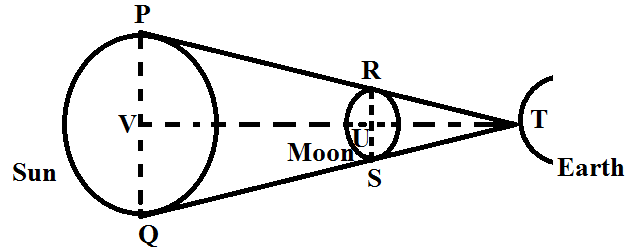
The position of the Sun, Moon, and Earth during a lunar eclipse is shown in the given figure.

Distance of the Moon from the Earth $=3.84 \times 10^8 \mathrm{~m}$ Distance of the Sun from the Earth $=1.496 \times 10^{11} \mathrm{~m}$ Diameter of the Sun $=1.39 \times 10^9 \mathrm{~m}$ It can be observed that $\Delta \mathrm{TRS}$ and $\Delta \mathrm{TPQ}$ are similar. Hence, it can be written as: $\mathrm{PQ} / \mathrm{RS}=$ VT/UT $1.39 \times 10^9 /$ RS $=1.496 \times 10^{11} / 3.84 \times 10^8 \mathrm{RS}=(1.39 \times 3.84 / 1.496) \times 10^6=3.57 \times 10^6 \mathrm{~m}$ Hence, the diameter of the Moon is $3.57 \times 10^6 \mathrm{~m}$

Need a full question paper?

Generate a complete, print-ready paper with questions like this in minutes — across 16+ boards, with answer keys.

Start Generating Free

Similar questions

A moving car encounters air resistance which is proportional to the square of the speed of the car. What is the ratio of the power required at $40kmh^{-1}$ to that required at $80kmh^{-1}$ with the same braking force?
A sitar wire is under a tension of 40N and the length between the bridges is 70cm. A 5m sample of the wire has a mass of 1.0g. Deduce the speed of transverse waves on the wire, frequency of the fundamental and the frequency of the first two harmonics.
A tube of length $L$ is filled completely with an incompressible liquid of mass $M$ and closed at both the ends. The tube is then rotated in a horizontal plane about one of its ends with a uniform angular velocity $\omega$. Determine the force exerted by the liquid at the other end.
A 3m long ladder weighing 20 kg leans on a frictionless wall. Its feet rest on the floor 1 m from the wall as shown in Fig.6.27. Find the reaction forces of the wall and the floor.
Define conservative and non$-$conservative forces. Give example and properties of conservative forces. A $5\ kg$ rifle fires a $58$ bullet with a speed of $500ms^{-1}$. What kinetic energy is acquired.
  1. By the bullet and.
  2. By the rifle?
  3. Find the the ratio of the distance which the rifle moves backward while the bullet is in the barrel to the distance the bullet moves forward.
The electric field in a region is given by $\overrightarrow{\text{E}}=\frac{\text{E}_0\text{x}}{\text{l}}\vec{\text{i}}.$ Find the charge contained inside a cubical volume bounded by the surfaces $x = 0, x = a, y = 0, y = a, z = 0$ and $z = a$. Take $E_0 = 5 \times 10^3Nc^{-1}, l = 2cm$ and $a = 1cm$.
A block of mass m slips on a rough horizontal table under the action of a horizontal force applied to it. The coefficient of friction between the block and the table is $\mu.$ The table does not move on the floor. Find the total frictional force applied by the floor on the legs of the table. Do you need the friction coefficient between the table and the floor or the mass of the table?
Find the maximum magnifying power of a compound Microscope having a $25$ diopter lens as the objective, a $5$ diopter lens as the eyepiece and the separation $30cm$ between the two lenses. The least distance for clear vision is $25cm$.
Show that for a projectile the angle between the velocity and the x-axis as a function of time is given by, $\theta(\text{t})=\tan^{-1}\Big(\frac{\text{u}_\text{oy}-\text{gt}}{\text{u}_\text{ox}}\Big)$
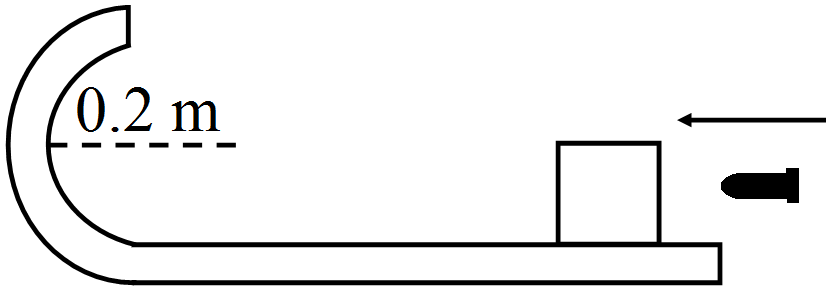
A bullet of mass $10g$ moving horizontally at a speed of $5017m/s$ strikes a block of mass $490g$ kept on a frictionless track as shown in figure. The bullet remains inside the block and the system proceeds towards the semicircular track of radius $0.2m$. Where will the block strike the horizontal part after leaving the semicircular track ?