Question
When a p-n junction is reverse-biased, the current becomes almost constant at $25\mu\text{A}.$ When it is forwardbiased at 200mV, a current of $75\mu\text{A}$ is obtained. Find the magnitude of diffusion current when the diode is,
  1. Unbiased.
  2. Reverse-biased at 200mV.
  3. Forward-biased at 200mV.

Answer

  1. $\text{i}_1=25\mu\text{A},\text{V}=200\text{mV},\text{i}_2=75\mu\text{A}$
When in unbiased condition drift current = diffusion current

$\therefore$ Diffusion current $=25\mu\text{A}.$
  1. On reverse biasing the diffusion current becomes ‘O’.
  2. On forward biasing the actual current be x.
x - Drift current = Forward biasing current

$\Rightarrow\text{x}-25\mu\text{A}=75\mu\text{A}$

$\Rightarrow\text{x}=(75+25)\mu\text{A}=100\mu\text{A}.$

Need a full question paper?

Generate a complete, print-ready paper with questions like this in minutes — across 16+ boards, with answer keys.

Start Generating Free

Similar questions

Define induction coefficient. Explain the phenomenon of mutual inductance with the help of an experiment. Obtain an expression for mutual inductance coefficient of two solenoids and prove that $M=\sqrt{L_1 L_2}$.
A neutron star has a density equal to that of the nuclear matter. Assuming the star to be spherical, find the radius of a neutron star whose mass is $4.0 \times 10^{30}kg$ (twice the mass of the sun).
Write Einstein's photoelectric equation and explain any two observations related to the photoelectric effect.
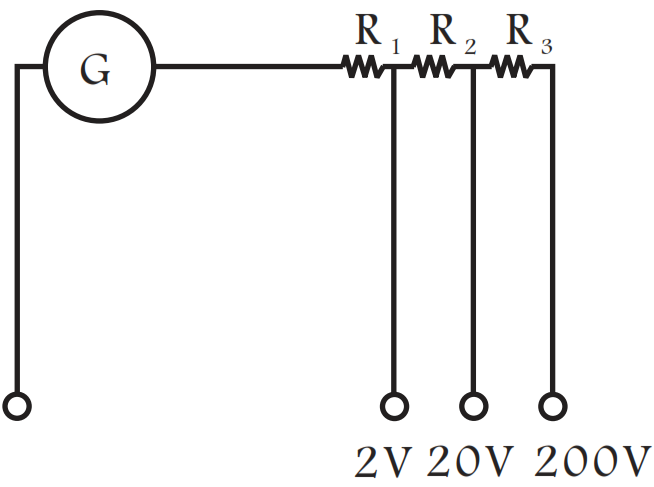
A multirange voltmeter can be constructed by using a galvanometer circuit as shown in Fig. We want to construct a voltmeter that can measure 2V, 20V and 200V using a galvanometer of resistance 10Ω and that produces maximum deflection for current of 1mA. Find $R_1, R_2$ and $R_3$ that have to be used.
Suppose the particle of the previous problem has a mass m and a speed v before the collision and it sticks to the rod after the collision. The rod has a mass M:
  1. Find the velocity of the centre of mass C of the system constituting ''The rod plus the particle''.
  2. Find the velocity of the particle with respect to C before the collision.
  3. Find the velocity of the rod with respect to C before the collision.
  4. Find the angular momentum of the particle and of the rod about the centre of mass C before the collision.
  5. Find the moment of inertia of the system about the vertical axis through the centre of mass C after the collision.
  6. Find the velocity of the centre of mass C and the angular velocity of the system about the centre of mass after the collision.
A circular loop of string rotates about its axis on a frictionless horizontal plane at a uniform rate so that the tangential speed of any particle of the string is v. If a small transverse disturbance is produced at. a point of the loop, with what speed (relative to the string) will this disturbance travel on the string?
A beam of monochromatic light of wavelength $\lambda$ ejects photoelectrons from a cesium surface $\big(\Phi=1.9\text{eV}\big).$ These photoelectrons are made to collide with hydrogen atoms in ground state. Find the maximum value of $\lambda$ for which (a) hydrogen atoms may be ionized, (b) hydrogen atoms may get excited from the ground state to the first excited state and (c) the excited hydrogen atoms may emit visible light.
A paisa coin is made up of Al-Mg alloy and weighs 0.75g. It has a square shape and its diagonal measures 17mm. It is electrically neutral and contains equal amounts of positive and negative charges.
Treating the paisa coins made up of only Al, find the magnitude of equal number of positive and negative charges. What conclusion do you draw from this magnitude?
Consider a metal exposed to light of wavelength 600nm. The maximum energy of the electron doubles when light of wavelength 400snm is used. Find the work function in eV.
A spherical capacitor has an inner sphere of radius 12cm and an outer sphere of radius 13cm. The outer sphere is earthed and the inner sphere is given a charge of 2.5µC. The space between the concentric spheres is filled with a liquid of dielectric constant 32.
  1. Determine the capacitance of the capacitor.
  2. What is the potential of the inner sphere?
  3. Compare the capacitance of this capacitor with that of an isolated sphere of radius 12cm. Explain why the latter is much smaller.