Question
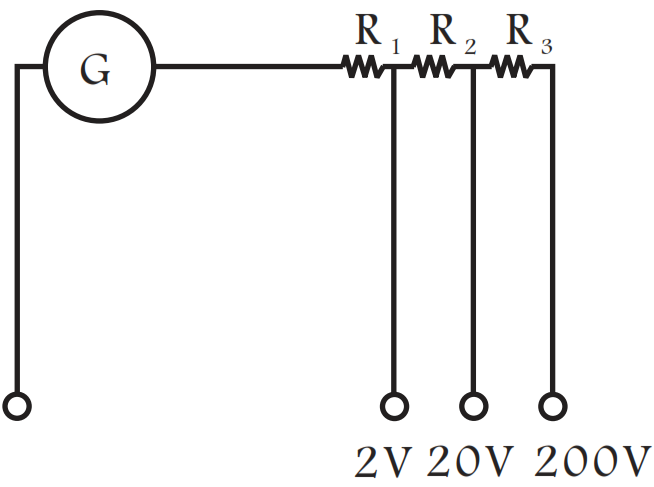
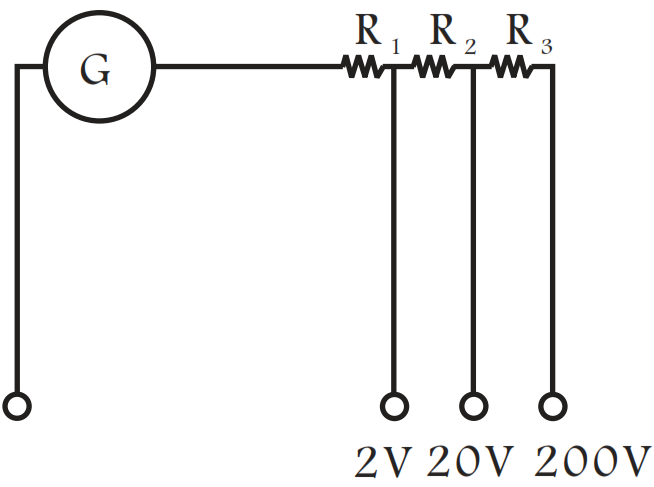
A multirange voltmeter can be constructed by using a galvanometer circuit as shown in Fig. We want to construct a voltmeter that can measure 2V, 20V and 200V using a galvanometer of resistance 10Ω and that produces maximum deflection for current of 1mA. Find $R_1, R_2$ and $R_3$ that have to be used.
Answer

Key concept: The galvanometer can also be used as a voltmeter to measure the voltage across a given section of the circuit. For this a very high resistance wire is to be connected in series with galvanometer. The relationship is given by $I_g(G + R)$ where $I_g$ is the range of galvanometer, G is the resistance of galvanometer and R is the resistance of wire connected in series with galvanometer.

Applying expression in different situations
For $I_g(G + R_1) = 2$ for 2V range
For $I_g(G + R_1 + R_2) = 20$ for 20V range
And For $I_g(G + R_1 + R_2 + R_3) = 200$  for 200V range
By solving, we get
$R_1 = 1990Ω, R_2 = 18kΩ$ and $R_3 = 180kΩ.$

Need a full question paper?

Generate a complete, print-ready paper with questions like this in minutes — across 16+ boards, with answer keys.

Start Generating Free

Similar questions

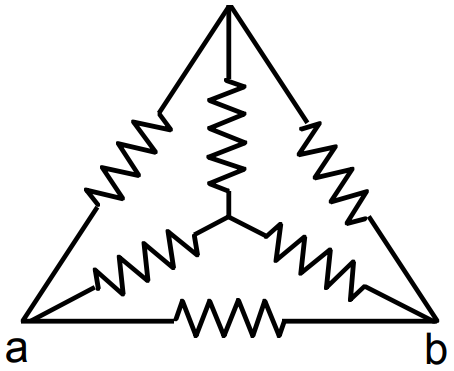
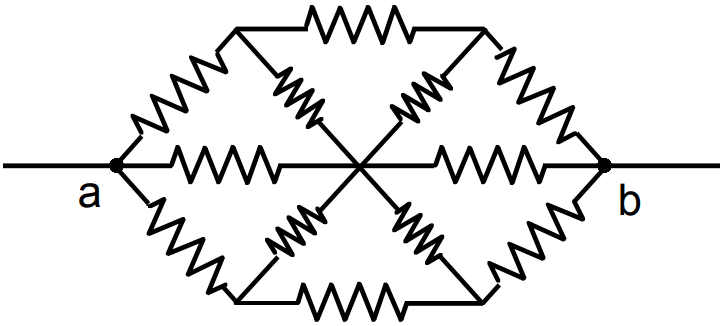
Find the equivalent resistance of the circuits shown in the figure. between the points a and b. Each resistor has resistance r.

(II) (a) Using Kirchhoff'᾿s laws obtain the equation of the balanced state in Wheatstone bridge.
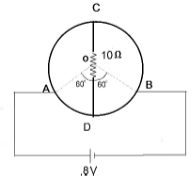
b) A wire of uniform cross-section and resistance of 12 ohm is bent in the shape of circle as shown in the figure. A resistance of 10 ohms is connected to diametrically opposite ends C and D. A battery of emf 8V is connected between A and B. Determine the current flowing through arm AD.

Image
  1. With the help of a diagram, explain the principle and working of a moving coil galvanometer.
  2. What is the importance of a radial magnetic field and how is it produced?
  3. Why is it that while using a moving coil galvanometer as a voltmeter a high resistance in series is required whereas in an ammeter a shunt is used?
A battery of emf 100V and a resistor of resistance $10\text{k}\Omega$ are joined in series. This system is used as a source to supply current to an external resistance R. If R is not greater than $100\Omega,$ the current through it is constant up to two significant digits. Find its value. This is the basic principle of a constant-current source.
An ideal gas having density $1.7 \times 10^{-3}g-cm^{-3}$ at a pressure $1.5 \times 10^5$ Pa is filled in a Kundt tube. When the gas is resonated at a frequency of 3.0KHz, nodes are formed at a separation of 6.0cm. Calculate the molar heat capacities $C_P$ and $C_v$ of the gas.
Define common potential. Find the expression for redistribution of charges and energy loss when capacitors are connected together.
It is found that yellow light does not eject photoelectrons from a metal. Is it advisable to try with orange light? With green light?
A room has AC run for 5 hours a day at a voltage of 220V. The wiring of the room consists of Cu of 1mm radius and a length of 10m. Power consumption per day is 10 commercial units. What fraction of it goes in the joule heating in wires? What would happen if the wiring is made of aluminium of the same dimensions?
$[\rho _{cu} = 1.7 \times 10^{-8}_{Ωm} , \rho _{Al} = 2.7 \times 10^{-8} Ωm]$
A copper wire of radius 0.1mm and resistance $1\text{k}\Omega$ is connected across a power supply of 20V.
(a) How many electrons are transferred per second between the supply and the wire at one end? (b) Write down the current density in the wire.
A beam of white light is incident normally on a plane surface absorbing 70% of the light and reflecting the rest. If the incident beam carries 10W of power, find the force exerted by it on the surface.