MCQ
When a particle moves in a uniform circular motion. It has
  • A
    Radial velocity and radial acceleration
  • Tangential velocity and radial acceleration
  • C
    Tangential velocity and tangential acceleration
  • D
    Radial velocity and tangential acceleration

Answer

Correct option: B.
Tangential velocity and radial acceleration
(b)

Need a full question paper?

Generate a complete, print-ready paper with questions like this in minutes — across 16+ boards, with answer keys.
Start Generating Free

Similar questions

A milli voltmeter of $25$ $milli$ $volt$ range is to be converted into an ammeter of $25$ $ampere$ range. The value (in $ohm$) of necessary shunt will be
A body of mass $40 \mathrm{~kg}$ having velocity $4 \mathrm{~m} / \mathrm{s}$ collides with another body of mass $60 \mathrm{~kg}$ having velocity $2 \mathrm{~m} / \mathrm{s}$. If the collision is inelastic, then loss in kinetic energy will be
Two identical heaters rated $220$ volt,$1000$ watt are placed in series with each other across $220$ volt lines. If resistance do not change with temperature, then the combined power is
If energy $(E)$, velocity $(v)$ and force $(F)$ be taken as fundamental quantity, then what are the dimensions of mass
A wave represented by the given equation $Y=A \sin \left(10 \pi x+15 \pi t+\frac{\pi}{3}\right),$ where $x$ is in meter and $t$ is in second. The expression represents
  1. A wave travelling in the positive $Y$ direction with a velocity of $1.5 \mathrm{~m} / \mathrm{sec}$
  2. A wave travelling in the negative $X$ direction with a velocity of $1.5 \mathrm{~m} / \mathrm{sec}$
  3. A wave travelling in the negative $X$ direction with a wavelength of $0.2 \mathrm{~m}$
  4. A wave travelling in the positive $Y$ direction with a wavelength of $0.2 \mathrm{~m}$
When $1 \mathrm{gm}$ of water at $0^{\circ} \mathrm{C}$ and $1 \times 10^5 \mathrm{~N} / \mathrm{m}^2$ pressure is converted into ice of volume $1.091 \mathrm{~cm}^2$, the external work done will be
A particle starts from rest, accelerates at $2 m / s$ for $10 s$ and then goes for constant speed for $30 s$ and then decelerates at $4 m / s$ till it stops. What is the distance travelled by it
When a current of $5\ mA$ is passed through a galvanometer having a coil of resistance $15\ \Omega$, it shows full scale deflection. The value of the resistance to be put in series with the galvanometer to convert it into to voltmeter of range $0 - 10\ V$ is
A spring when stretched by $2 \mathrm{~mm}$ its potential energy becomes $4 \mathrm{~J}$. If it is stretched by $10 \mathrm{~mm}$, its potential energy is equal to
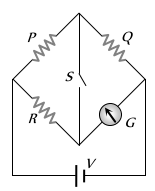
In the circuit shown $P \neq R$, the reading of the galvanometer is same with switch $S$ open or closed. ThenA

Image