Question
When a particle moves in a uniform circular motion. It has

Answer

An object moving in a circle is accelerating. Accelerating objects are objects which are changing their velocity - either the speed (i.e., magnitude of the velocity vector) or the direction. An object undergoing uniform circular motion is moving with a constant speed.

Need a full question paper?

Generate a complete, print-ready paper with questions like this in minutes — across 16+ boards, with answer keys.
Start Generating Free

Similar questions

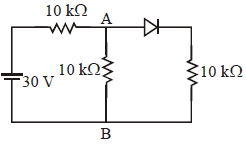
In the figure, potential difference between $A$ and $B$ is......$V$
Two waves represented by,

${y_1} = 10\,\sin \,200\pi t$,

${y_2} = 20\,\sin \,\left( {2000\pi t + \frac{\pi }{2}} \right)$

are superimposed at any point at a particular instant. The amplitude of the resultant wave is

A ball is projected from ground at an angle of $\theta $ from horizontal then graph of kinetic energy and time will be
In resonance tube two successive positions of resonance are obtained at $15 \,cm$ and $48 \,cm$. If the frequency of the fork is $500 \,cps$, the velocity of sound is ......... $m / s$
A coil of radius $1\, cm$ and of turns $100$ is placed in the middle of a long solenoid of  radius $5\, cm$. and having $5\, turns/cm$. parallel to the axis of solenoid The mutual  inductance in millihenery will be
Assertion : Heavy water is a better moderator than normal water.

Reason : Heavy water absorbs neutrons more efficiently than normal water.
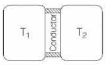
A thin piece of thermal conductor of constant thermal conductivity insulated on the lateral sides connects two reservoirs which are maintained at temperatures $T_{1}$ and $T_{2}$ as shown in the figure alongside. Assuming that the system is in steady state, which of the following plots best represents the dependence of the rate of change of entropy on the ratio of $T_{1} / T_{2}$ ?
In Young's experiment, the distance between the slits is reduced to half and the distance between the slit and screen is doubled, then the fringe width
The frequency and work function of an incident photon are $v$ and ${\phi _0}$. If $v_0$ is the threshold frequency then necessary condition for the emission of photo electron is
A liquid of mass m and specific heat $c$ is heated to a temperature $2T.$ Another liquid of mass $m/2$ and specific heat $2c$ is heated to a temperature $T.$ If these two liquids are mixed, the resulting temperature of the mixture is