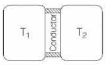
A thin piece of thermal conductor of constant thermal conductivity insulated on the lateral sides connects two reservoirs which are maintained at temperatures $T_{1}$ and $T_{2}$ as shown in the figure alongside. Assuming that the system is in steady state, which of the following plots best represents the dependence of the rate of change of entropy on the ratio of $T_{1} / T_{2}$ ?
KVPY 2017, Advanced
Download our app for free and get started
$(b)$ Entropy change for a system or body is
$\Delta S=\frac{Q}{T}$
Now, for given system to be in steady state, heat lost by resorvoir at temperature $T_{1}=$ heat gained by resorvoir at temperature $T_{2}$ (=Q say).
So, change in entropy for heat conduction process is
$\Delta S-\frac{-Q}{}+\frac{(+Q)}{T_{1}}$
$\Rightarrow \quad \Delta S=Q\left(\frac{1}{T_{2}}-\frac{1}{T_{1}}\right)$
So, time rate of change of entropy is
$\frac{d S}{d t}=\frac{d}{d t}\left\{Q\left(\frac{1}{T_{2}}-\frac{1}{T_{1}}\right)\right\}$
$=\left(\frac{1}{T_{2}}-\frac{1}{T_{1}}\right) \cdot\left(\frac{d Q}{d t}\right)$
$\frac{d S}{d t}=\left(\frac{T_{1}}{T_{2}}-1\right) \cdot T_{1}\left(\frac{d Q}{d t}\right)$
As, $\quad \frac{d Q}{d t}=-k A\left(\frac{d T}{d x}\right)$
So, $\quad \frac{d S}{d t}=-k A \frac{d T}{d x} \cdot T_{1}\left(\frac{T_{1}}{T_{2}}-1\right)$
$\Rightarrow \quad \frac{d S}{d t}=k A T_{1} \cdot\left(1-\frac{T_{1}}{T_{2}}\right) \cdot \frac{d T}{d x}$
$=\frac{k A T_{1}}{x}\left(1-\frac{T_{1}}{T_{2}}\right)\left(T_{1}-T_{2}\right)$
$=\frac{k A T_{1}^{2}}{x}\left(1-\frac{T_{1}}{T_{2}}\right)\left(1-\frac{T_{2}}{T_{1}}\right)$
Clearly, at $\frac{T_{1}}{T_{2}}=1, \frac{d S}{d t}=0$.
Also, graph is asym metrical. So, correct option is $(b)$.

Download our appand get started for free
Experience the future of education. Simply download our apps or reach out to us for more information. Let's shape the future of learning together!No signup needed.*
Similar Questions
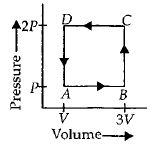
- 1A thermodynamic system is taken through the cycle $ABCD$ as shown in figure. Heat rejected by the gas during the cycle isView Solution
- 2A Carnot engine whose heat $\operatorname{sinks}$ at $27\,^{\circ} C$, has an efficiency of $25 \%$. By how many degrees should the temperature of the source be changed to increase the efficiency by $100 \%$ of the original efficiency $?$View Solution
- 3For a thermodynamic process $\delta Q = -50$ $calorie$ and $W = -20$ $calorie$ . If the initial internal energy is $-30$ $calorie$ then final internal energy will be ....... $calorie$View Solution
- 4A Carnot engine has efficiency $25\%$ . It operates between reservoirs of constant temperature with temperature difference of $80\,K$ . What is the temperature of low temperature reservoir ...... $^oC$View Solution
- 5A Carnot engine absorbs $1000\,J$ of heat energy from a reservoir at $127\,^oC$ and rejects $600\,J$ of heat energy during each cycle. The efficiency of engine and temperature of sink will beView Solution
- 6View SolutionFirst law thermodynamics states that
- 7Two moles of monoatomic gas is expanded from $(P_0, V_0)$ to $(P_0 , 2V_0)$ under isobaric condition. Let $\Delta Q_1$, be the heat given to the gas, $\Delta W_1$ the work done by the gas and $\Delta U_1$ the change in internal energy. Now the monoatomic gas is replaced by a diatomic gas. Other conditions remaining the same. The corresponding values in this case are $\Delta Q_2 , \Delta W_2 , \Delta U_2$ respectively, thenView Solution
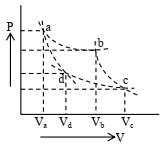
- 8Two different adiabatic paths for the same gas intersect two isothermal curves as shown in$P-V$ diagram. The relation between the ratio $\frac{V_a}{V_d}$ and the ratio $\frac{V_b}{V_c}$ is:View Solution
- 9$N _{2}$ gas is heated from $300\, K$ temperature to $600\, K$ through an isobaric process. Then find the change in entropy of the gas. $( n =1 mole )$ (in $J/K$)View Solution
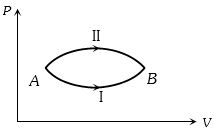
- 10A system goes from $A$ to $B$ via two processes $I$ and $II$ as shown in figure. If $\Delta {U_1}$ and $\Delta {U_2}$ are the changes in internal energies in the processes $I$ and $II$ respectively, thenView Solution