MCQ
When a potential difference is applied across, the current passing through
  • A
    An insulator at $0K$ is zero
  • B
    A semiconductor at $0K$ is zero
  • C
    A P-N diode at $300K$ is finite, if it is reverse biased
  • All of the above

Answer

Correct option: D.
All of the above
d
(d) At $0 K$, a semiconductor becomes a perfect insulator. Therefore at $0 K$, if some potential difference is applied across an insulator or a semiconductor, current is zero. But a conductor will become a superconductor at $0 K$. Therefore, current will be infinite. In reverse biasing at $300\, K$ through a $P-N$ junction diode, a small finite current flows due to minority charge carriers.

Need a full question paper?

Generate a complete, print-ready paper with questions like this in minutes — across 16+ boards, with answer keys.
Start Generating Free

Similar questions

A uniform electric field of $20\, N/C$ exists along the $x$ -axis in a space. The potential  difference $(V_B -V_A)$ for the point $A(4\,m, 2\,m)$ and $B(6\,m, 5\,m)$ is.....$V$
Current is flowing in a circular coil of radius r. There are n turns in the coil. Its magnetic moment varies with r. As:
Photo cell is a device to
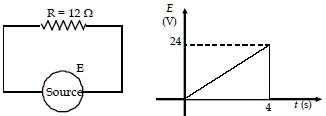
A resistance $R = 12\, \Omega$ is connected across a source of emf as shown in the figure . Its $emf$ changes with time as shown in the graph . What is the heat developed in the resistance in the first four seconds ? ............. $J$
A sonometer wire supports a $4\ kg$ load and vibrates in fundamental mode with a tuning fork of frequency $416\ Hz$. The length of the wire between the bridges is now doubled. In order to maintain fundamental mode, the load should be changed to:
 
Electric lines of force about negative point charge are
The expression for magnetic induction inside a solenoid of length L carrying a current I and having N number of turns is
A sphere of 4 cm radius is suspended within a hollow sphere of 6 cm radius. The inner sphere is charged to potential 3 e.s.u. and the outer sphere is earthed. The charge on the inner sphere is
A galaxy is moving away from the earth at a speed of $286\, kms ^{-1}$. The shift in the wavelength of a red line at $630\, nm$ is $x \times 10^{-10}\, m$. The value of $x ,$ to the nearest integer, is........

[Take the value of speed of light $c,$ as $3 \times 10^{8}$ $\left. ms ^{-1}\right]$

When an object is kept at a distance of $30\, cm$ from a concave mirror, the image is formed at a distance of $10\, cm$ from the mirror. If the object is moved with a speed of $9\, cms ^{-1}$, the speed (in $cms ^{-1}$ ) with which image moves at that instant is$....m/s$