Question
When a potential difference is applied across the ends of a linear metallic conductor(a) The free electrons are accelerated continuously from the lower potential end to the higher potential end of the conductor(b) The free electrons are accelerated continuously from the higher potential end to the lower potential end of the conductor(c) The free electrons acquire a constant drift velocity from the lower potential end to the higher potential end of the conductor(d) The free electrons are set in motion from their position of rest


Answer

(c) The free electrons acquire a constant drift velocity from the lower potential end to the higher potential end of the conductor

Need a full question paper?

Generate a complete, print-ready paper with questions like this in minutes — across 16+ boards, with answer keys.

Start Generating Free

Similar questions

Why are red coloured lights are used in traffic signals to stop the vehicles?
What should be the current in a circular coil of radius $5\ cm$ to annul $B_{H}=5 \times 10^{-5} T$
A uniform spherical shell gradually shrinks maintaining its shape. The gravitational potential at the centre:
  1. Increases.
  2. Decreases.
  3. Remains constant.
  4. Oscillates.
When objects at different distances are seen by the eye, which of the following remains constant(a) The focal length of the eye lens(b) The object distance from the eye lens(c) The radii of curvature of the eye lens(d) The image distance from the eye lens
   
   
Solar spectrum is an example of:
A star moves away from earth at speed $0.8\ c$ while emitting light of frequency $6\times 10^{14} Hz$ What frequency will be observed on the earth $($in units of $10^{14}Hz) (c =$ speed of light$)$
The collector plate in an experiment on photoelectric effect is kept vertically above the emitter plate. Light source is put on and a saturation photocurrent is recorded. An electric field is switched on which has a vertically downward direction.
  1. The photocurrent will increase.
  2. The kinetic energy of the electrons will increase.
  3. The stopping potential will decrease.
  4. The threshold wavelength will increase.
Equipotential surfaces of a single point charge are _____ surfaces centred at the charge.
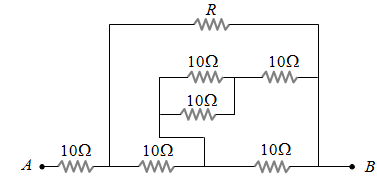
For what value of $R$ the net resistance of the circuit will be $18$ ohms
In Rutherford's $\alpha$-scattering experiment, if atomic number increases with thin metal foil then scattering angle is :