Question
When a proton is released from rest in a room, it starts with an initial acceleration $a_0$​​​​​​​ towards west. When it is projected towards north with a speed $v_0$, it moves with an initial acceleration $3a_0$ towards west. Find the electric field and the maximum possible magnetic field in the room.

Answer

$\text{q}_\text{p}=\text{e},\ \text{mp}=\text{m},\ \text{F}=\text{q}_\text{p}\times\text{E}$
$\text{ma}_0=\text{eE}$
$\text{E}=\frac{\text{ma}_0}{\text{e}}$ towards west

The acceleration changes from $a_0$ to $3a_0$
Hence net acceleration produced by magnetic field $\overrightarrow{\text{B}}$ is $2a_0.$
Force due to magnetic field
$\overrightarrow{\text{F}}_\text{B}=\text{m}\times2\text{a}_0=\text{e}\times\text{V}_0\times\text{B}$
$\Rightarrow\text{B}=\frac{2\text{ma}_0}{\text{eV}_0}$ downwards

Need a full question paper?

Generate a complete, print-ready paper with questions like this in minutes — across 16+ boards, with answer keys.

Start Generating Free

Similar questions

Figure. shows a part of a circuit. If a current of 12mA exists in the $5\text{k}\Omega$ resistor, find the currents in the other three resistors. What is the potential difference between the points A and B?
A particle A with a mass $m_A$ is moving with a velocity v and hits a particle $B ($mass $m_B) $ at rest (one dimensional motion). Find the change in the de Broglic wavelength of the particle A. Treat the collision as elastic.
The time constant of an LR circuit is 40ms. The circuit is connected at t = 10 and the steady-state current is found to be 2.0A. Find the current at:
  1. t = 10ms
  2. t = 20ms
  3. t = 100ms
  4. t = 1s.
$(II)$ A compound microscope consists of an objective lens of focal length $2.0 \ cm$ and an eyepiece of focal length $6.25 \ cm$ separated by a distance of $15 \ cm$. How far from the objective should an object be placed in order to obtain the final image at
$(a)$ the least distance of distinct vision $(25 \ cm)$ and
$(b)$ infinity? What is the magnifying power of the microscope in each case?
The activity R of an unknown radioactive nuclide is measured at hourly intervals. The results found are tabulated as follows:
t(h) 0 1 2 3 4
R(MBq) 100 35.36 12.51 4.42 1.56
  1. Plot the graph of R versus t and calculate half-life from the graph.
  2. Plot the graph of 0 ln $\Big(\frac{\text{R}}{\text{R}_0}\Big)$ versus t and obtain the value of half-life from the graph.
Verify the Gauss’s law for magnetic field of a point dipole of dipole moment m at the origin for the surface which is a sphere of radius R.
Consider a situation similar to that of the previous problem except that the ends of the rod slide on a pair of thick metallic rails laid parallel to the wire. At one end the rails are connected by resistor of resistance R.
  1. What force is needed to keep the rod sliding at a constant speed v?
  2. In this situation what is the current in the resistance R?
  3. Find the rate of heat developed in the resistor.
  4. Find the power delivered by external agent exerting the force on the rod.
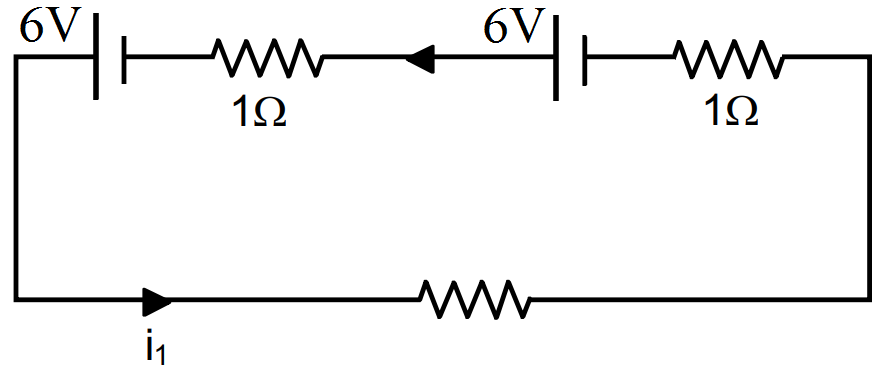
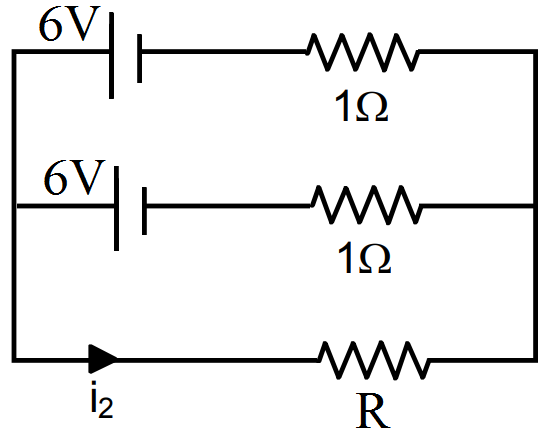
Find the value of $\frac{\text{i}_1}{\text{i}_2}$ in the figure. if (a) $\text{R}=0.1\Omega$ (b) $\text{R}=1\Omega$ and (c) $\text{R}=10\Omega.$ Note from your answers that in order to get more current from a combination of two batteries, they should be joined in parallel if the external resistance is small and in series if the external resistance is large, compared to the internal resistance.
The energy from the sun reaches just outside the earth's atmosphere at a rate of $1400W/m^2.$ The distance between the sun and the earth is $1.5 \times 10^{11}m.$
  1. Calculate the rate at which the sun is losing its mass.
  2. How long will the sun last assuming a constant decay at this rate? The present mass of the sun is $2 \times 10^{80}kg.$
An electron gun with its collector at a potential of 100 V fires out electrons in a spherical bulb containing hydrogen gas at low pressure $(\sim 10^{–2}$ mm of Hg$)$. A magnetic field of $2.83 \times 10^{–4}$ T curves the path of the electrons in a circular orbit of radius 12.0 cm. (The path can be viewed because the gas ions in the path focus the beam by attracting electrons, and emitting light by electron capture; this method is known as the ‘fine beam tube’ method.) Determine e/m from the data.