Question
When a semiconductor is heated, its resistance(a) Decreases(b) Increases(c) Remains unchanged(d) Nothing is definite
       

Answer

(a) Decreases

Need a full question paper?

Generate a complete, print-ready paper with questions like this in minutes — across 16+ boards, with answer keys.
Start Generating Free

Similar questions

'Mirage' is a phenomenon due to(a) Reflection of light(b) Refraction of light(c) Total internal reflection of light(d) Diffraction of light
   
   
The electrochemical equivalent Z of any element can be obtained by multiplying the electrochemical equivalent of hydrogen with(a) Atomic weight(b) Molecular weight(c) Chemical equivalent(d) A constant
       
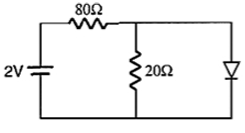
In the circuit shown, the current through the ideal diode is:
Image
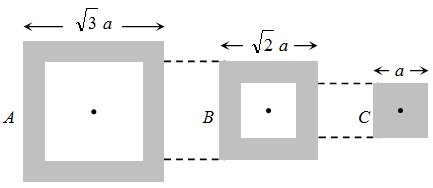
Following figure shows cross$-$sections through three long conductors of the same length and material, with square cross$-$section of edge lengths as shown. Conductor $B$ will fit snugly within conductor $A,$ and conductor $C$ will fit snugly within conductor $B$. Relationship between their end to end resistance is
.
Two magnets, each of magnetic moment $' M\ '$ are placed so as to form a cross at right angles to each other. The magnetic moment of the system will be
The process of radioactive radiations remains unaffected due to:
With the modulation of carrier wave frequency $f_{c}$ audio wave frequency $f_{m}$ the received band width is :
The de$-$Broglie wavelength is proportional to
The magnetic field due to the earth is closely equivalent to that due to(a) A large magnet of length equal to the diameter of the earth(b) A magnetic dipole placed at the centre of the earth(c) A large coil carrying current(d) Neither of the above


An electron of charge ‘e’ coulomb passes through a potential difference of V  volts. Its energy in ‘joules’ will be(a) V/e (b) eV(c) e/V (d) V