Question
When a spherical mirror is held towards the sun and its sharp image is formed on a piece of a carbon paper for some time, a hole is burnt in the carbon paper.
  1. What is the nature of spherical mirror?
  2. Why is a hole burnt in the carbon paper?
  3. At which point of the spherical mirror the carbon paper is placed?
  4. What name is given to the distance between spherical mirror and carbon paper?
  5. What is the advantage of using a carbon paper rather than a white paper?
Answer

  1. The spherical mirror is concave.
  2. A concave mirror converges light rays, and in this case it will converge the incoming parallel rays of the sun at its focus. Since the carbon paper was kept at the focus of the concave mirror, the hole was burnt into it. 
  3. The carbon paper was kept at the focus of the spherical mirror.
  4. The distance between the mirror and the carbon paper is the focal length.
  5. A carbon paper is a good absorber of sunlight; hence, it burnt quickly.​

Need a full question paper?

Generate a complete, print-ready paper with questions like this in minutes — across 16+ boards, with answer keys.

Start Generating Free

Similar questions

a. List four characteristics of the image formed by a convex lens when an object is placed between its optical centre and principal focus.
b. Size of the image of an object by a concave lens of focal length 20 cm is observed to be reduced to $\frac{1}{3} \mathrm{rd}$ of its size. Find the distance of the object from the lens.
How can three resistors of resistances 2 Ω, 3 Ω, and 6 Ω be connected to give a total resistance of (a) 4 Ω, (b) 1 Ω?
What is long-sightedness? State the two causes of long-sightedness (or hypermetropia). With the help of ray diagrams, show:
  1. The eye-defect long-sightedness.
  2. Correction of long-sightedness by using a lens.
  1. If the image formed by a mirror for all positions of the object placed in front of it is always diminished, erect and virtual, state the type of the mirror and also draw a ray diagram to justify your answer. Write one use such mirrors are put to and why.
  2. Define the radius of curvature of spherical mirrors. Find the nature and focal length of a spherical mirror whose radius of curvature is + 24 cm.
An electric circuit consisting of a 0.5m long nichrome wire XY, an ammeter, a voltmeter, four cells of 1.5V each and a plug key was set up.

  1. Draw a diagram of this electric circuit to study the relation between the potential difference maintained between the points ‘X’ and ‘Y’ and the electric current flowing through XY.
  2. Following graph was plotted between V and I values:

What would be the values of ratios when the potential difference is 0.8V, 1.2V and 1.6V respectively? What conclusion do you draw from these values?

  1. What is the resistance of the wire?
i. Define principal axis of a lens. Draw a ray diagram to show what happens when a ray of light parallel to the principal axis of a concave lens passes through it.
ii. The focal length of a concave lens is 20 cm . At what distance from the lens should a 5 cm tall object be placed so that its image is formed at a distance of 15 cm from the lens? Also calculate the size of the image formed.
List the parts of the human eye that control the amount of light entering into it. Explain, how they perform this function?
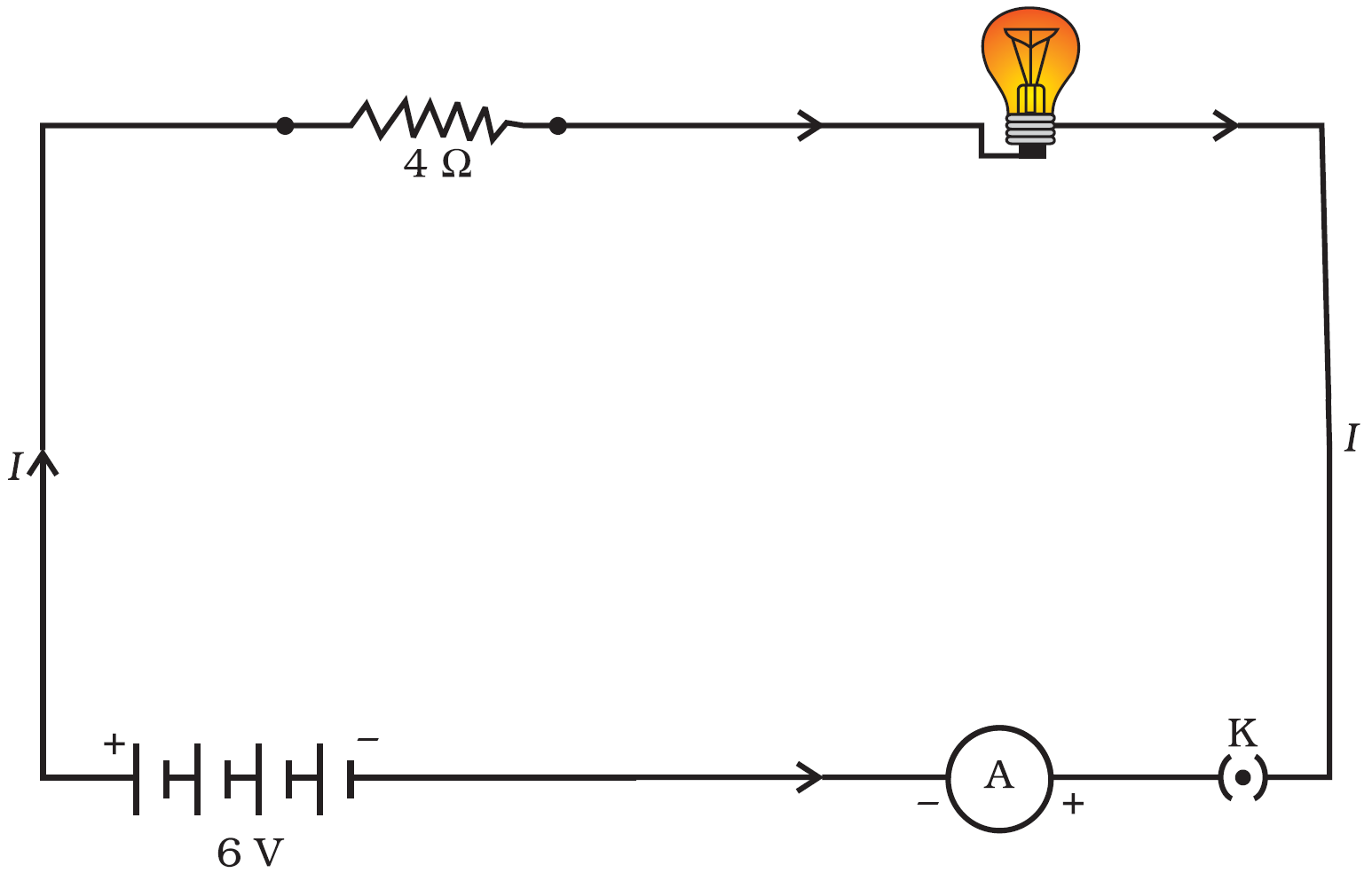
An electric lamp of resistance $20\Omega$ and a conductor of resistance $4\Omega$ are connected to a 6V battery as shown in the circuit. Calculate:


  1. The total resistance of the circuit,
  2. The current through the circuit,
  3. The potential difference across the (i) electric lamp and (ii) conductor, and
  4. Power of the lamp.
  1. One-half of a convex lens is covered with a black paper. Will such a lens produce an image of the complete object? Support your answer with a ray diagram.
  2. An object 5 cm high is held 25 cm away from a converging lens of focal length 10 cm.
  1. Draw the ray diagram.
  2. Calculate the position and size of the image formed.
  3. What is the nature of the image?
An electric circuit consisting of a 0.5m long nichrome wire XY, an ammeter, a voltmeter, four cells of 1.5V each and a plug key was set up.

  1. Draw a diagram of this electric circuit to study the relation between the potential difference maintained between the points ‘X’ and ‘Y’ and the electric current flowing through XY.
  2. Following graph was plotted between V and I values:

What would be the values of ratios when the potential difference is 0.8V, 1.2V and 1.6V respectively? What conclusion do you draw from these values?

  1. What is the resistance of the wire?