MCQ
When a stationary wave is formed then its frequency is
  • Same as that of the individual waves
  • B
    Twice that of the individual waves
  • C
    Half that of the individual waves
  • D
    None of the above

Answer

Correct option: A.
Same as that of the individual waves
a
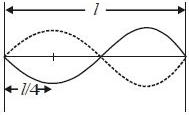
Second harmonic means $2$ loops in a total length. Hence plucking distance from one end

$=\frac{l}{2 p}=\frac{l}{2 \times 2}=\frac{l}{4}$
Need a full question paper?

Generate a complete, print-ready paper with questions like this in minutes — across 16+ boards, with answer keys.
Start Generating Free

Similar questions

A ball is suspended on a thread from the ceiling of a car. The brakes are applied and the speed of car changes from $5\, m/sec$ to $5/3\, m/sec$ during the time interval of $3\, seconds$. The angle that the thread will deviate from vertical
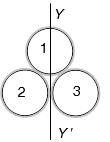
Three rings each of mass $M$ and radius $R$ are arranged as shown in the figure. The moment of inertia of the system about $YY' $ will be 
A sample of radioactive element containing $4 \times 10^{16}$ active nuclei. Half life of element is $10$ days, then number of decayed nuclei after $30$ days is  ........ $\times 10^{16}$ 
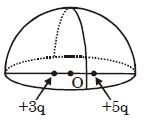
The figure shows a hollow hemisphere of radius $R$ in which two charges $3q$ and $5q$ are placed symmetrically about the centre $O$ on the planar surface. The electric flux over the curved surface is
Wolf kishner reduction, reduces
Ratio between maximum range and square of time of flight in projectile motion is
Two forces ${F_1} = 1\,N$ and ${F_2} = 2\,N$ act along the lines $x = 0$ and $y = 0$ respectively. Then the resultant of forces would be
A body $A$ is projected upwards with a velocity of $98\,m/s$. The second body $B$ is projected upwards with the same initial velocity but after $4 \,sec$. Both the bodies will meet after...........$sec$
An ideal gas expands isothermally from a volume ${V_1}$ to ${V_2}$ and then compressed to original volume ${V_1}$adiabatically. Initial pressure is ${P_1}$ and final pressure is ${P_3}$. The total work done is $W$. Then
A constant magnetic field of $1 \,{T}$ is applied in the ${x}\,>\,0$ region. A metallic circular ring of radius $1 \,{m}$ is moving with a constant velocity of $1 \,{m} / {s}$ along the $x$-axis. At $t=0$ $s,$ the centre of $O$ of the ring is at ${x}=-1 \,{m}$. What will be the value of the induced $emf$ in the ring at $t=1\, s$ ? (Assume the velocity of the ring does not change.) (In ${V}$)