MCQ
Wolf kishner reduction, reduces
  • A
    $ - COOH$ group
  • B
    $ - C \equiv C$-group
  • $ - CHO$ group
  • D
    $ - O - $group

Answer

Correct option: C.
$ - CHO$ group
c
(c) It reduce $ - CHO$ group into hydrocarbon.

Need a full question paper?

Generate a complete, print-ready paper with questions like this in minutes — across 16+ boards, with answer keys.

Start Generating Free

Similar questions

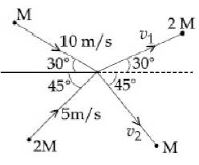
Two particles, of masses $M$ and $2M$, moving as shown, with speeds of $10\, m/s$ and $5\, m/s$, collide elastically at the origin. After the collision, they move along the indicated directions with speeds $v_1$ and $v_2$ respectively. The value of $v_1$ and $v_2$ are nearly
If $P = \frac{{{A^3}}}{{{B^{5/2}}}}$ and $\Delta A$ is absolute error in $A$ and $\Delta B$ is absolute error in $B$ then absolute error $\Delta P$ in $P$ is
Visible light of wavelength $6000 \times 10^{-8}\; \mathrm{cm}$ falls normally on a single slit and produces a diffraction pattern. It is found that the second diffraction minimum is at $60^{\circ}$ from the central maximum. If the first minimum is produced at $\theta_{1},$ then $\theta_{1}$ is close to.....$^o$
Decibel is unit of
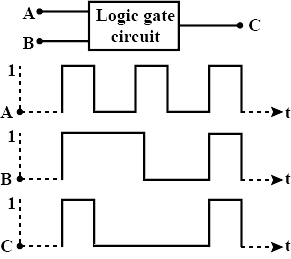
The following figure shows a logic gate circuit with two inputs $A$ and $B$ and the output $C.$ The voltage waveforms of $A, B$ and $C$ are as shown below. The logic circuit gate is
A solid disc of radius $20 \,{cm}$ and mass $10\, {kg}$ is rotating with an angular velocity of $600\, {rpm}$, about an axis normal to its circular plane and passing through its centre of mass. The retarding torque required to bring the disc at rest in $10\, {s}\, ......\, \pi \times \,10^{-1}\, {Nm}$.
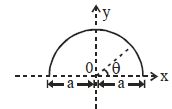
A semicircular ring of radius $'a'$ has charge density $\lambda  = {\lambda _0}\,\cos \,\theta $ where ${\lambda _0}$ is constant and $'\theta'$ is shown in figure. Then total charge on the ring is
The pressure at the bottom of a tank containing a liquid does not depend on
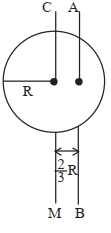
$I _{ CM }$ is moment of inertia of a circular disc about an axis $( CM )$ passing through its center and perpendicular to the plane of disc. $I _{ AB }$ is it's moment of inertia about an axis $A B$ perpendicular to plane and parallel to axis $CM$ at a distance $\frac{2}{3} R$ from center. Where $R$ is the radius of the disc. The ratio of $I _{ AB }$ and $I _{ CM }$ is $x: 9$. The value of $x$ is $........$
A beam of ultraviolet light of all wavelengths passes through hydrogen gas at room temperature, in the $x-$ direction. Assume that all photons emitted due to electron transition inside the gas emerge in the $y-$ direction. Let $A$ and $B$ denote the lights emerging from the gas in the $x$ and $y$ directions respectively.