MCQ
When air is filled in the balloon, the pressure and volume both increases while temperature does not change. Here Boyle's law is not obeyed because
  • A
    Mass of air is negligible
  • Mass of air does not remain constant
  • C
    Air is not perfect gas
  • D
    Pressure inside the balloon is less than that of the atmospheric pressure
Answer

Correct option: B.
Mass of air does not remain constant
b
No, because the mols of air and also changing in this case as you blow into the balloon

we have,

$P V=n R T .$

Let the tempenatune stays constant when you blow in to a balloon, if $P$ increases by scale facton of $x$ and $V$ increases by scale facton of $x$, then the number of mols would have to increse by Scale facton of $x^{2}$.

$\frac{P V}{n}=R T .$

To express this realtionship:

$\frac{P_{1} V_{1}}{n_{1}}=\frac{P_{2} V_{2}}{n_{2}} .$

Need a full question paper?

Generate a complete, print-ready paper with questions like this in minutes — across 16+ boards, with answer keys.

Start Generating Free

Similar questions

The dimensions of  ${\left( {{\mu _0}{\varepsilon _0}} \right)^{ - \frac{1}{2}}}$ are
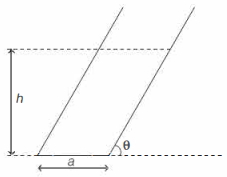
A hollow tilted cylindrical vessel of negligible mass rests on a horizontal plane as shown. The diameter of the base is $a$ and the side of the cylinder makes an angle $\theta$ with the horizontal.Water is then slowly poured into the cylinder. The cylinder topples over when the water reaches a certain height $h$, given by
A rocket is propelled by a gas which is initially at a temperature of $4000\, K$. The temperature of the gas falls to $1000\, K$ as it leaves the exhaust nozzle. The gas which will acquire the largest momentum while leaving the nozzle, is
Imagine earth to be a solid sphece of mass $M$ and radius $R$. If the value of acceleration due to gravity at a depth d below earth's surface is same as its value at a height $h$ above its surface and equal to $\frac{g}{4}$ (where $g$ is the value of acceleration due to gravity on the surface of earth), the ratio of $\frac{h}{d}$ will be
If the kinetic energy of a body increases by $0.1\%$, the percent increase of its momentum will be .............. $\%$
A man squatting on the ground gets straight up and stand. The force of reaction of ground on the man during the process is:
  1. Constant and equal to mg in magnitude.
  2. Constant and greater than mg in magnitude.
  3. Variable but always greater than mg.
  4. At first greater than mg, and later becomes equal to mg.
Three particles A, B and C projected from the same point with the same initial speeds making angle 30°, 45° and 60°, respectively with the horizontally. Which of the following statements is correct?
If vibrations of a string are to be increased by a factor of two, then tension in the string must be made
A particle is moving in one dimension (along $\mathrm{x}$ axis) under the action of a variable force. It's initial position was $16 \mathrm{~m}$ right of origin. The variation of its position ( $\mathrm{x}$ ) with time ( $\mathrm{t})$ is given as $\mathrm{x}=-3 \mathrm{t}^5+18 \mathrm{t}^2+16 \mathrm{t}$, where $\mathrm{x}$ is in $\mathrm{m}$ and $\mathrm{t}$ is in $\mathrm{s}$. The velocity of the particle when its acceleration becomes zero is________ $\mathrm{m} / \mathrm{s}.$
A car of mass $m$ has an engine which can deliver power $P$. The minimum time in which car can be accelerated from rest to a speed $v$ is .............