MCQ
A particle is moving in one dimension (along $\mathrm{x}$ axis) under the action of a variable force. It's initial position was $16 \mathrm{~m}$ right of origin. The variation of its position ( $\mathrm{x}$ ) with time ( $\mathrm{t})$ is given as $\mathrm{x}=-3 \mathrm{t}^5+18 \mathrm{t}^2+16 \mathrm{t}$, where $\mathrm{x}$ is in $\mathrm{m}$ and $\mathrm{t}$ is in $\mathrm{s}$. The velocity of the particle when its acceleration becomes zero is________ $\mathrm{m} / \mathrm{s}.$
  • A
    $50$
  • $52$
  • C
    $57$
  • D
    $60$

Answer

Correct option: B.
$52$
b
$x=3 t^3+18 t^2+16 t$

$v=-9 \mathrm{t}^2+36+16$

$a=-18 \mathrm{t}+36$

$a=0 \text { at } \mathrm{t}=2 \mathrm{~s}$

$v=-9(2)^2+36 \times 2+16$

$v=52 \mathrm{~m} / \mathrm{s}$

Need a full question paper?

Generate a complete, print-ready paper with questions like this in minutes — across 16+ boards, with answer keys.

Start Generating Free

Similar questions

A black body has maximum wavelength ${\lambda _m}$ at temperature $2000\; K$. Its corresponding wavelength at temperature $3000 \;K$ will be
Two identical piano wires, kept under the same tension $T$ have a fundamental frequency of $600\,\, Hz.$ The fractional increase in the tension of one of the wires which will lead to occurrence of $6\,\, beats/s$ when both the wires oscillate together would be
Consider two containers A and B containing identical gases at the same pressure, volume and temperature. The gas in container A is compressed to half of its original volume isothermally while the gas in container B is compressed to half of its original value adiabatically. The ratio of final pressure of gas in B to that of gas in A is

  1. $2^{\gamma-1}$

  2. $\Big(\frac{1}{2}\Big)^{\gamma-1}$

  3. $\Big(\frac{1}{1-\gamma}\Big)^2$

  4. $\Big(\frac{1}{\gamma-1}\Big)^2$

Two vectors $\dot{A}$ and $\dot{B}$ are defined as $\dot{A}=a \hat{i}$ and $\overrightarrow{\mathrm{B}}=\mathrm{a}(\cos \omega t \hat{\mathrm{i}}+\sin \omega t \hat{j}$ ), where a is a constant and $\omega=\pi / 6 \mathrm{rad} \mathrm{s}^{-1}$. If $|\overrightarrow{\mathrm{A}}+\overrightarrow{\mathrm{B}}|=\sqrt{3}|\overrightarrow{\mathrm{A}}-\overrightarrow{\mathrm{B}}|$ at time $t=\tau$ for the first time, the value of $\tau$, in, seconds, is. . . . . .
A wave is propagating along $x$-axis. The displacement of particles of the medium in $z$-direction at $t = 0$ is given by: $z =$ exp$[ -(x + 2)^2]$ , where $‘x’$ is in meters. At $t = 1s$, the same wave disturbance is given by: $z =$ exp $ [ - (2 - x)^2 ]$. Then, the wave propagation velocity is
A torque of 0.5Nm is required to drive a screw into a wooden frame with the help of a screw driver. If one of the two forces of couple produced by screw driver is 50N, the width of the screw driver is:
What is the minimum velocity with which a body of mass $m$ must enter a vertical loop of radius $R$ so that it can complete the loop $?$
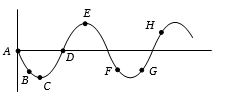
The diagram below shows the propagation of a wave. Which points are in same phase
In a transverse wave, the particles of the medium:
$Assertion$: A rigid disc rolls without slipping on a fixed rough horizontal surface with uniform angular velocity. Then the acceleration of lowest point on the disc is zero.
$Reason$ : For a rigid disc rolling without slipping on a fixed rough horizontal surface, the velocity of the lowest point on the disc is always zero