MCQ
When $Al$ is added to $KOH$ solution
  • A
    No action takes place
  • B
    Oxygen is evolved
  • C
    Water is produced
  • Hydrogen is evolved

Answer

Correct option: D.
Hydrogen is evolved
d
(d) $2KOH + 2Al + 2{H_2}O \to 2KAl{O_2} + 3{H_2}$

Need a full question paper?

Generate a complete, print-ready paper with questions like this in minutes — across 16+ boards, with answer keys.

Start Generating Free

Similar questions

Equilibrium constant $(K_c)$ of $2HI_{(g)}  \rightleftharpoons  H_{2(g)} + I_{2(g)}$ is $5\times10^3$. What is the equilibrium concentration of $HI$, if equilibrium concentrations of $H_{2(g)}$ and $I_{2(g)}$ respectively are $2.2\times10^{-2}\, M$ and $2.2\times10^{-4}\, M$ ?
Match List$-I$ with List$-II.$

List$-I$

(Oxide)

List$-II$

(Nature)

$(A)$ $Cl _{2} O _{7}$ $(I)$ Amphoteric
$(B)$ $Na _{2} O$ $(II)$ Basic
$(C)$ $Al _{2} O _{3}$ $(III)$ Neutral
$(D)$ $N _{2} O$ $(IV)$ Acidic

Choose the correct answer from the options given below

Carbon tetrachloride has no net dipole moment because of
The number of structural isomers for $C_6H_{14}$ is
Calculate the correct increasing order of average oxidation number of sulphur in

$S_8,\,S_2O_3^{2-},\, S_2O_7^{-2},\, S_4O_6^{-2},\, SO_3^{-2}$

Consider the reaction $N _{2} O _{4}( g ) \rightleftharpoons 2 NO _{2}( g )$

The temperature at which $K _{ C }=20.4$ and $K _{ P }=600.1,$ is ....... $K$. (Round off to the Nearest Integer).

[Assume all gases are ideal and $R =0.0831\, L\,bar \, K ^{-1} mol ^{-1}]$

Which of the following statement is CORRECT :
$(I)$ Where orbitals are available in degenerate sets maximum spin multiplicity is observed
$(II)$ Where two electrons occupy the same shell they may have same spins
$(III)$ All noble gases do not have same valence shell electronic configuration
The total number of intensive properties from the following is $........$.

Volume, Molar heat capacity, Molarity, $E ^\theta$ cell, Gibbs free energy change, Molar mass, Mole
In thermodynamics a process is reversible when:
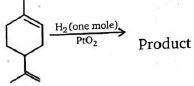
In polyenes that contain differently substituted $(C=C)$ double bonds, it is  possible to hydrogenate chemeselectively one $(C=C)$ double bond. Product is