- AThe maximum voltage between plates is 220V.
- BThe current is in phase with the applied voltage.
- CThe charge on the plates is in phase with the applied voltage.
- DPower delivered to the capacitor is zero.
Solution:
If the alternating voltage is applied to the capacitor, the plate connected to the positive terminal of the source will be at higher potential and the plate connected to the negative terminal of source will be at lower potential. So the plates capacitor is charged.
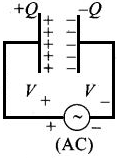
If $\text{V}=\text{V}_0\sin\omega\text{t},\text{Q}=\text{C V}_0\sin\omega\text{t}$ or we can say that Q and emf are in pahse.
As $\text{P}=\text{V}_\text{rms}\text{I}_\text{rms}\cos\phi$ and in case of a capacitor, $\phi=\frac{\pi}{2}\text{P} = 0,$ or we can say that power delivered to the capacitor is zero.
⇒ Pav = power delivered = 0.
Generate a complete, print-ready paper with questions like this in minutes — across 16+ boards, with answer keys.
The mass of a particle is 400 times than that of an electron and the charge is double. The particle is accelerated by 5 V. Initially the particle remained in rest, then its final kinetic energy will be
|
(a) 5 eV |
(b) 10 eV |
(c) 100 eV |
(d) 2000 eV |
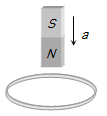
A metallic ring is attached with the wall of a room. When the north pole of a magnet is brought near to it, the induced current in the ring will be

|
(a) First clockwise then anticlockwise |
(b) In clockwise direction |
|
(c) In anticlockwise direction |
(d) First anticlockwise then clockwise |
Ionization potential of hydrogen atom is 13.6 V.
Hydrogen atoms in the ground state are excited by monochromatic radiation of photon energy 12.1 eV. The spectral lines emitted by hydrogen atoms according to Bohr's theory will be
|
(a) One |
(b) Two |
(c) Three |
(d) Four |