MCQ
When an aeroplane takes off from the ground:
  • A
    Kinetic energy increases and Potential energy decreases
  • B
    Potential energy increases and Kinetic energy remains constant
  • C
    Both Kinetic energy and Potential energy remain constant
  • Both Kinetic energy and Potential energy increase
Answer

Correct option: D.
Both Kinetic energy and Potential energy increase
Kinetic energy is due to the motion of the object and potential energy is due to relative elevation.
So as the plane takes off height increases and also its speed increase,
so both kinetic and potential energy increases.
Kinetic energy$=\frac{1}{2}\text{min}^2$
Potential energy $= \ce{mgH}$

Need a full question paper?

Generate a complete, print-ready paper with questions like this in minutes — across 16+ boards, with answer keys.

Start Generating Free

Similar questions

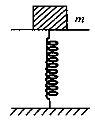
A mass of $2.0\, kg$ is put on a flat pan attached to a vertical spring fixed on the ground as shown in the figure. The mass of the spring and the pan is negligible.  When pressed slightly and released the mass executes a simple harmonic motion. The spring constant is $200\, N/m.$ What should be the minimum amplitude of the motion so that the mass gets detached from the pan (take $g = 10 m/s^2$). 
A horizontal disc rotating freely about a vertical axis through its centre makes $90$ revolutions per minute. A small piece of wax of mass $m$ falls vertically on the disc and sticks to it at a distance $r$ from the axis. If the number of revolutions per minute reduce to $60$ , then the moment of inertia of the disc is .........
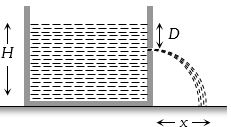
A tank is filled with water up to a height $H$. Water is allowed to come out of a hole $ P$  in one of the walls at a depth $ D $ below the surface of water. Express the horizontal distance $x$  in terms of $ H $ and $D$ 
Match List$-I$ with List$-II.$

List$-I$ List$-II$
$(a)$ Capacitance, $C$ $(i)$ ${M}^{1} {L}^{1} {T}^{-3} {A}^{-1}$
$(b)$ Permittivity of free space, $\varepsilon_{0}$ $(ii)$ ${M}^{-1} {L}^{-3} {T}^{4} {A}^{2}$
$(c)$ Permeability of free space, $\mu_{0}$ $(iii)$ ${M}^{-1} L^{-2} T^{4} A^{2}$
$(d)$ Electric field, $E$ $(iv)$ ${M}^{1} {L}^{1} {T}^{-2} {A}^{-2}$

Choose the correct answer from the options given below

A block of mass $200\, g$ executing $SHM$ under the influence of a spring of spring constant $K=90\, N\,m^{-1}$ and a damping constant $b=40\, g\,s^{-1}$. The time elapsed for its amplitude to drop to half of its initial value is ...... $s$ (Given $ln\,\frac{1}{2} = -0.693$)
The isothermal bulk modulus of a perfect gas at normal pressure is
The displacement of a particle is represented by the equation $\text{y}=\sin^3\omega\text{t}.$ The motion is:
A ball of radius $11\ cm$ and mass $8\ kg$ rolls from rest down a ramp of length $2\ m$. The ramp is inclined at ${35^o}$ to the horizontal. When the ball reaches the bottom, its velocity is .......... $m/s$.  $(sin\ 35^o  = 0.57)$
Match List $I$ with List $II$ :

List $I$ List $II$
$A$ Isothermal Process $I$ Work done by the gas decreases internal energy
$B$ Adiabatic Process $II$ No change in internal energy
$C$ Isochoric Process $III$ The heat absorbed goes partly to increase internal energy and partly to do work
$D$ Isobaric Process $IV$ No work is done on or by the gas

Choose the correct answer from the options given below :

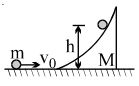
A particle of mass $m$ moving horizontally with $v_0$ strikes $a$ smooth wedge of mass $M$, as shown in figure. After collision, the ball starts moving up the inclined face of the wedge and rises to $a$ height $h$. The final velocity of the wedge $v_2$ is