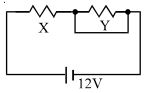
When an ammeter of negligible internal resistance is inserted in series with circuit it reads $1A$. When the voltmeter of very large resistance is connected across $X$ it reads $1V$. When the point $A$ and $B$ are shorted by a conducting wire, the voltmeter measures $10\, V$ across the battery. The internal resistance of the battery is equal to .............. $\Omega$
Medium


Download our appand get started for free
Experience the future of education. Simply download our apps or reach out to us for more information. Let's shape the future of learning together!No signup needed.*
Similar Questions
- 1$A$ current passes through a wire of nonuniform cross section. Which of the following quantities are independent of the cross-section?View Solution
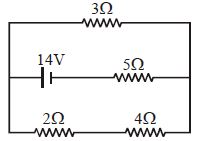
- 2In the following circuit, the magnitude of current $I _{ l }$, is $............A$.View Solution
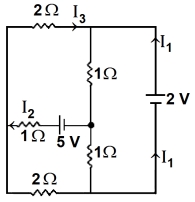
- 3View SolutionAccording to Joule's law, if the potential difference across a conductor having a material of specific resistance remains constant, then the heat produced in the conductor is directly proportional to
- 4View SolutionThe mechanism of the heat produced in a conductor when an electric current flows through it, can be explained on the basis of
- 5On interchanging the resistances, the balance point of a meter bridge shifts to the left by $10\ cm$. The resistance of their series combination is $1\ k\Omega$. How much was the resistance on the left slot before interchanging the resistances? .................. $\Omega$View Solution
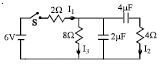
- 6In the circuit shown in the figure, the switch $S$ is initially open and the capacitor is initially uncharged. $ I_1, I_2$ and $I_3$ represent the current in the resistance $2\,\Omega , 4\,\Omega $ and $8\,\Omega$ respectively.View Solution
- 7An electric bulb rated as $200\, {W}$ at $100 \,{V}$ is used in a circuit having $200\, {V}$ supply. The resistance $'R'$ that must be put in series with the bulb so that the bulb delivers the same power is $.....\,\Omega$View Solution
- 8What will be the most suitable combination of three resistors $A =2\, \Omega, B =4\, \Omega, C =6\, \Omega$ so that $\left(\frac{22}{3}\right)\Omega$ is equivalent resistance of combination$?$View Solution
- 9The effective resistance between $A$ and $B$, if resistance of each resistor is $R$, will beView Solution
- 10Find out current in $3\,\Omega $ resistance in given circuitView Solution