Question
When an atom undergoes $\beta$-decay, its atomic number:

Answer

  1. Increases by 1
Explanation:
When an atom undergoes $\beta$-decay the atomic number increases by 1.
When an atom undergoes $\beta$-decay, one of the neutrons breaks into one proton and one electron. The resultant electron is then ejected out of the nucleus and this is called as the $\beta$ particle.
While the resultant proton stays inside the nucleus which results in increase of atomic number by 1, whereas the atomic mass remains invariant.

Need a full question paper?

Generate a complete, print-ready paper with questions like this in minutes — across 16+ boards, with answer keys.
Start Generating Free

Similar questions

Which of the following particles will describe the smallest circle when projected with the same velocity perpendicular to a magnetic field?
If a convex lens of focal  length 80 cm and a concave lens of focal length 50 cm are combined together, what will be their resulting power(a) + 6.5D(b) – 6.5 D(c) + 7.5 D(d) – 0.75 D
       
Consider sunlight incident on a slit of width $10^4A$. The image seen through the slit shall.
An electron is accelerated through a potential difference of $200$ volts. If $e/m$ for the electron be $1.6 \times 10^{11}$ coulomb/kg, the velocity acquired by the electron will be
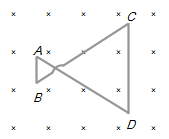
A conducting wire frame is placed in a magnetic field which is directed into the paper. The magnetic field is increasing at a constant rate. The directions of induced current in wires $AB$ and $CD$ are
A bullet hits a block kept at rest on a smooth horizontal surface and gets embedded into it. Which of the following does not change?
  1. Linear momentum of the block.
  2. Kinetic energy of the block.
  3. Gravitational potential energy of the block.
  4. Temperature of the block.
One end of a metal rod is dipped in boiling water and the other is dipped in melting ice:
  1. All parts of the rod are in thermal equilibrium with each other.
  2. We can assign a temperature to the rod.
  3. We can assign a temperature to the rod after steady state is reached.
  4. The state of the rod does not change after steady state is reached.
Lorentz force is:
A double convex lens of focal length $20 \ cm$ is made of glass of refractive index $\frac{3}{2}.$ When placed completely in water $\left(\mathrm{a}^{\mu_{\mathrm{w}}=\frac{4}{3}}\right)$, its focal length will be
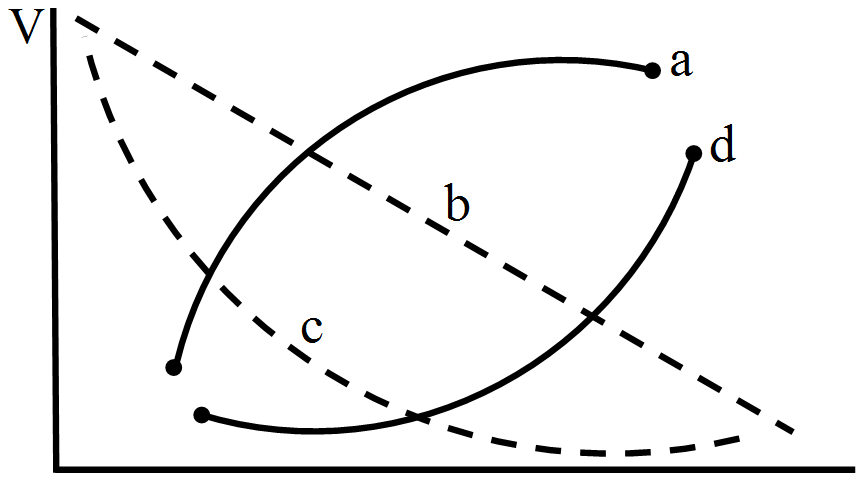
Which of the following curves may represent the speed of the electron in a hydrogen atom as a function of the principal quantum number n?