MCQ
When an atom undergoes $\beta-$decay, its atomic number:
  • A
    Does not change
  • Increases by $1$
  • C
    Decreases by $1$
  • D
    Increases by $2$

Answer

Correct option: B.
Increases by $1$

When an atom undergoes $\beta-$decay the atomic number increases by $1.$
When an atom undergoes $\beta-$decay, one of the neutrons breaks into one proton and one electron. The resultant electron is then ejected out of the nucleus and this is called as the $\beta$ particle.
While the resultant proton stays inside the nucleus which results in increase of atomic number by $1$, whereas the atomic mass remains invariant.

Need a full question paper?

Generate a complete, print-ready paper with questions like this in minutes — across 16+ boards, with answer keys.
Start Generating Free

Similar questions

Five identical plates each of area $A$ are joined as shown in the figure. The distance between the plates is $d$. The plates are connected to a potential difference of $V\;volts$. The charge on plates $1$ and $4$ will be
An electron is travelling in east direction and a magnetic field is applied in upward direction then electron will deflect in
The electron cannot exist inside the nucleus because:
An a-particle of 5 MeV energy strikes with a nucleus of uranium at stationary at an scattering angle of $180^{\circ}$. The nearest distance upto which a-particle reaches the nucleus will be of the order of
The energy contained in a small volume through which an electromagnetic wave is passing oscillates with:
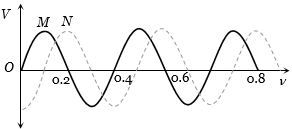
Two sinusoidal voltages of the same frequency are shown in the diagram. What is the frequency, and the phase relationship between the voltages

Frequency in $Hz$                    Phase lead of $N$ over $M$ in radians
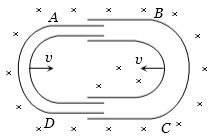
One conducting $U$ tube can slide inside another as shown in figure, maintaining electrical contacts between the tubes. The magnetic field $B$ is perpendicular to the plane of the figure. If each tube moves towards the other at a constant sped $v$ then the emf induced in the circuit in terms of $B,\,l$ and $v$ where $l$ is the width of each tube, will be
${ }_{92}^{238} A \rightarrow{ }_{90}^{234} B +{ }_2^4 D + Q$

In the given nuclear reaction, the approximate amount of energy released will be $.....\,MeV$

$\text { [Given, mass of }{ }_{92}^{238} A =238.05079 \times 931.5\,MeV / c ^2$

$\text { mass of }{ }_{90}^{234} B =234.04363 \times 931.5\,MeV / c ^2$

$\text { mass of } \left.{ }_2^4 D =4.00260 \times 931.5\,MeV / c ^2\right]$

Carbon -14 decays with half-life of about 5,800 years. In a sample of bone, the ratio of carbon -14 to carbon -12 is found to be $\frac {1}{4}$ of what it is in free air. This bone may belong to a period about x centuries ago, where x is nearest to
An electron $($mass m$)$ with an initial velocity $\text{v}=\text{v}_0\hat{\text{i}}$ is in an electric field $\text{E}=\text{E}_0\hat{\text{j}}$. If $\lambda_0=\frac{\text{h}}{\text{mv}_0}$, it’s de Breoglie wavelength at time t is given by: