Question
When an electron falls from a higher energy to a lower energy level, the difference in the energies appears in the form of electromagnetic radiation. Why cannot it be emitted as other forms of energy?

Answer

As electrons interact only electromagnetically, so, the transition of an electron from a higher energy to a lower energy level can appears in the form of electromagnetic radiation.

Need a full question paper?

Generate a complete, print-ready paper with questions like this in minutes — across 16+ boards, with answer keys.
Start Generating Free

Similar questions

Draw a plot of the binding energy per nucleon as a function of mass number for a large number of nuclei, 2⩽ A⩽240. How do you explain the constancy of binding energy per nucleon in the range 30 < A < 170 using the property that nuclear force is short - ranged?
An electron beam projected along the positive X-axis deflects along the positive Y-axis. If this deflection is caused by a magnetic field, what is the direction of the field? Can we conclude that the field is parallel to the Z-axis?
Describe briefly with the help of a circuit diagram, how the flow of current carriers in a p-n-p transistor is regulated with emitter-base junction forward biased and base-collector junction reverse biased.
Explain Ohm's law.
If work function of caesium metal is $2.14\ eV ,$ then calculate its threshold frequency.
What is the ratio of first excited state and corresponding orbital radius of ground state in hydrogen atom?
Sketch graph to show how charge Q given to a capacitor of capacitance C varies with the potential difference.
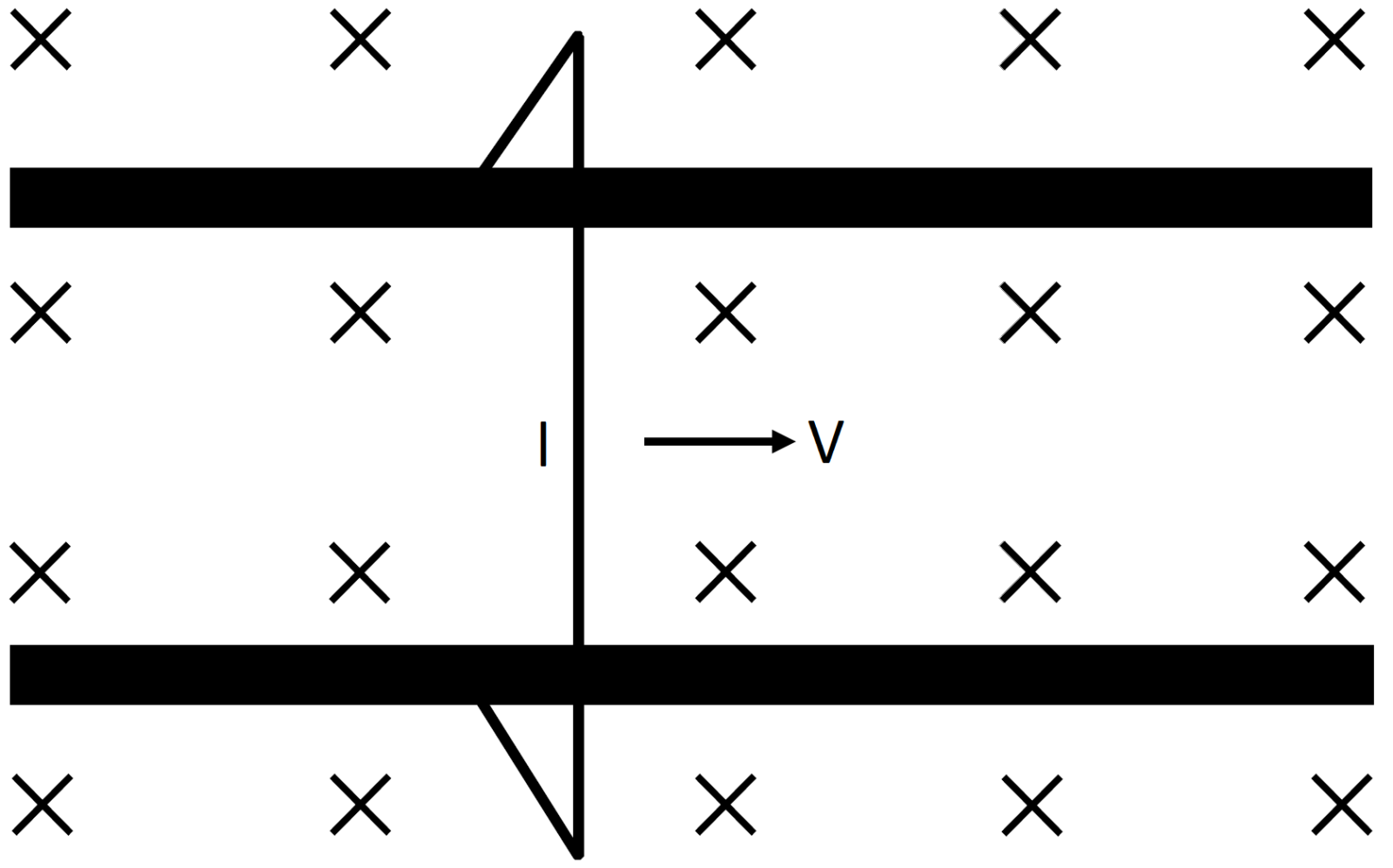
Figure shows a wire sliding on two parallel, conducting rails placed at a separation l. $A$ magnetic field $B$ exists in a direction perpendicular to the plane of the rails. What force is necessary to keep the wire moving at a constant velocity $v?$​​​​​​​
It is said that a liquid rises or is depressed in a capillary due to the surface tension. If a liquid neither rises nor depresses in a capillary, can we conclude that the surface tension of the liquid is zero?
Find the minimum and maximum wavelengths of sound in water that is in the audible range (20-20000Hz) for an average human ear. Speed of sound in water = 1450m/s.