Question 12 Marks
Define the distance of closest approach. An α-particle of kinetic energy 'K' is bombarded on a thin gold foil. The distance of the closest approach is 'r'. What will be the distance of closest approach for an α-particle of double the kinetic energy?
AnswerIt is the distance of charged particle from the centre of the nucleus, at which the whole of the initial kinetic energy of the (far off) charged particle gets converted into the electric potential energy of the system. Distance of closest approach $(r_c)$ is given by
$r_c=\frac{1}{4\pi\varepsilon_0}.\frac{2Ze^2}{K}$
‘K’ is doubled, $\therefore\text{ }r_c$ becomes $\frac{r}{2}$
View full question & answer→Question 22 Marks
The ground state energy of hydrogen atom is –13.6 eV. What are the kinetic and potential energies of the electron in this state?
AnswerGround state energy of hydrogen atom, E = -13.6 eV
This is the total energy of a hydrogen atom. Kinetic energy is equal to the negative of the total energy.
Kinetic energy = -E = -(-13.6) = 13.6 eV
Potential energy Is equal to the negative of two times of kinetic energy.
Potential energy = -2 × (13.6) = -27.2 eV
View full question & answer→Question 32 Marks
The radius of the innermost electron orbit of a hydrogen atom is $5.3\times 10^{–11} m.$ What are the radii of the $n = 2$ and $n = 3$ orbits?
AnswerThe radius of the innermost orbit of a hydrogen atom, $r_1 = 5.3 \times 10^{-11} rn.$
Let $r_2$ be the radius of the orbit at $n = 2$. It is related to the radius of the innermost orbit as:
$r_2 = (n)^2 r_1$
$= 4 \times 5.3 \times 10^{-11} = 2.12 \times 10^{-10} m$
For $n = 3,$ we can write the corresponding electron radius as:
$r_3 = (n)^2 r_1$
$= 9 \times 5.3 \times 10^{-11} = 4.77 \times 10^{-10} m$
Hence, the radii of an electron for $n = 2$ and $n = 3$ orbits are $2.12 \times 10^{-10} m$ and $4.77 \times 10^{-10} rn$ respectively.
View full question & answer→Question 42 Marks
If Bohr’s quantisation postulate (angular momentum $=\text{nh}/\pi$) is a basic law of nature, it should be equally valid for the case of planetary motion also. Why then do we never speak of quantisation of orbits of planets around the sun?
AnswerWe never speak of quantization of orbits of planets around the Sun because the angular momentum associated with planetary motion is largely relative to the value of Planck's constant (h). The angular momentum of the Earth in its orbit is of the order of 1070h. This leads to a very high value of quantum levels n of the order of 1070. For large values of n, successive energies and angular momenta are relatively very small. Hence, the quantum levels for planetary motion are considered continuous.
View full question & answer→Question 52 Marks
Suppose you are given a chance to repeat the alpha-particle scattering experiment using a thin sheet of solid hydrogen in place of the gold foil. $($Hydrogen is a solid at temperatures below $14 K.)$ What results do you expect?
AnswerIn the alpha$-$particle scattering experiment, if a thin sheet of solid hydrogen is used in place of a gold foil, then the scattering angle would not be large enough. This is because the mass of hvdroqen $(1.67 \times 10^{-27} \ kg)$ is less than the mass of incident $a-$parttcles $(6.64 \times 10^{-27} \ kg).$
Thus, the mass of the scattering particle is more than the target nucleus $($hydrogen$).$ As a result, the $Cl$ particles would not bounce back if solid hydrogen is used in the $a-$particle scattering experiment.
View full question & answer→Question 62 Marks
According to the classical electromagnetic theory, calculate the initial frequency of the light emitted by the electron revolving around a proton in hydrogen atom.
AnswerFrom Example 12.3 we know that velocity of electron moving around a proton in hydrogen atom in an orbit of radius $5.3 \times 10^{-11} m$ is $2.2 \times 10^{-6} m / s$. Thus, the frequency of the electron moving around the proton is
$
\begin{array}{r}
v=\frac{v}{2 \pi r}=\frac{2.2 \times 10^6 m s ^{-1}}{2 \pi\left(5.3 \times 10^{-11} m \right)} \\
\approx 6.6 \times 10^{15} Hz .
\end{array}
$
According to the classical electromagnetic theory we know that the frequency of the electromagnetic waves emitted by the revolving electrons is equal to the frequency of its revolution around the nucleus. Thus the initial frequency of the light emitted is $6.6 \times 10^{15} Hz$.
View full question & answer→Question 72 Marks
It is found experimentally that $13.6 eV$ energy is required to separate a hydrogen atom into a proton and an electron. Compute the orbital radius and the velocity of the electron in a hydrogen atom.
AnswerTotal energy of the electron in hydrogen atom is $-13.6 eV =$ $-13.6 \times 1.6 \times 10^{-19} J =-2.2 \times 10^{-18} J$. Thus from Eq. (12.4), we have
$
E=-\frac{e^2}{8 \pi \varepsilon_0 r}=-2.2 \times 10^{-18} J
$
This gives the orbital radius
$
\begin{aligned}
r & =-\frac{e^2}{8 \pi \varepsilon_0 E}=-\frac{\left(9 \times 10^9 N m ^2 / C ^2\right)\left(1.6 \times 10^{-19} C \right)^2}{(2)\left(-2.2 \times 10^{-18} J \right)} \\
& =5.3 \times 10^{-11} m .
\end{aligned}
$
The velocity of the revolving electron can be computed from Eq. (12.3) with $m=9.1 \times 10^{-31} kg$,
$
v=\frac{e}{\sqrt{4 \pi \varepsilon_0 m r}}=2.2 \times 10^6 m / s
$
View full question & answer→Question 82 Marks
In the Rutherford's nuclear model of the atom, the nucleus (radius about $10^{-15} m$ ) is analogous to the sun about which the electron move in orbit (radius $\approx 10^{-10} m$ ) like the earth orbits around the sun. If the dimensions of the solar system had the same proportions as those of the atom, would the earth be closer to or farther away from the sun than actually it is? The radius of earth's orbit is about $1.5 \times 10^{11} m$. The radius of sun is taken as $7 \times 10^8 m$.
AnswerThe ratio of the radius of electron's orbit to the radius of nucleus is $\left(10^{-10} m \right) /\left(10^{-15} m \right)=10^5$, that is, the radius of the electron's orbit is $10^5$ times larger than the radius of nucleus. If the radius of the earth's orbit around the sun were $10^5$ times larger than the radius of the sun, the radius of the earth's orbit would be $10^5 \times 7 \times 10^8 m =$ $7 \times 10^{13} m$. This is more than 100 times greater than the actual orbital radius of earth. Thus, the earth would be much farther away from the sun.
It implies that an atom contains a much greater fraction of empty space than our solar system does.
View full question & answer→Question 92 Marks
The ground state energy of hydrogen atom is – 13·6 eV. If an electron makes a transition from an energy level – 1·51 eV to – 3·4 eV, calculate the wavelength of the spectral line emitted and name the series of hydrogen spectrum to which it belongs.
AnswerEnergy difference $=3.4\text{ }\text{eV}-1.51\text{ }\text{eV}=1.89\text{ }\text{eV}=3.024\times10^{-19}\text{ }\text{J}$
Energy $=\frac{hc}{\lambda}=3.024\times10^{-19}\text{ }\text{J}$
Wavelength $=6.57\times 10^{-7}\text{m}$
Series is Balmer series.
View full question & answer→Question 102 Marks
Using Rutherford model of the atom, derive the expression for the total energy of the electron in hydrogen atom. What is the significance of total negative energy possessed by the electron?
AnswerAs per Rutherford’s model $\frac{\text{mv}^{2}}{\text{r}} = \frac{1}{4\pi\in_{o}}\frac{\text{ze}^{2}}{\text{r}}$ $\rightarrow\text{mv}^{2} = \frac{1}{4\pi\in_{o}}\frac{\text{ze}^{2}}{\text{r}}$ 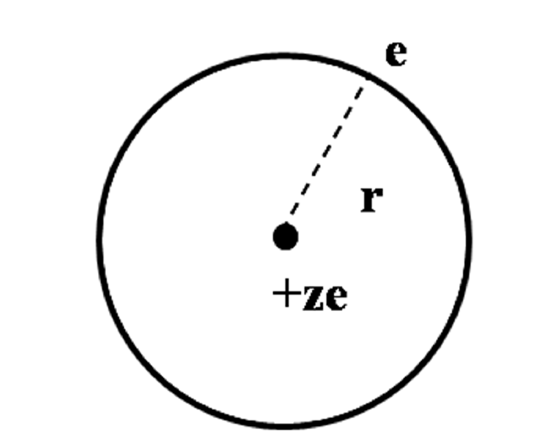 Total energy = P.E +K.E. $ = - \frac{1}{4\pi\in_{o}}\frac{\text{ze}^{2}}{\text{r}} + \frac{1}{2}\text{mv}^{2}$ $ = - \frac{1}{2}.\frac{1}{4\pi\in_{o}}\frac{\text{ze}^{2}}{\text{r}} = = - \frac{1}{8\pi\in_{o}}\frac{\text{ze}^{2}}{\text{r}}$ Negative Sign implies that. Electron – nucleus form a bound system.Alternate Answer
Electron – nucleus form an attractive system. View full question & answer→Question 112 Marks
Define ionisation energy. How would the ionsation energy change when electron in hydrogen atom is replaced by a particle of mass 200 times that of the electron but having the same charge?
AnswerThe minimum energy, required to free the electron from the ground state of the hydrogen atom, is known as Ionization Energy.
$\text{E}_{k} = \frac{\text{me}^{4}}{8\in_{o}^{2}\text{h}^{2}}\text{i.e,.}\text{E}_{o}\propto\text{m}$
Therefore, Ionization Energy will become 200 times.
View full question & answer→Question 122 Marks
Calculate the shortest wavelength of the spectral lines emitted in Balmer series.$[$Give Rydberg constant, $R = 10^{7 }m^{-1}]$
Answer$\frac{1}{\lambda} =\text{R}\bigg(\frac{1}{2^{2}} - \frac{1}{\propto^{2}}\bigg)$
For shortest wavelength, $\text{n} = \alpha$
Therefore, $\frac{1}{\lambda} = \frac{\text{R}}{4} = > \lambda = \frac{4}{\text{R}} = 4 \times10^{-7}\text{m}.$
View full question & answer→Question 132 Marks
Using Bohr’s postulates of the atomic model, derive the expression for radius of $n^{th}$ electron orbit. Hence obtain the expression for Bohr’s radius.
AnswerFor the electron, we have
Bohr’s Postulate $(\text{mvr} = \frac{\text{nh}}{2\pi})$
$\frac{\text{mv}^{2}}{\text{r}} = \frac{1}{4\pi\in_{o}}\frac{\text{ze}^{2}}{\text{r}^{2}}$
and mvr $ = \frac{\text{nh}}{2\pi}$
$\therefore\text{m}^{2}\text{v}^{2}\text{r}^{2} = \frac{\text{n}^{2}\text{h}^{2}}{4\pi^{2}}$
and $mv^2r = \frac{1}{4\pi\in_{o}}\text{ze}^{2}$
$\therefore\text{r} = \frac{\in_{o}\text{n}^{2}\text{h}^{2}}{\pi\text{ze}^{2}\text{m}}$
Bohr’s radius $($for $n = 1) = \in_{o } \text{h}^{2}/\pi\text{ze}^{2}\text{m}.$
View full question & answer→Question 142 Marks
Determine the distance of closest approach when an alpha particle of kinetic energy 4·5 MeV strikes a nucleus of Z = 80, stops and reverses its direction.
AnswerDistance of the closest approach.
$\text{r}_{o} = \frac{1}{4\pi\in_{0}}.\frac{2\text{ze}^{2}}{\text{E}_\propto}$
$ =\frac{2\times9\times10^{9}\times80\times(1.6\times10^{-19})^{2}}{4.5\times10^{6}\times1.6\times10^{−19}}$
$ =5.12\times 10^{−14} \text{?}$.
View full question & answer→Question 152 Marks
A 12·5 eV electron beam is used to excite a gaseous hydrogen atom at room temperature. Determine the wavelengths and the corresponding series of the lines emitted.
Answer
- We have $E_n\propto\frac{1}{n^2}$
- $\therefore$ The energy levels are
−13.6 eV; −3.4 eV; −1.5 eV
$\therefore$ The 12.5 eV electron beam can excite the electron up to n = 3 level only.
- Energy values, of the emitted photons, of the three possible lines are
3 → 1 ∶ (−1.5 + 13.6)eV = 12.1 eV
2 → 1 ∶ (−3.4 + 13.6)eV = 10.2 eV
3 → 2 ∶ (−1.5 + 3.4)eV = 1.9 eV
The corresponding wavelengths are: 102 nm, 122 nm and 653 n
$\big(\lambda=\frac{hc}{E}\big)$ View full question & answer→Question 162 Marks
- State Bohr postulate of hydrogen atom that gives the relationship for the frequency of emitted photon in a transition.
- An electron jumps from fourth to first orbit in an atom. How many maximum number of spectral lines can be emitted by the atom? To which series these lines correspond?
Answer
- Bohr’s (third) postulate: An electron might make a transition from one of its specified non- radiating orbits to another of lower energy. When it does so, a photon is emitted having energy equal to the energy difference between the initial and final states. The frequency of the emitted photon is given by $hv=E_i-E_f$
- Six spectral lines can be emitted.
| 4 → 1 |
$\bigg\}$ |
Lyman series |
| 3 → 1 |
| 2 → 1 |
| 4 → 2 |
$\bigg\}$ |
Balmer series |
| 3 → 2 |
| 4 → 3 |
|
Paschen series |
View full question & answer→Question 172 Marks
Use de$-$ Broglie’s hypothesis to write the relation for the nth radius of Bohr orbit in terms of Bohr’s quantization condition of orbital angular momentum.
AnswerWavelength associated with electron in its orbit is given by de$-$ Broglie relation
$\lambda=\frac{h}{p}=\frac{h}{mv_n}$
Only those waves survive which form standing waves. For electron moving in $n^{th}$ circular orbit of radius $r_n$
$2\pi r_n=n\lambda;\text{ }\text{n}=1,2,3.....$
$\therefore\text{ }2\pi r_n=\frac{nh}{m\vartheta_n}{}$
$r_n=\frac{nh}{2\pi m\vartheta_n}$
View full question & answer→Question 182 Marks
Calculate the energy in fusion reaction:
$^{2}_{1}\text{H} + ^{2}_{1}\text{H}\rightarrow^{3}_{2}\text{H}+ \text{n}, \text{where BE}\text{ of} ^{ 2}_{1}\text{H} = 2.23 \text{MeV} \text{and} \text{of} ^{3}_{2}\text{He} = 7.73 \text{MeV}.$
AnswerTotal Binding energy of Initial System
i.e. $^{2}_{1}\text{H} + ^{2}_{1}\text{H} = ( 2.23 + 2.23)\text{MeV}$
= 4.46 MeV
Binding energy of Final System i.e. $^{3}_{2}\text{He}$
= 7.73 MeV
Hence energy released = 7.73 MeV- 4.46 MeV
= 3.27 MeV.
View full question & answer→Question 192 Marks
Show that the radius of the orbit in hydrogen atom varies as n2, where n is the principal quantum number of the atom.
Answer$\frac{\text{mv}^{2}}{\text{r}} = \frac{1}{4\pi\in_{\circ}}\frac{\text{e}^{2}}{\text{r}^{2}}$
or $\text{mv}^{2}\text{r} = \frac{1}{4\pi\in_{\circ}}\text{e}^{2}$.................................(i)
$\text{mvr} = \frac{\text{nh}}{\text{2}\pi}$
$\text{m}^{2}\text{v}^{2}\text{r}^{2} = \frac{\text{n}^{2}\text{h}^{2}}{4\pi^{2}}$......................................(ii)
Divide (ii) by (i)
$\text{mr} =\frac{\text{n}^{2}\text{h}^{2}}{\text{4}\pi^{2}}\times\frac{4\pi\in_\circ}{\text{e}^{2}}$
$\therefore\text{r} = \frac{\text{n}^{2}\text{h}^{2}}{4\pi^{2}\text{me}^{2}}.4\pi\in_{\circ}$
$\therefore\text{r}\propto\text{n}^{2}$.
View full question & answer→Question 202 Marks
Find the wavelength of the electron orbiting in the first excited state in hydrogen atom.
AnswerRadius of $n^{th}$ orbit $r= \text{r}_{o}\text{n}^2=0.53n^2\mathring{\text{A}}$
$=0.53\times4\mathring{\text{A}}$
$=212 \mathring{\text{ A}}$
For an electron revolving in $n^{th}$ orbit, according to de Broglie relation $2\pi{r}_n= n \lambda,$ For ${1}^{st}$ excited state ${n}=2$
$2\times3.14\times2.12\times10^{-10}=2\lambda$
$\lambda=3.14\times2.12\times10^{-10}n$
$=6.67\overset{\circ}{\text{A}}$
Alternate Answer
$\lambda=\frac{\text{h}}{\text{p}}=\frac{\text{h}}{\text{m}_ev}$
Velocity of electron in first excited state, $v=1.1\times10^{-6}{\text{m/s}}$
$\lambda=\frac{6.63\times10^{-34}}{9\times10^{-31}\times1.1\times10^{6}}$
$=6.67\times{10}^{-10}\text{m}$
$=6.67\overset{\circ}{\text{A}}$
Alternate Answer
Let $\lambda_n$ be the wavelength of the electron in the $n^{th}$ orbit.
We then have $2\pi r_n=n\lambda_n$
$\therefore \lambda_2=\pi{r}_{2}$
Also ${r}_{2}=4{\text{r}}_{0}$
$(r_{0} =$ radius of the ground state orbit$)$
$\therefore \lambda_2=4\pi{r}_{0}$
Alternate Answer
Let $\lambda_n$ be the wavelength of the electron in the $n^{th}$ orbit.
We then have $\lambda_n=\frac{h}{mv_n}$ But $v_n=\frac{v_0}{n}$
$\lambda_2=\frac{2h}{mv_0}$ Where $v_0$ is the velocity of electron in ground state.
View full question & answer→Question 212 Marks
A nucleus with mass number A=240 and BE/A = 7.6 MeV breaks into two fragments each of A = 120 with BE/A = 8.5 MeV. Calculate the released energy.
AnswerBinding energy of nucleus with mass number 240,
$\text{E}_{bn} = 240\times7.6\text{MeV}$
Binding energy of two fragments
= 2 × 120 × 8.5 MeV
Energy released = 240 (8.5 – 7.6) MeV
= 240 × 0.9
= 216 MeV.
View full question & answer→Question 222 Marks
Write two important limitations of Rutherford nuclear model of the atom.
Answer
- According to Rutherford model, electron orbiting around the nucleus, continuously radiates energy due to the acceleration; hence the atom will not remain stable.
- As electron spirals inwards; its angular velocity and frequency change continuously; therefore it will emit a continuous spectrum.
View full question & answer→Question 232 Marks
Find out the wavelength of the electron orbiting in the ground state of hydrogen atom.
AnswerRadius of ground state of hydrogen atom $=0.53\mathring{\text{A}}=0.53\times10^{-10}m$ According to de Broglie relation $2\pi =n\lambda$ For ground state $n=1$ $2\times3.14\times0.53\times10^{-10}=1\times\lambda$ $\therefore\lambda=3.32\times10^{-10}m$ $=3.32\mathring{\text{A}}$Alternate Answer
Velocity of electron, in the ground state, of hydrogen atom $=2.18\times10^{-6}m/s$ Hence momentum of revolving electron $\text{p}=mv$ $=9.1\times10^{-31}\times2.18\times10^{-6}kg\text{ }m/s$ $\lambda=\frac{h}{p}=\frac{6.63\times10^{-34}}{9.1\times10^{-31}\times2.18\times10^{-6}}\text{m}$ $=3.32\mathring{\text{A}}$
View full question & answer→Question 242 Marks
Using Bohr’s atomic model, derive the expression for the radius of $n^{th}$ orbit of the revolving electron in a hydrogen atom.
Answer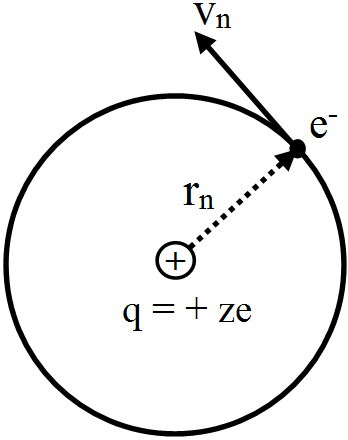
Centripetal force $=$ Electrostatic attraction between nucleus $\&\ e^-,$
$\Rightarrow\frac{\text{mv}^2_\text{n}}{\text{r}_\text{n}}\Big(\frac{1}{4\pi\varepsilon_0}\Big)\frac{(\text{ze)}(\text{e})}{\text{r}^\text{x}_\text{n}}$
$\Rightarrow\text{mv}^2_\text{n}\text{r}_\text{n}=\frac{\text{ze}^2}{4\pi\varepsilon_0}\ ...(1)$
By Bohr $II$ postulali,
Angular momentum of $e^-$
$\text{mv}_\text{n}\text{r}_\text{n}=\frac{\text{nh}}{2\pi}\ . ..(2)$
$(1)\div(2)$
$\Rightarrow\frac{\text{mv}^2_\text{n}\text{r}_\text{n}}{\text{mv}_\text{n}\text{r}_\text{n}}=\Big(\frac{\text{z}e^2}{4\pi\varepsilon_0}\Big)\times\frac{2\pi}{\text{rh}}$
$\Rightarrow\text{speed of e}^-$
$\Rightarrow\text{v}_\text{n}=\frac{\text{ze}^2}{2\varepsilon_0\text{nh}}$ View full question & answer→Question 252 Marks
State Bohr’s quantization condition of angular momentum. Calculate the shortest wavelength of the Bracket series and state to which part of the electromagnetic spectrum does it belong.
AnswerAccording to Bohr's quantisation, the electrons revolve around the nucleus only in those orbits for which the angular momentum is the integral multiple of
$\frac{\text{h}}{2\pi}$
$\text{L}=\frac{\text{nh}}{2\pi}$
For Bracket series $\text{n}_2=\infty,$
$\frac{1}{\lambda}=\text{R}_\text{H}\text{Z}^2\Big\{\frac{1}{4^2}-\frac{1}{\infty}\Big\}$
$\frac{1}{\lambda}=\frac{\text{R}_\text{H}}{16}$
$\lambda=\frac{16}{\text{R}_\text{H}}=14.58\times10^{-7}\text{m}$
This wavelength belongs to the inftra-red region.
View full question & answer→Question 262 Marks
Calculate the orbital period of the electron in the first excited state of hydrogen atom.
Answer$\text{r}=0.53\frac{\text{n}^2}{\text{z}}\times10^{-10}\text{m}$
For first excited state n = 2
$\text{r}=0.53\frac{2^2}{1}\times10^{-10}$
$\text{r}=2.12\times10^{-10}\text{m}$
$\text{v}=\text{v}_0\times\frac{\text{z}}{\text{n}}\text{m}/\text{s}$
$\text{v}=2.188\times10^6\times\frac{\text{z}}{\text{n}}\text{m}/\text{s}$
For first exicited state, n = 2, Z = 1 for hydrogen atom
$\therefore\text{v}=2.188\times10^6\times\frac{1}{2}\text{m}/\text{s}$
$\Rightarrow\text{v}=1.094\times10^6\text{m}/\text{s}$
$\because$ Orbital period $=\frac{2\pi\text{r}}{\text{v}}=\frac{2\times3.14\times2.12\times10^{-10}}{1.094\times10^6}$
Orbital period $=1.22\times10^{-15}\ \text{sec}$
View full question & answer→Question 272 Marks
State Bohr’s quantisation condition of angular momentum. Calculate the shortest wavelength of the Bracket series and state to which part of the electromagnetic spectrum does it belong.
AnswerAccording to Bohr's quantisation, the electrons revolve around the nucleus only in those orbits for which the angular momentum is the integral multiple of
$\frac{\text{h}}{2\pi}$
$\text{L}=\frac{\text{nh}}{2\pi}$
For Bracket series $\text{n}_2=\infty,$
$\frac{1}{\lambda}=\text{R}_\text{H}\text{Z}^2\Big\{\frac{1}{4^2}-\frac{1}{\infty}\Big\}$
$\frac{1}{\lambda}=\frac{\text{R}_\text{H}}{16}$
$\lambda=\frac{16}{\text{R}_\text{H}}=14.58\times10^{-7}\text{m}$
This wavelength belongs to the infra-red region.
View full question & answer→Question 282 Marks
Suppose, in certain conditions only those transitions are allowed to hydrogen atoms in which the principal quantum number n changes by 2. (a) Find the smallest wavelength emitted by hydrogen. (b) List the wavelength emitted by hydrogen in the visible range (380nm to 780nm).
Answer
- $\text{n}_1=1,\text{ n}_2=3,\text{ E}=13.6\Big(\frac{1}{1}-\frac{1}{9}\Big)=\frac{13.6\times8}{9}=\frac{\text{hc}}{\lambda}$
or $\frac{13.6\times8}{9}=\frac{4.14\times10^{-15}\times3\times10^8}{\lambda}$
$\lambda=\frac{4.14\ \times\ 3\ \times\ 10^{-7}}{13.6\ \times\ 8}=1.027\times10^{-7}=103\text{nm}$
- As ‘n’ changes by 2, we may consider n = 2 to n = 4
then, $\text{E}=13.6\times\Big(\frac{1}{4}-\frac{1}{16}\Big)=2.55\text{ev}$ and $2.55=\frac{1242}{\lambda}$ or $\lambda=487\text{nm}$ View full question & answer→Question 292 Marks
- Find the first excitation potential of $He^+$ ion.
- Find the ionization potential of $Li^{++}$ ion.
Answer
- First excitation potential of,
$He^+ = 10.2 \times z^2 = 10.2 \times 4 = 40.8V$
- Ionization potential of $L_1{}^{++}$
$= 13.6V \times z^2 = 13.6 \times 9 = 122.4V$ View full question & answer→Question 302 Marks
The mass of a $H-$atom is less than the sum of the masses of a proton and electron. Why is this?
AnswerFrom mass energy equivalence relationship $($given by Einstein$), E = mc^2.$
Suppose, $B.E.$ represents the binding energy of Hydrogen atom $(= 13.6\ eV),$
the equivalent of this energy $= B/c^2.$
The mass of Hydrogen atom $= mp + me - B/c^2$ and is less than the mass of a proton and electron.
View full question & answer→Question 312 Marks
A spectroscopic instrument can resolve two nearby wavelengths $\lambda$ and $\lambda+\Delta\lambda$ if $\frac{\lambda}{\Delta\lambda}$ is smaller than 8000. This is used to study the spectral lines of the Balmer series of hydrogen. Approximately how many lines will be resolved by the instrument?
AnswerThe range of Balmer series is 656.3nm to 365nm. It can resolve $\lambda$ and $\lambda+\Delta\lambda$ if $\frac{\lambda}{\Delta\lambda}=8000$
$\therefore$ No. of wavelength in the range $=\frac{656.3-365}{8000}=36$
Total no. of lines 36 + 2 = 38 [extra two is for first and last wavelength]
View full question & answer→Question 322 Marks
What is the longest wavelength of photon that can ionize a hydrogen atom in its ground state? Specify the type of radiation.
AnswerSince, the energy of the incident photon $=\text{hv}=\frac{\text{hc}}{\lambda}=13.6\text{eV}$
$\lambda=\frac{6.6\times10^{-34}\times3\times10^8}{13.6\times1.6\times10^{-19}}$
$\lambda=0.910\times10^{-10}\text{m}$
This radiation is in ultraviolet region.
View full question & answer→Question 332 Marks
The light emitted in the transition $n = 3$ to $n = 2$ in hydrogen is called $\text{H}_\alpha$ light. Find the maximum work function a metal can have so that $\text{H}_\alpha$ light can emit photoelectrons from it.
Answer$n_1 = 2, n_2 = 3$
Energy possessed by $\text{H}_\alpha$ light
$=13.6\bigg(\frac{1}{\text{n}^2_1}-\frac{1}{\text{n}^2_2}\Big)$
$=13.6\times\Big(\frac{1}{4}-\frac{1}{9}\Big)$
$=1.89\ \text{ev}$
For $\text{H}_\alpha$ light to be able to emit photoelectrons from a metal.
the work function must be greater than or equal to $1.89\ ev.$
View full question & answer→Question 342 Marks
Find the maximum Coulomb force that can act on the electron due to the nucleus in a hydrogen atom.
Answer$\text{F}=\frac{\text{q}_1\text{q}_2}{4\pi\epsilon_0\text{r}^2}$
[Smallest dist. Between the electron and nucleus in the radius of first Bohrs orbit]
$=\frac{\big(1.6\times10^{-19}\big)\times\big(1.6\times10^{-19}\big)\times9\times10^9}{\big(0.53\times10^{-10}\big)^2}$
$=82.02\times10^{-9}=8.202\times10^{-8}=8.2\times10^{-8}\text{N}$
View full question & answer→Question 352 Marks
A filter transmits only the radiation of wavelength greater than $440\ nm.$ Radiation from a hydrogen$-$discharge tube goes through such a filter and is incident on a metal of work function $2.0eV.$ Find the stopping potential which can stop the photoelectrons.
AnswerWavelength of radiation coming from filter, $\lambda=440\text{nm}$
Work function of metal, $\phi=2\text{eV}$
Charge of an electron e $= 1.6 \times 10^{-9}C$
Let $V_0$ be the stopping potential.
From Einstein's photoelectric equation,
$\frac{\text{hc}}{\lambda}-\phi=\text{eV}_0$
Here,
$h =$ Planck constant
$c =$ Speed of light
$\lambda=$ Wavelength of radiation
$\frac{4.14\times10^{-15}\times3\times10^8}{440\times10^{-9}}-2\text{eV}=\text{eV}_0$
$\text{eV}_0=\Big(\frac{1242}{440}-2\Big)\text{eV}$
$\text{eV}_0=0.823\text{eV}$
$\text{V}_0=0.823\text{ volts}$
View full question & answer→Question 362 Marks
When an electron falls from a higher energy to a lower energy level, the difference in the energies appears in the form of electromagnetic radiation. Why cannot it be emitted as other forms of energy?
AnswerAs electrons interact only electromagnetically, so, the transition of an electron from a higher energy to a lower energy level can appears in the form of electromagnetic radiation.
View full question & answer→Question 372 Marks
The average kinetic energy of molecules in a gas at temperature $T$ is $1.5kT.$ Find the temperature at which the average kinetic energy of the molecules of hydrogen equals the binding energy of its atoms. Will hydrogen remain in molecular from at this temperature? Take $k = 8.62 \times 10^{-5}eVK^{-1}.$
Answer$\text{KE}=\frac{3}{2}\text{KT}=1.5\text{KT},\text{ K}=8.62\times10^{-5}\text{eV/k},$
Binding Energy $=-13.6\Big(\frac{1}{\infty}-\frac{1}{1}\Big)=13.6\text{eV}$
According to the question, $1.5KT = 13.6$
$\Rightarrow1.5\times8.62\times10^{-5}\times\text{T}=13.6$
$\Rightarrow\text{T}=\frac{13.6}{1.5\ \times\ 8.62\ \times\ 10^{-5}}=1.05\times10^5\text{K}$
No, because the molecule exists an $H_2^+$ which is impossible.
View full question & answer→Question 382 Marks
Consider two different hydrogen atoms. The electron in each atom is in an excited state. Is it possible for the electrons to have different energies but the same orbital angular momentum according to the Bohr model?
AnswerAs per Bohr model, $\text{En}=-\Big(\frac{13.6}{\text{n}^2}\Big)$. Now electrons have different energies it means they have different values of n. So, their angular momentum $\Big(\text{mvr}=\frac{\text{nh}}{2\pi}\Big)$ will be different.
View full question & answer→Question 392 Marks
According to Maxwell's theory of electrodynamics, an electron going in a circle should emit radiation of frequency equal to its frequency of revolution. What should be the wavelength of the radiation emitted by a hydrogen atom in ground state if this rule is followed?
AnswerFrequency of the revolution in the ground state is $\frac{\text{V}_0}{2\pi\text{r}_0}$
$[r_0 =$ radius of ground state$, V_0 =$ velocity in the ground state$]$
$\therefore$ Frequency of radiation emitted is $\frac{\text{V}_0}{2\pi\text{r}_0}=\text{f}$
$\therefore\text{C}=\text{f}\lambda$
$\lambda=\frac{\text{C}}{\text{f}}=\frac{2\pi\text{C}\text{r}_0}{\text{V}_0}$
$\therefore\lambda=\frac{2\pi\text{C}\text{r}_0}{\text{V}_0}$
$\lambda=45.686\ \text{nm}$
$=45.7\text{nm}$
View full question & answer→Question 402 Marks
Balmer series was observed and analysed before the other series. Can you suggest a reason for such an order?
AnswerThe Balmer series lies in the visible range. Therefore, it was observed and analysed before the other series.
The wavelength range of Balmer series is from $364\ nm (\text{for n}_2=\infty)$ to $655\ nm ($for $n_{2 }= 3).$
View full question & answer→Question 412 Marks
Light from Balmer series of hydrogen is able to eject photoelectrons from a metal. What can be the maximum work function of the metal?
AnswerThe maximum energy liberated by the Balmer Series is $\text{n}_1=2,\text{ n}_2=\infty$
$\text{E}=13.6\bigg(\frac{1}{\text{n}^2_1}-\frac{1}{\text{n}^2_2}\bigg)=13.6\times\frac{1}{4}=3.4\text{ev}$
3.4ev is the maximum work function of the metal.
View full question & answer→Question 422 Marks
Electrons are emitted from an electron gun at almost zero velocity and are accelerated by an electric field $E$ through a distance of $1.0m.$ The electrons are now scattered by an atomic hydrogen sample in ground state. What should be the minimum value of $E$ so that red light of wavelength $656.3\ nm$ may be emitted by the hydrogen?
AnswerThe given wavelength in Balmer series.
The first line, which requires minimum energy is from $n_1 = 3$ to $n_2= 2$
$\therefore$ The energy should be equal to the energy required for transition from ground state to $n = 3$
i.e., $\text{E}=13.6\Big[1-\Big(\frac{1}{9}\Big)\Big]$
$=12.09\ \text{eV}$
$\therefore$ Minimum value of electric field $= 12.09\ v/m = 12.1\ v/m$
View full question & answer→Question 432 Marks
A neutron having kinetic energy 12.5eV collides with a hydrogen atom at rest. Nelgect the difference in mass between the neutron and the hydrogen atom and assume that the neutron does not leave its line of motion. Find the possible kinetic energies of the neutron after the event.
AnswerIn one dimensional elastic collision of two bodies of equal masses. The initial velocities of bodies are interchanged after collision.
$\therefore$ Velocity of the neutron after collision is zero.
Hence, it has zero energy.
View full question & answer→Question 442 Marks
Why do $\alpha$-particles have high ionising power?
Answer$\alpha$-particles are heavier, they move slowly; so possess large momentum. Due to this property they come in contact with large number of particles; so they possess high ionising power.
View full question & answer→Question 452 Marks
Find the binding energy of a hydrogen atom in the state n = 2.
Answer$\text{n}_1=2,\ \text{n}_2=\infty$
$\text{E}=\frac{-13.6}{\text{n}^2_1}-\frac{-13.6}{\text{n}^2_2}$
$\text{E}=13.6\bigg(\frac{1}{\text{n}^2_1}-\frac{1}{\text{n}^2_2}\bigg)$
$\text{E}=13.6\Big(\frac{1}{\infty}-\frac{1}{4}\Big)$
$\text{E}=\frac{-13.6}{4}=-3.4\text{eV}$
View full question & answer→Question 462 Marks
Find the maximum angular speed of the electron of a hydrogen atom in a stationary orbit.
AnswerWe know, $\text{m}\mu\text{r}=\frac{\text{nh}}{2\pi}$
$\Rightarrow\text{mr}^2\text{w}=\frac{\text{nh}}{2\pi}$
$\Rightarrow\text{w}=\frac{\text{hn}}{2\pi\times\text{m}\times\text{r}^2}$
$\Rightarrow\text{w}=\frac{1\times6.63\times10^{-34}}{2\times3.14\times9.1\times10^{-31}\times(0.53)^2\times10^{-20}}$
$\Rightarrow\text{w}=0.413\times10^{17}\text{rad/s}$
$\Rightarrow\text{w}=4.13\times10^{17}\text{rad/s}$
View full question & answer→Question 472 Marks
Evaluate Rydberg constant by putting the values of the fundamental constants in its expression.
Answer$\text{Rydbergs constant}=\frac{\text{me}^4}{8\text{h}^3\text{C}\epsilon_0^2}$
$\text{m}_\text{e}=9.1\times10^{-31}\text{kg},\text{ e}=1.6\times10^{-19}\text{c},\text{ h}=6.63\times10^{-34}\text{J-s}$
$\text{C}=3\times10^{8}\text{m/s},\epsilon_0=8.85\times10^{-12}$
$\text{R}=\frac{9.1\times10^{-31}\times(1.6\times10^{-19})^4}{8\times(6.63\times10^{-34})^3\times3\times10^8\times(8.85\times10^{-12})^2}$
$\text{R}=1.097\times10^{7}\text{m}^{-1}$
View full question & answer→Question 482 Marks
Using Bohr model, calculate the electric current created by the electron when the $H-$atom is in the ground state.
Answer$v =$ velocity of electron$, a_0 =$ Bohr radius.
Number of revolutions per unit time $=\frac{2\pi\text{a}_0}{\text{V}_0}$
So, current $=\text{i}=\frac{2\pi\text{a}_0}{\text{v}}\text{e}.$
View full question & answer→Question 492 Marks
A gas of hydrogen$-$like ions is prepared in a particular excited state $A$. It emits photons having wavelength equal to the wavelength of the first line of the Lyman series together with photons of five other wavelengths. Identify the gas and find the principal quantum number of the state $A.$
Answer
- The gas emits 6 wavelengths, let it be in $n^{th}$ excited state.
$\Rightarrow\frac{\text{n}(\text{n}-1)}{2}=6$
$\Rightarrow\text{n}=4$
$\therefore$ The gas is in $4^{th}$ excited state.
- Total no. of wavelengths in the transition is $6.$ We have,
$\frac{\text{n}(\text{n}-1)}{2}=6$
$\Rightarrow\text{n}=4$ View full question & answer→Question 502 Marks
A hydrogen atom in a state having a binding energy of 0.85eV makes transition to a state with excitation energy 10.2eV (a) Identify the quantum numbers n of the upper and the lower energy states involved in the transition. (b) Find the wavelength of the emitted radiation.
Answer
- From the energy data we see that the H atom transists from binding energy of 0.85 eV to exitation energy of 10.2eV = Binding Energy of -3.4eV.
So, n = 4 to n = 2
- We know $=\frac{1}{\lambda}=1.097\times10^{7}\Big(\frac{1}{4}-\frac{1}{16}\Big)$
$\lambda=\frac{16}{1.097\times3\times10^7}=4.8617\times10^{-7}=487\text{nm}$ View full question & answer→Question 512 Marks
"The total energy of the electron in the hydrogen atom is negative." What does this fact indicate? If the total energy of the electron was positive than what result will have been achieved?
AnswerNegative energy indicates that the electron is bound to the nucleus. If energy were positive, the electron would be free and would not revolve in a closed orbit.
View full question & answer→