MCQ
When an electron jumps from the fourth orbit to the second orbit, one gets the:
- ASecond line of Paschen series.
- BSecond line of Balmer series.
- CFirst line of Pfund series.
- DSecond line of Lyman series.
Generate a complete, print-ready paper with questions like this in minutes — across 16+ boards, with answer keys.
Assertion : When PN-junction is forward biased then motion of charge carriers at junction is due to diffusion. In reverse biasing. The cause of motion of charge is drifting.
Reason : In the following circuit emitter is reverse biased and collector is forward biased.

|
(a) If both assertion and reason are true and the reason is the correct explanation of the assertion. |
|
(b) If both assertion and reason are true but reason is not the correct explanation of the assertion. |
|
(c) If assertion is true but reason is false. |
|
(d) If the assertion and reason both are false. |
Television signals broadcast from the moon can be received on the earth while the TV broadcast from Delhi cannot be received at places about 100 km distant from Delhi. This is because
|
(a) There is no atmosphere around the moon |
|
(b) Of strong gravity effect on TV signals |
|
(c) TV signals travel straight and cannot follow the curvature of the earth |
|
(d) There is atmosphere around the earth |
If in a voltaic cell 5 gm of zinc is consumed, then we get how many ampere hours ? (Given that E.C.E. of Zn is 3.387  kg/coulomb)
|
(a) 2.05 |
(b) 8.2 |
(c) 4.1 |
(d) |
In the given figure, the equivalent resistance between the points A and B is

|
(a) 8 W |
(b) 6 W |
(c) 4 W |
(d) 2 W |
In producing X-rays a beam of electrons accelerated by a potential difference V is made to strike a metal target. For what value of V, X-rays will have the lowest wavelength of 0.3094 Å
| (a) 10 kV | (b) 20 kV | (c) 30 kV | (d) 40 kV |
A metallic square loop ABCD is moving in its own plane with velocity v in a uniform magnetic field perpendicular to its plane as shown in the figure. An electric field is induced
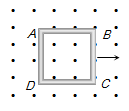
|
(a) In AD, but not in BC |
(b) In BC, but not in AD |
|
(c) Neither in AD nor in BC |
(d) In both AD and BC |
