MCQ
When an object covers equal distances in equal time intervals, then its speed is:
  • A
    slow motion
  • B
    accelerated pace
  • C
    uneven motion
  • uneven motion

Answer

Correct option: D.
uneven motion
d

Need a full question paper?

Generate a complete, print-ready paper with questions like this in minutes — across 16+ boards, with answer keys.
Start Generating Free

Similar questions

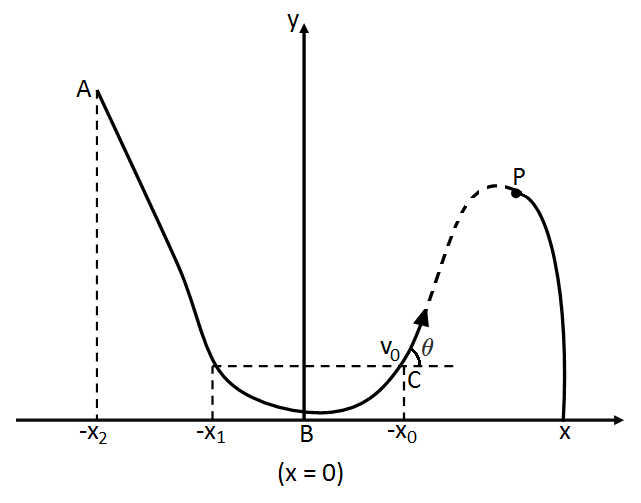
A particle slides down a frictionless parabolic (y = x) track (A – B – C) starting from rest at point A. Point B is at the vertex of parabola and point C is at a height less than that of point A. After C, the particle moves freely in air as a projectile. If the particle reaches highest point at P, then

Two bodies P and Q of equal masses are kept at heights x and 4x respectively. What will be the ratio of their potential energies?
A trolley of mass $m_1$ is placed on horizontal rigid pair of rails at same height. A mass $m_2$ is suspended to the trolley vertically by me ans of a ideal massless rope. The rope hangs between rails without touching them. Trolley can move along smooth rails but can't move in any other direction. Suspended mass is given small oscillation and perform $SHM$ after displacing small from stable equilibrium position in two ways, first perpendicular to the rails and second parallel to the rails. The ratio of time period of these (second case to first case) two $SHM's$ is
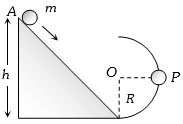
A solid ball of mass $m$ and radius $r$ rolls without slipping along the track shown in the fig. The radius of the circular part of the track is $R$. The ball starts rolling down the track from rest from a height of $8R$ from the ground level. When the ball reaches the point $P$ then its velocity will be
Two rods of same length and cross section are joined along the length. Thermal conductivities of first and second rod are ${K_1}\,\,{\rm{and}}\,\,{K_2}$. The temperature of the free ends of the first and second rods are maintained at ${\theta _1}\,\,{\rm{and }}{\theta _2}$ respectively. The temperature of the common junction is
A particle is moving in a circular path. The acceleration and momentum vectors at an instant of time are $\vec{a}=2 \hat{i}+3 \hat{j} m / s ^2$ and $\overrightarrow{ p }=6 \hat{ i } + 4 \hat{ j } kgm /$ $s$. Then the motion of the particle is
An object at rest at the origin begins to move in the $+x$-direction with a uniform acceleration of $1 \,m / s ^2$ for $4 \,s$ and then it continues moving with a uniform velocity of $4 \,m / s$ in the same direction.The $x-t$ graph for object's motion will be
A proton and an electron are placed in a uniform electric field.
  1. The electric forces acting on them will be equal.
  2. The magnitudes of the forces will be equal.
  3. Their accelerations will be equal.
  4. The magnitudes of their accelerations will be equal.
A particle executes $SHM $ in a line $4\, cm $ long. Its velocity when passing through the centre of line is $12\, cm/s$. The period will be ..... $s$
The displacement due to a wave moving in the positive $x-$direction is given by $y = \frac{1}{{(1 + {x^2})}}$ at time $t = 0$ and by $y = \frac{1}{{[1 + {{(x - 1)}^2}]}}$ at $t = 2$ seconds, where $x$ and $y$ are in metres. The velocity of the wave in $m/s$ is